

You can be a caring woman without being an endlessly available woman.
Do you struggle to say no without feeling guilty? Find yourself constantly prioritizing everyone else's needs? Feel exhausted from being the dependable one, the peacemaker, or the person everyone turns to?
Maybe you know you need boundaries, but setting them feels uncomfortable, selfish, or even frightening.
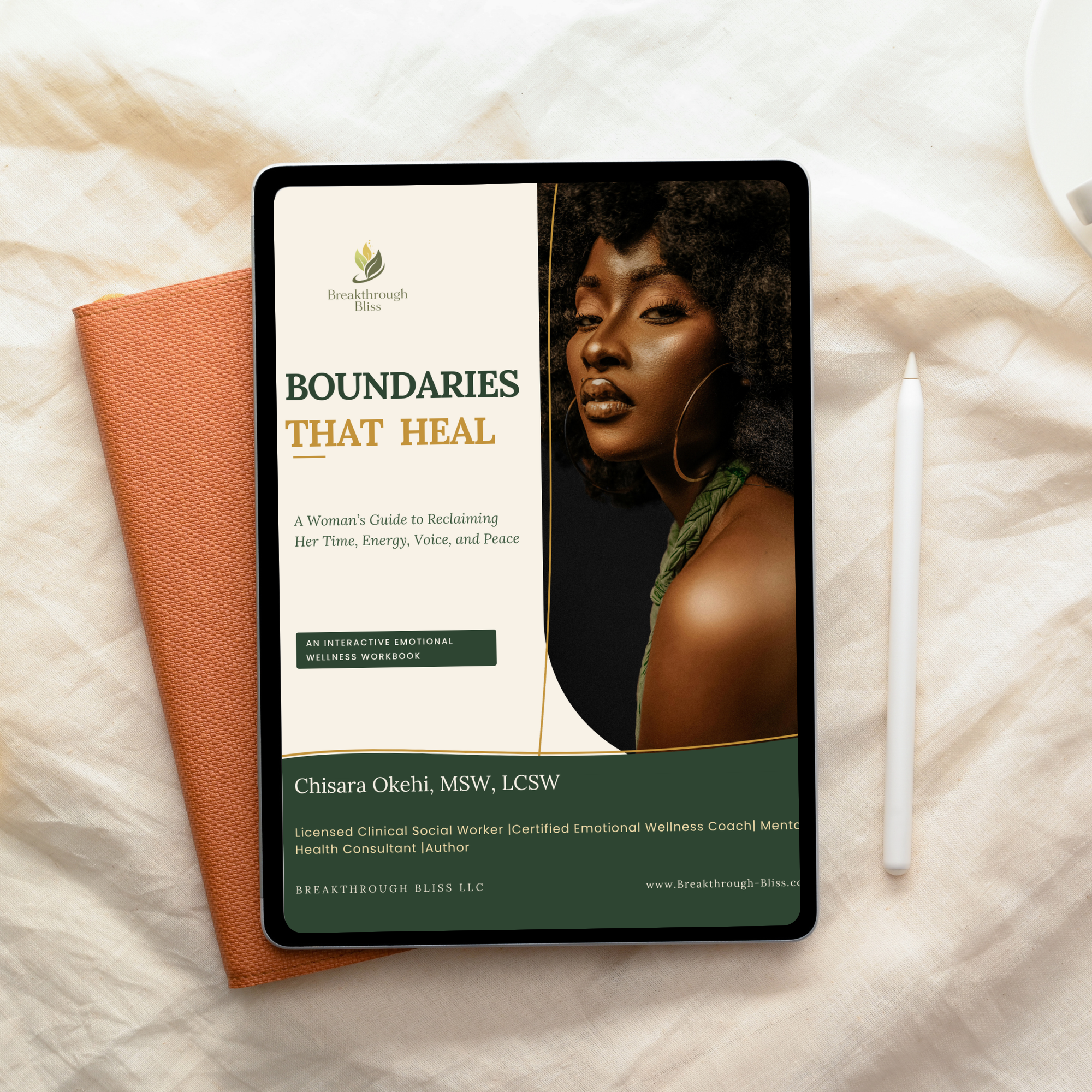
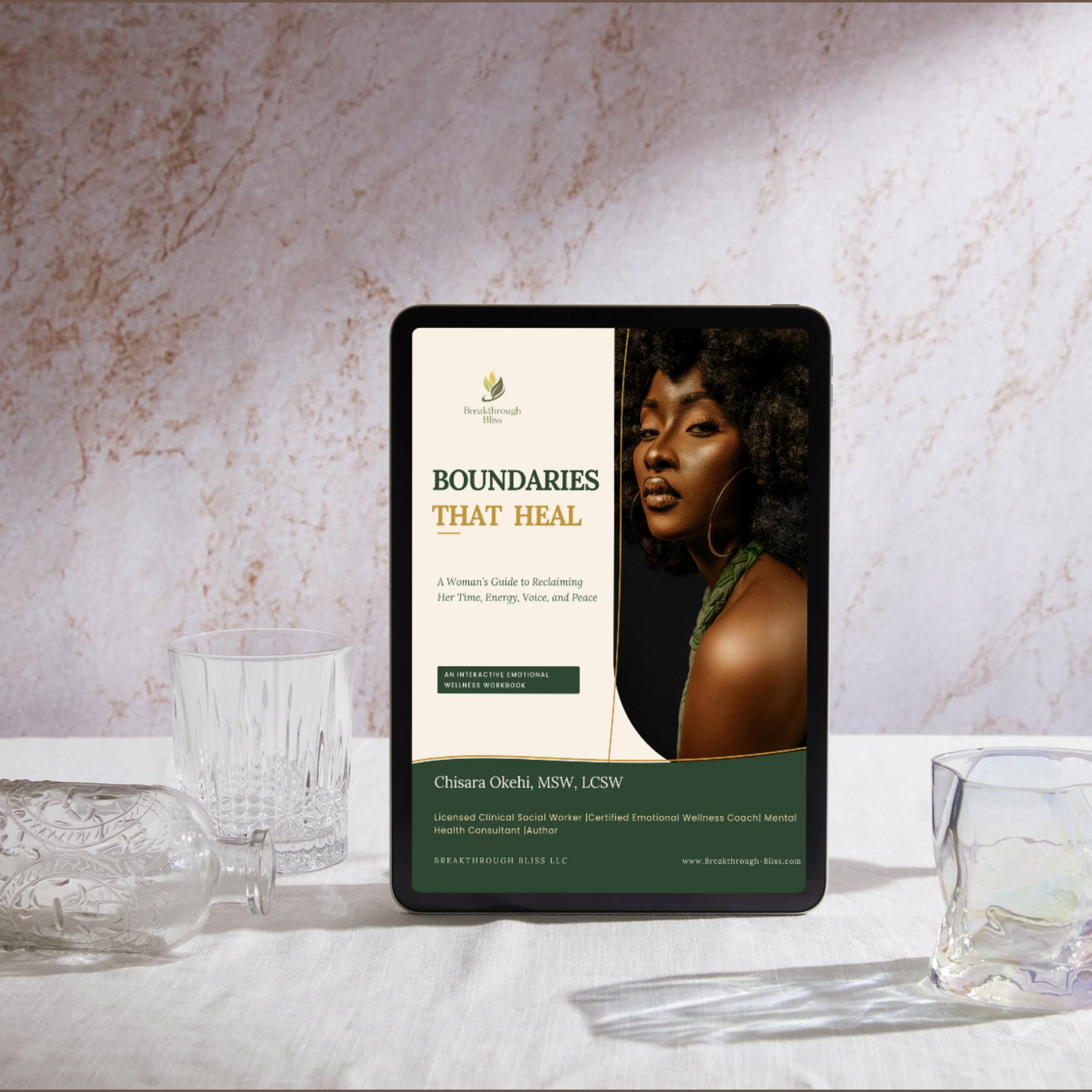
Boundaries That Heal was created to help you understand why boundaries feel difficult and develop practical skills to communicate and maintain them.
Created by Chisara Okehi, MSW, LCSW, Licensed Clinical Social Worker, Certified Emotional Wellness Coach, and author, this 33-page emotional wellness workbook combines trauma-informed psychoeducation, self-reflection, mindfulness-based grounding, and practical communication exercises.
People-pleasing and overgiving: Recognize when helping others becomes chronic self-neglect.
Boundary guilt: Understand why saying no may trigger discomfort, fear, or a sense of obligation.
Family conditioning: Explore the childhood roles and expectations that influence your adult relationships.
Emotional responsibility: Learn to distinguish your responsibilities from the feelings and choices of others.
Assertive communication: Practice expressing limits clearly, respectfully, and confidently.
Self-trust and follow-through: Develop realistic actions that support healthier relationship patterns.
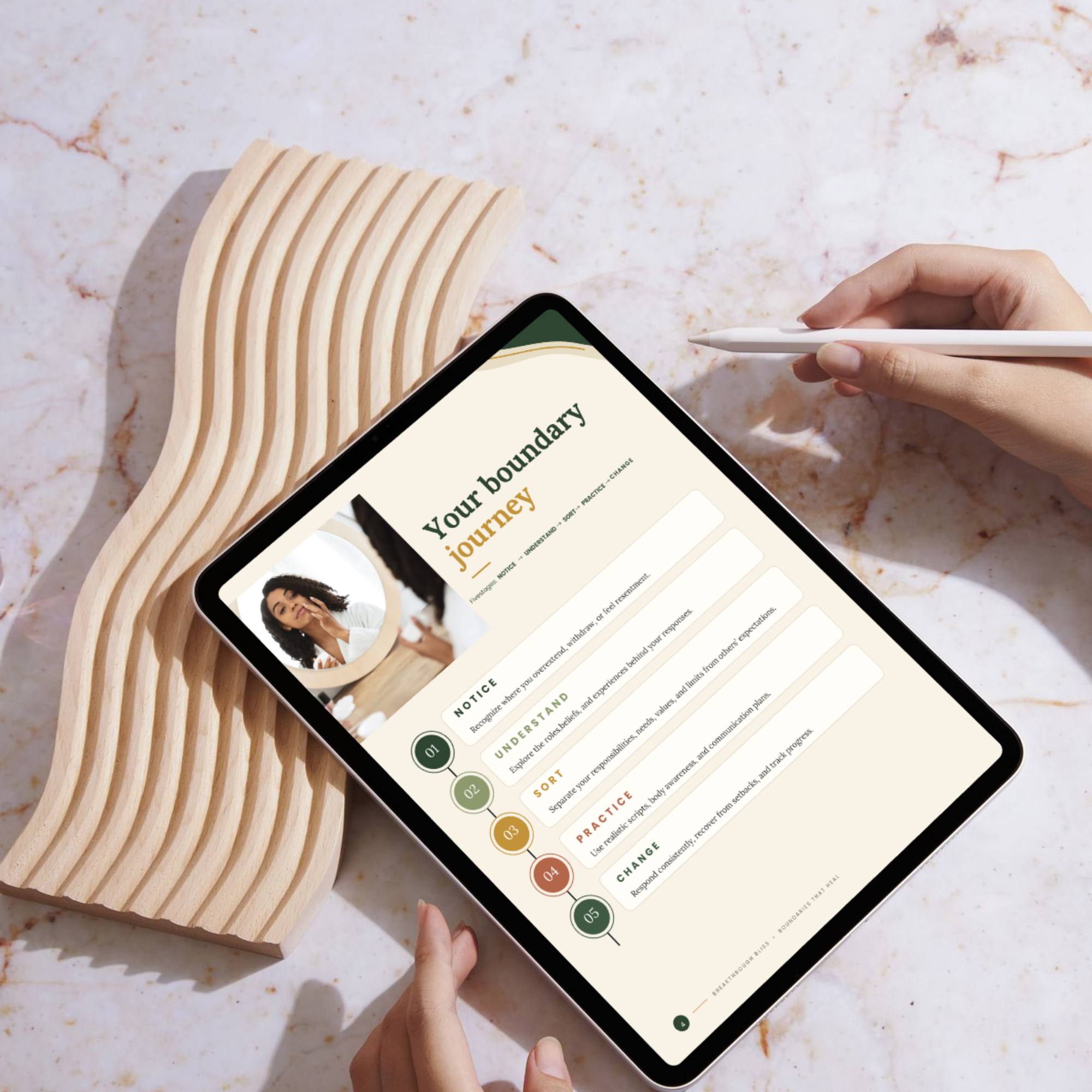
01 | NOTICE: Recognize overextension, resentment, exhaustion, and boundary warning signs.
02 | UNDERSTAND: Explore family roles, learned expectations, guilt, fear, and the Good Woman Trap.
03 | SORT: Identify your values, responsibilities, nonnegotiables, and personal limits.
04 | PRACTICE: Learn assertive communication, create boundary statements, and prepare for difficult conversations.
05 | CHANGE: Build consistency through a seven-day boundary experiment, practice tracker, and personal commitment.
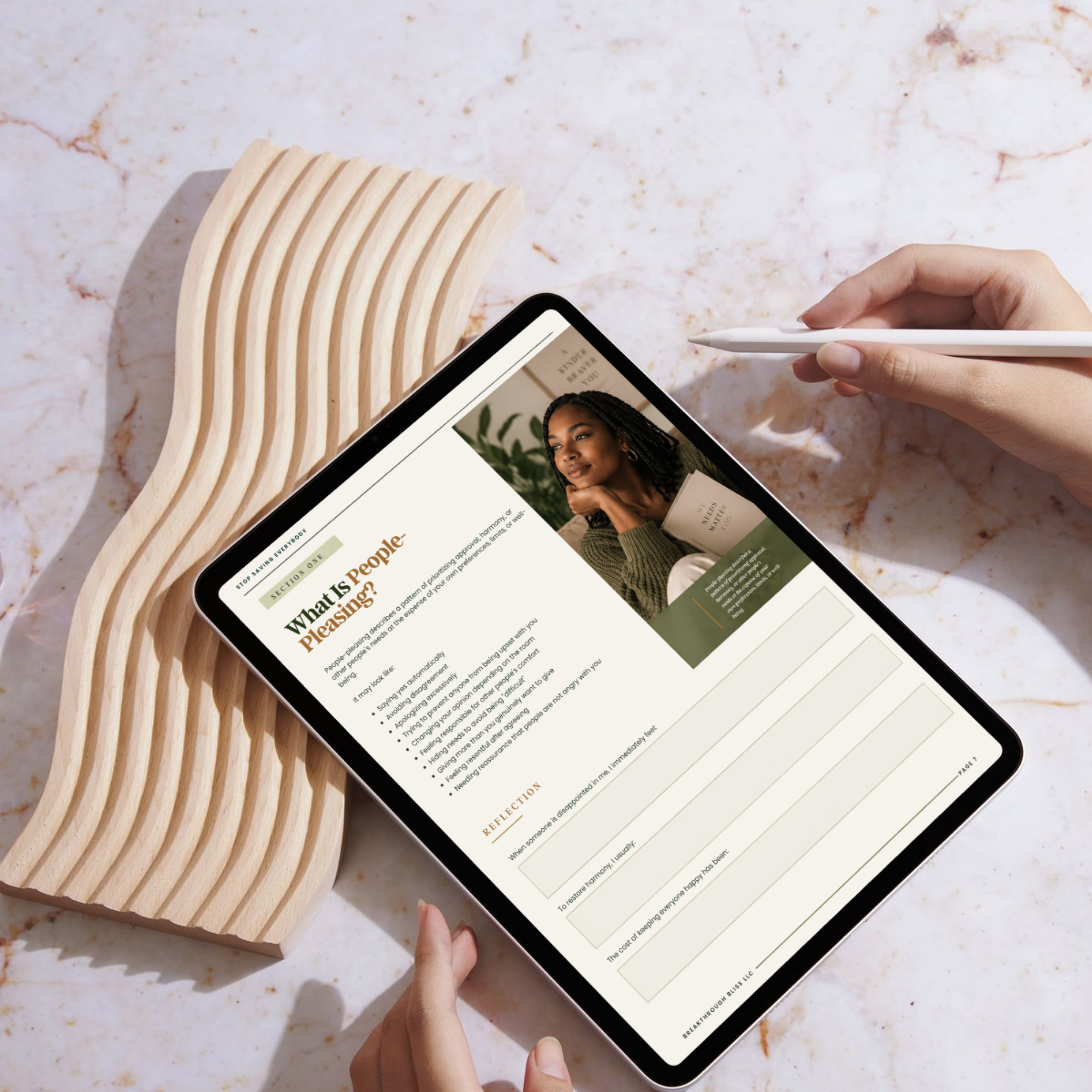
Boundary self-reflection check-in
Six types of personal boundaries
Family role exploration
The Good Woman Trap reflection
Body awareness and grounding exercise
Responsibility sorter and boundary map
Ready-to-use boundary communication scripts
Difficult conversation planner
Real-world boundary scenarios
Seven-day boundary experiment and progress tracker
Personal boundary commitment exercise
Women who are tired of overgiving, struggle to say no, feel responsible for other people's emotions, experience guilt when setting limits, or want healthier communication in their relationships, families, friendships, and workplaces.
You do not have to become less loving to become more intentional about your limits.
Format: Digital PDF workbook
Length: 33 pages
Delivery: Instant digital download
Use: Complete digitally using a compatible PDF reader or print for handwritten reflection
Author: Chisara Okehi, MSW, LCSW
Publisher: Breakthrough Bliss LLC
Please note: This is a digital product. No physical item will be shipped.
Important: This workbook is an educational and self-reflection resource. It is not psychotherapy, a diagnostic assessment, or a substitute for individualized mental health treatment. Purchasing it does not establish a therapist-client relationship. If you are experiencing coercion, abuse, or threats, prioritize safety and seek appropriate professional support.
You are allowed to care deeply about others while making room for yourself. Start your boundary journey today.



You can be kind without disappearing.
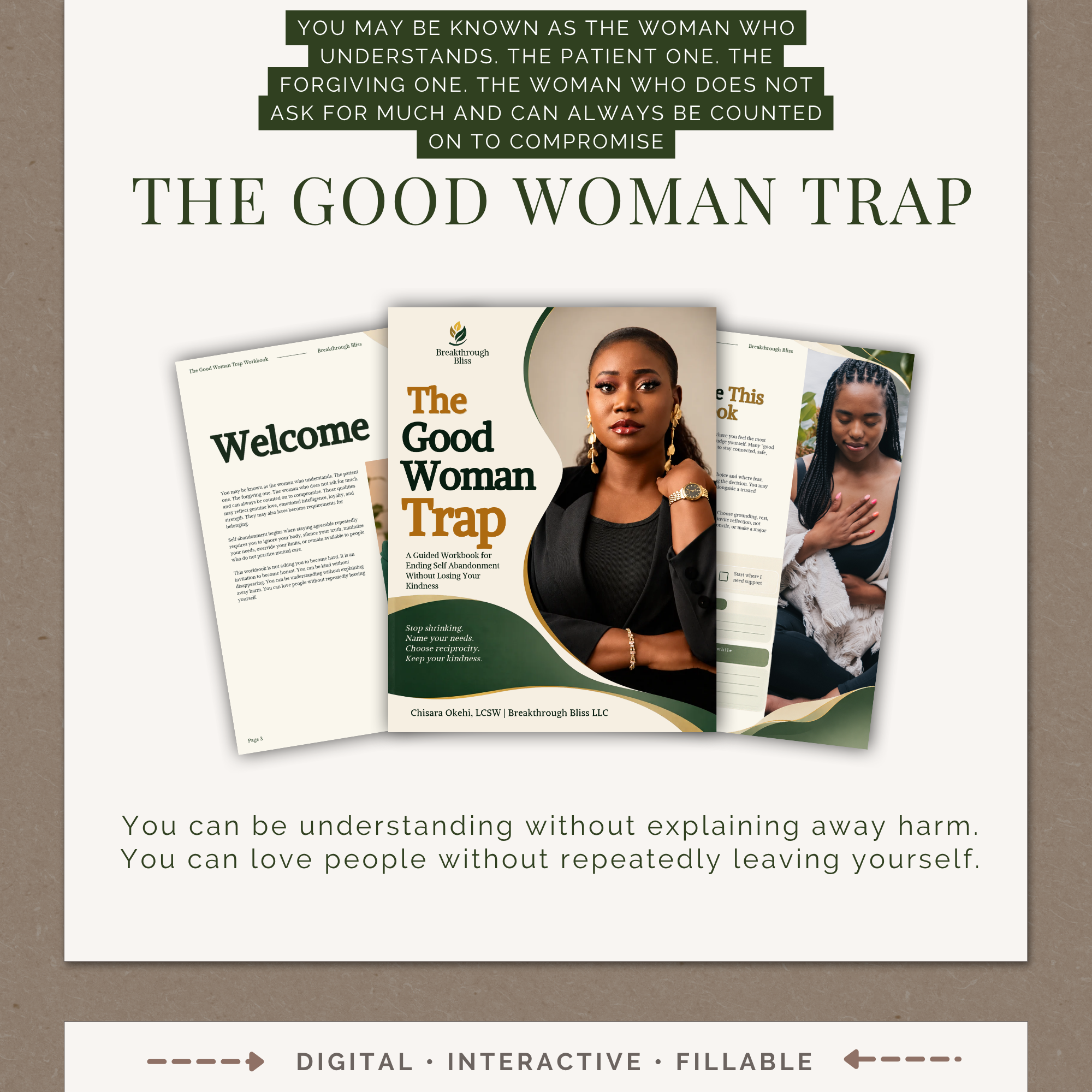
You can be understanding without explaining away harm.
You can love people without repeatedly leaving yourself.
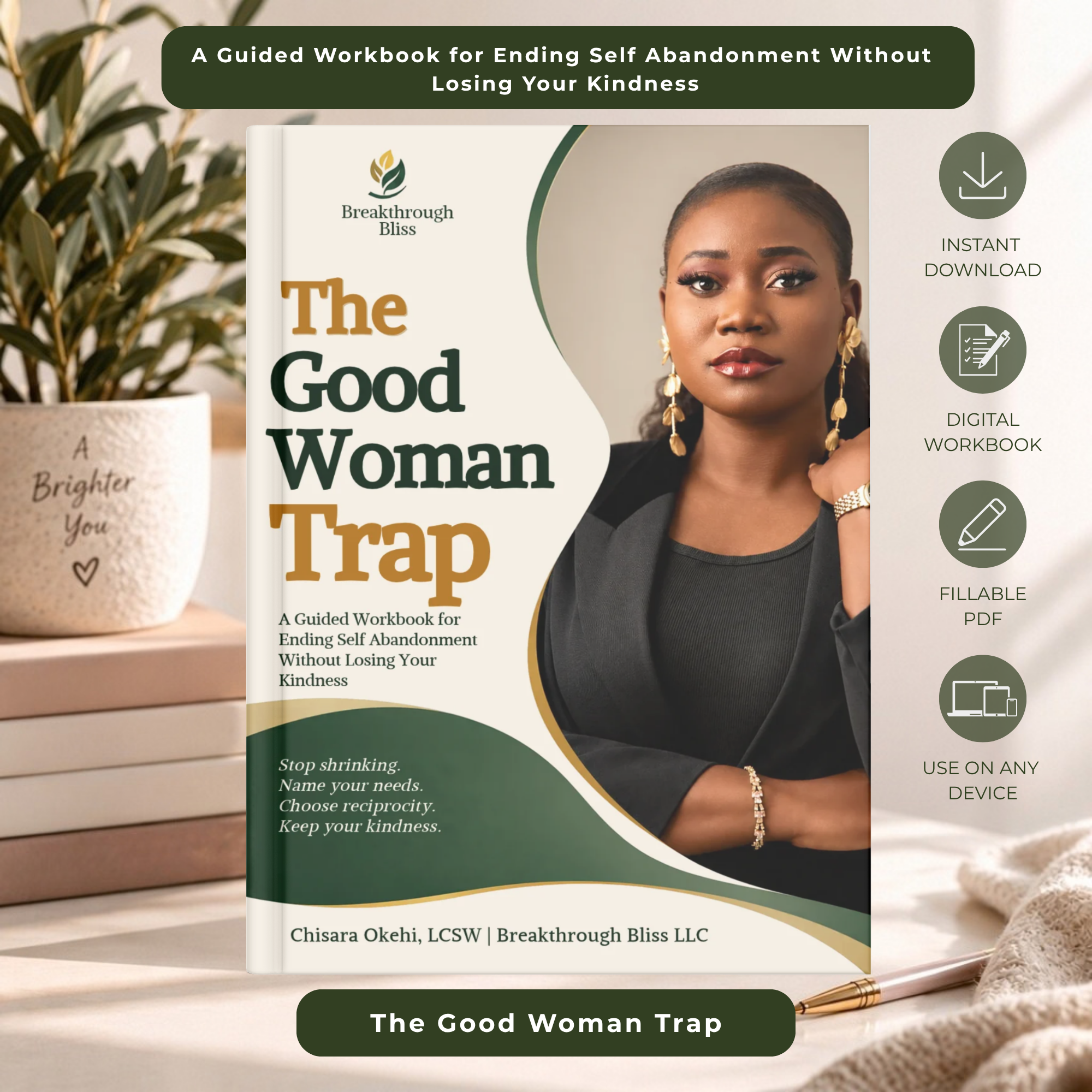
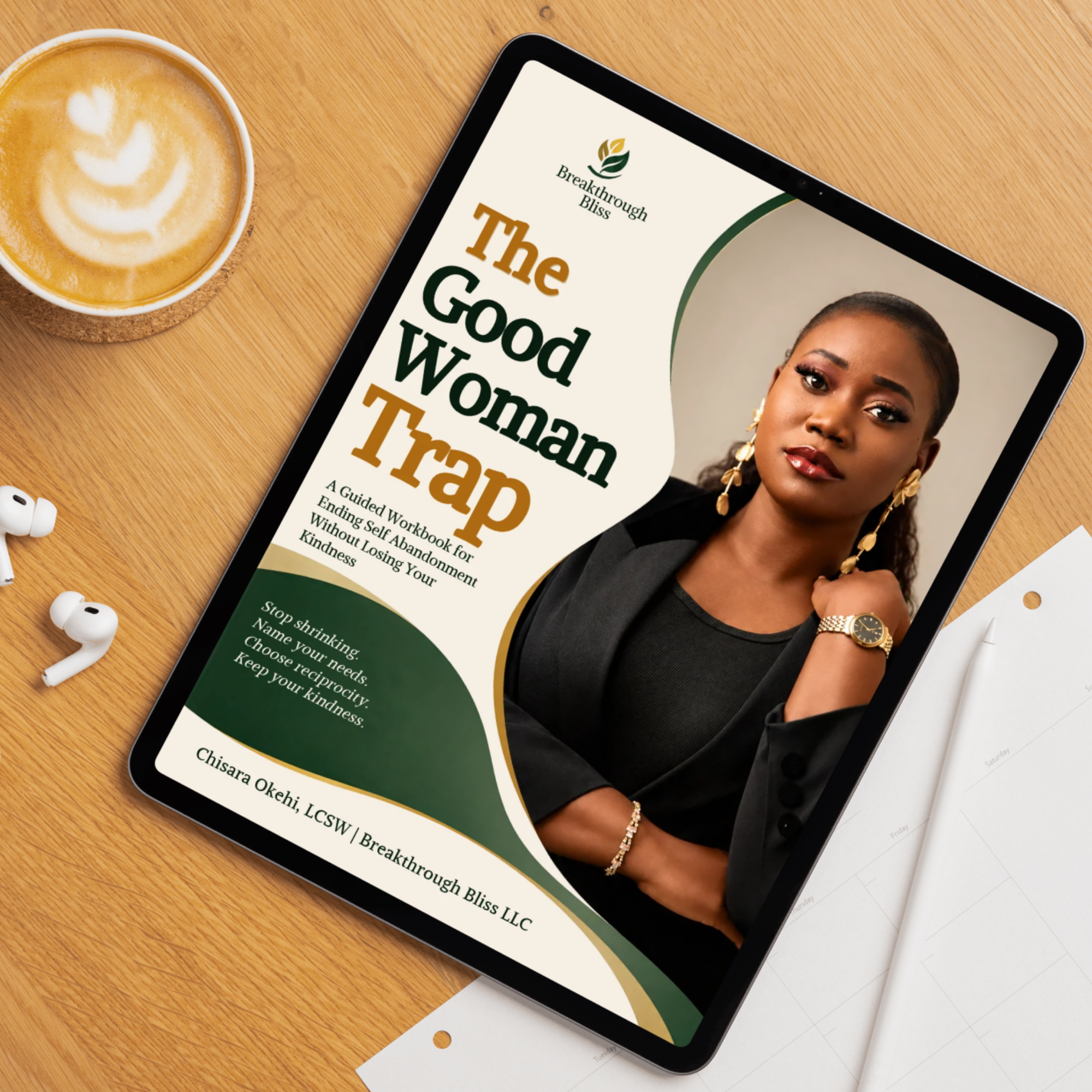
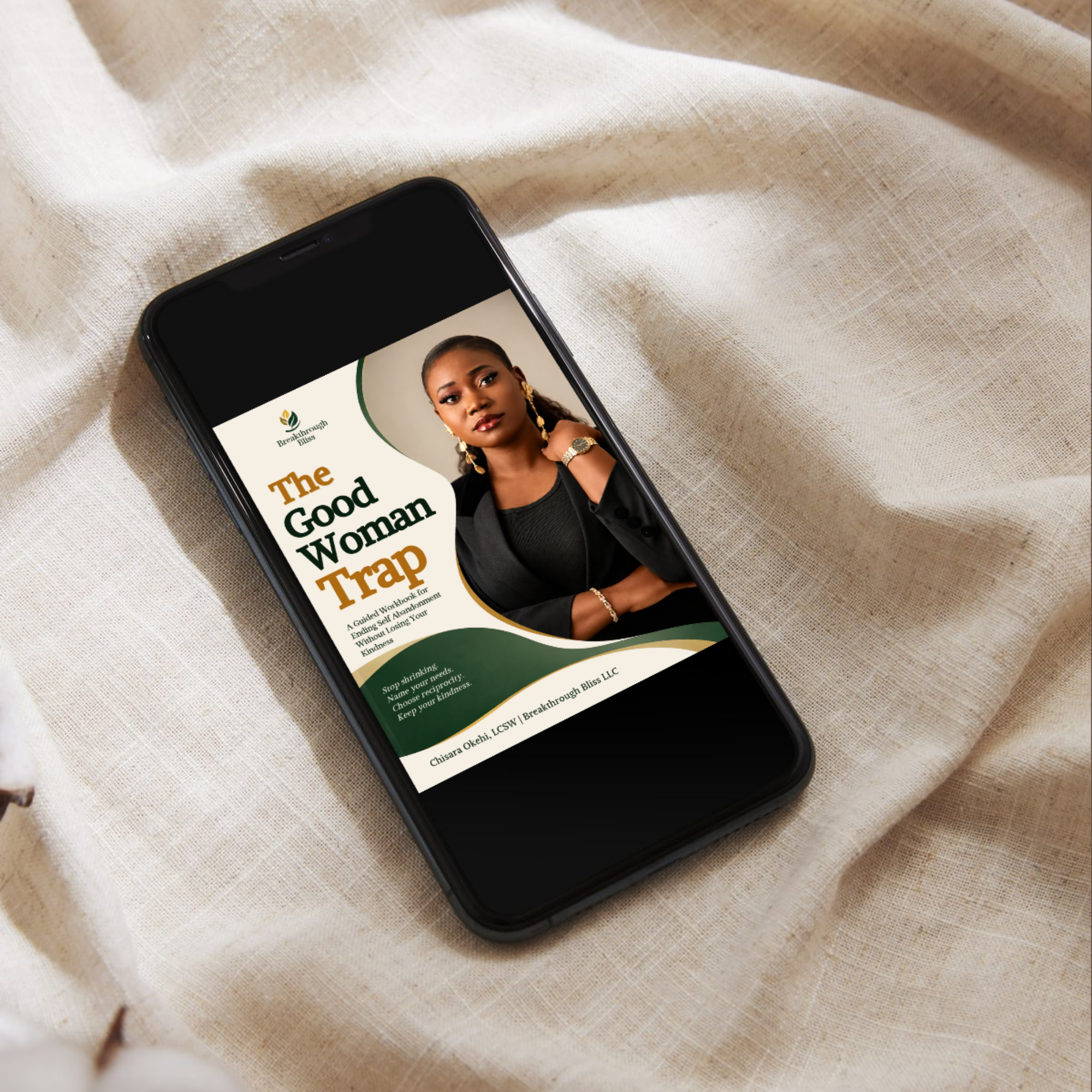
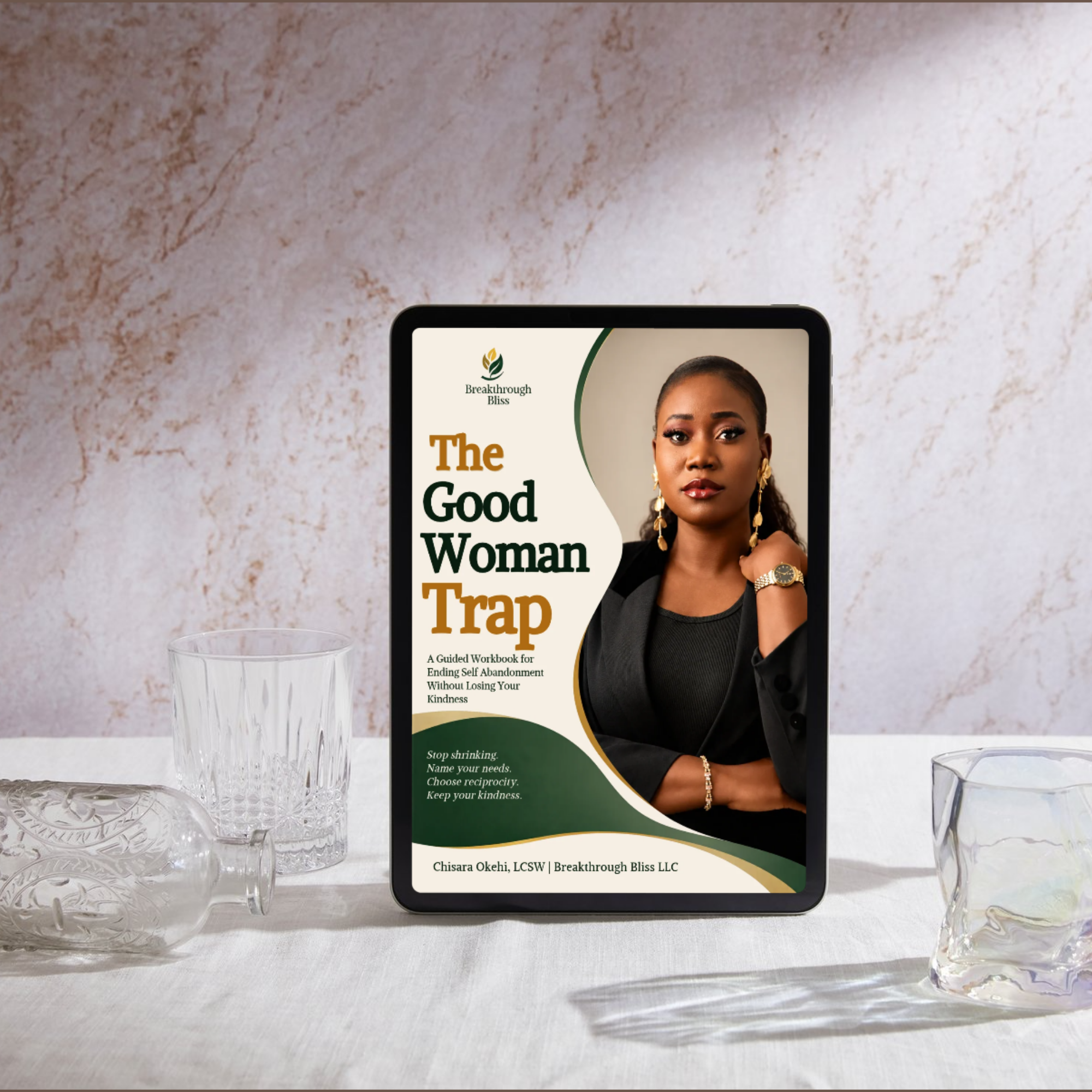
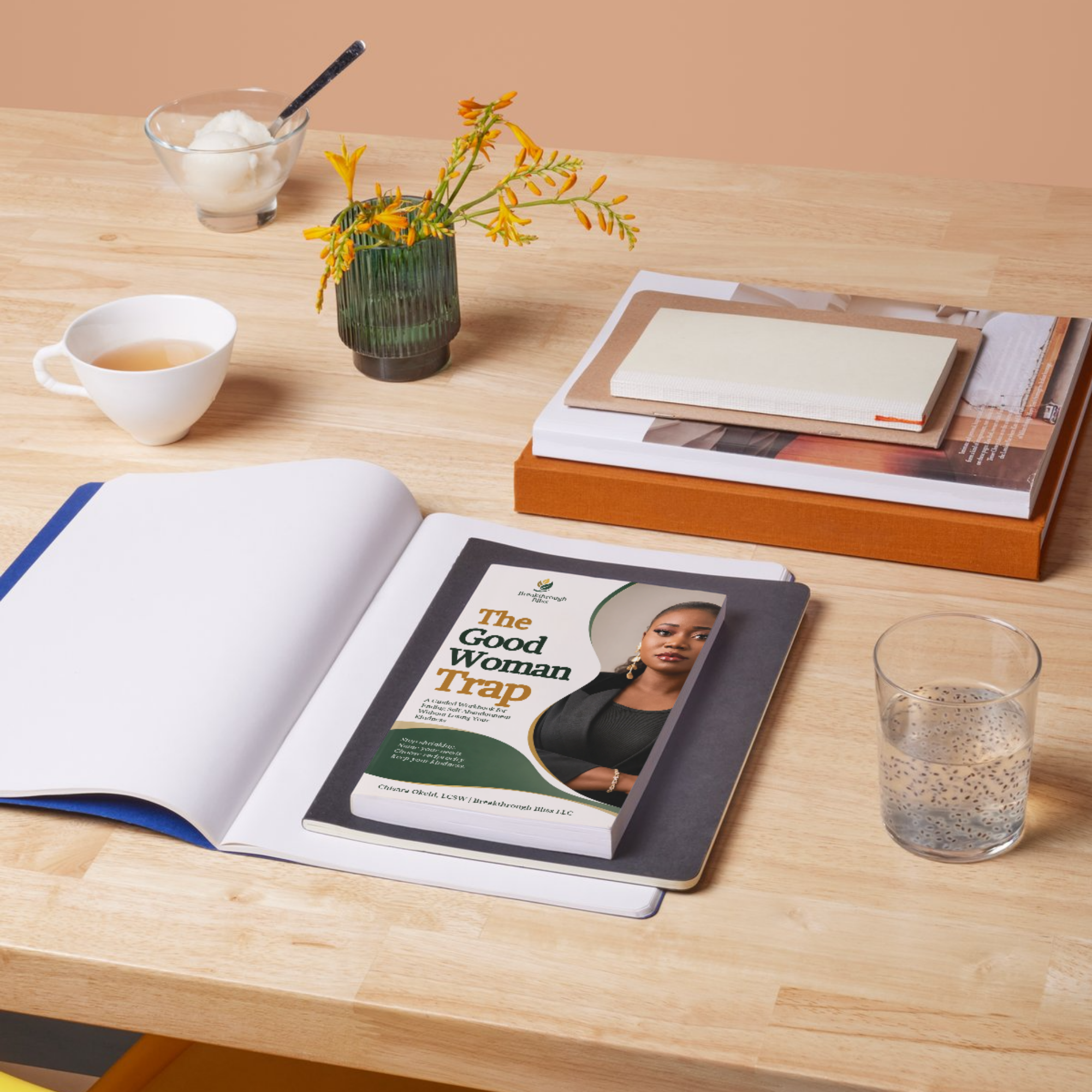
The Good Woman Trap is a 41-page, trauma-informed workbook created by Chisara Okehi, LCSW, for women who have learned to earn love, approval, safety, or belonging by being agreeable, forgiving, endlessly patient, low-maintenance, and easy to accommodate.
Perhaps you are known as the woman who understands. The dependable one. The person who does not ask for much. You compromise, make room, give another chance, manage everyone’s comfort, and convince yourself that your needs can wait.
These qualities may reflect genuine kindness, loyalty, and emotional intelligence. But when belonging repeatedly requires you to ignore your body, silence your truth, minimize your needs, override your limits, or tolerate one-sided relationships, kindness can quietly become self-abandonment.
This workbook will help you recognize where being “good” is still a freely chosen value and where it has become a role you perform to avoid rejection, conflict, disappointment, shame, or disapproval.
THIS WORKBOOK IS NOT ABOUT BECOMING COLD OR SELFISH
It is about learning to include yourself in your own care.
You will explore how to remain compassionate without becoming overresponsible, communicate honestly without overexplaining, set boundaries without treating someone else’s disappointment as proof that you did something wrong, and build relationships where care moves in more than one direction.
INSIDE THE WORKBOOK
• The Good Woman Role
• What Gets Rewarded and the hidden cost
• Where you learned the rules about being “good”
• Good Woman Pattern Inventory
• Approval and Belonging Map
• Body-awareness exercises
• Resentment Thermometer
• What self-abandonment is
• Kindness versus fear
• Accommodation versus mutuality
• Compromise versus self-erasure
• Forgiveness without repair
• The Low-Maintenance Myth
• Patience versus tolerating harm
• Emotional Labor and Reciprocity Audit
• Values versus inherited rules
• What Is Mine to Carry exercise
• The Consent of Self Check
• Relationship Reciprocity Map
• Needs you may minimize
• Anger as information
• Grieving the version of yourself who stayed quiet
• Pause, Check, Choose decision tool
• Honest communication scripts
• Boundaries and follow-through
• Tolerating disapproval
• Asking for care
• 30-Day Reclaim Practice
• Closing manifesto and support resources
THE FIVE-STAGE PROCESS
NOTICE
Recognize the Good Woman role, its rewards, and its emotional cost.
UNDERSTAND
Identify self-abandonment, unequal patterns, resentment, and the ways your needs become minimized.
SORT
Separate your values from fear, inherited rules, overresponsibility, pressure, and obligation.
PRACTICE
Build skills for pausing, checking inward, communicating honestly, setting boundaries, making requests, and following through.
CHANGE
Create a relationship with yourself that no longer requires your disappearance.
THIS WORKBOOK MAY BE HELPFUL IF YOU
• Say yes when you want to say no
• Feel responsible for managing other people’s comfort
• Minimize your needs to avoid conflict or disappointment
• Pride yourself on being “low-maintenance” while feeling unseen
• Forgive without receiving accountability or repair
• Carry more emotional labor than the people around you
• Struggle to identify what you want, need, or have capacity for
• Feel guilty when setting boundaries
• Fear being viewed as difficult, selfish, angry, or ungrateful
• Experience resentment after repeatedly overgiving
• Want to stop abandoning yourself without losing your kindness
WHAT YOU WILL RECEIVE
• One 41-page printable PDF workbook
• One 41-page interactive and fillable PDF workbook
• Guided assessments and reflection exercises
• Emotional-labor and reciprocity audits
• Boundary and communication scripts
• Body-awareness and resentment exercises
• A 30-day practice for reclaiming your voice, needs, and limits
• Immediate digital access after purchase
HOW TO USE IT
Download the files after purchase. Print the workbook at home or through a professional printing service, or use the fillable version with a compatible PDF reader on your computer, tablet, or phone.
Move through the five stages in order or begin with the section that feels most relevant. Complete the workbook independently, with a trusted support person, or bring selected pages to therapy for deeper exploration.
CONTENT AND SAFETY NOTE
Some exercises may bring up grief, anger, fear, or memories of difficult experiences. You may pause, skip an exercise, return later, or seek additional support.
Boundaries and honest communication do not make every relationship safe. If you are experiencing coercion, threats, stalking, financial control, retaliation, violence, or fear for your safety, prioritize individualized safety planning and qualified support.
DIGITAL PRODUCT
This is an instant digital download. No physical workbook will be mailed.
PERSONAL USE ONLY
Your purchase provides a license for individual personal use. The workbook may not be copied, shared, reproduced, uploaded, distributed, resold, or used with clients, groups, courses, or commercial programs without written permission.
This workbook provides psychoeducation and guided self-reflection. It is not psychotherapy, diagnosis, mental health treatment, medical advice, crisis care, or legal advice. Purchasing or completing it does not establish a therapist-client or coach-client relationship.
Created by Chisara Okehi, LCSW
Licensed Clinical Social Worker, author, and emotional wellness educator
Breakthrough Bliss LLC
Stop shrinking. Name your needs. Choose reciprocity. Keep your kindness.
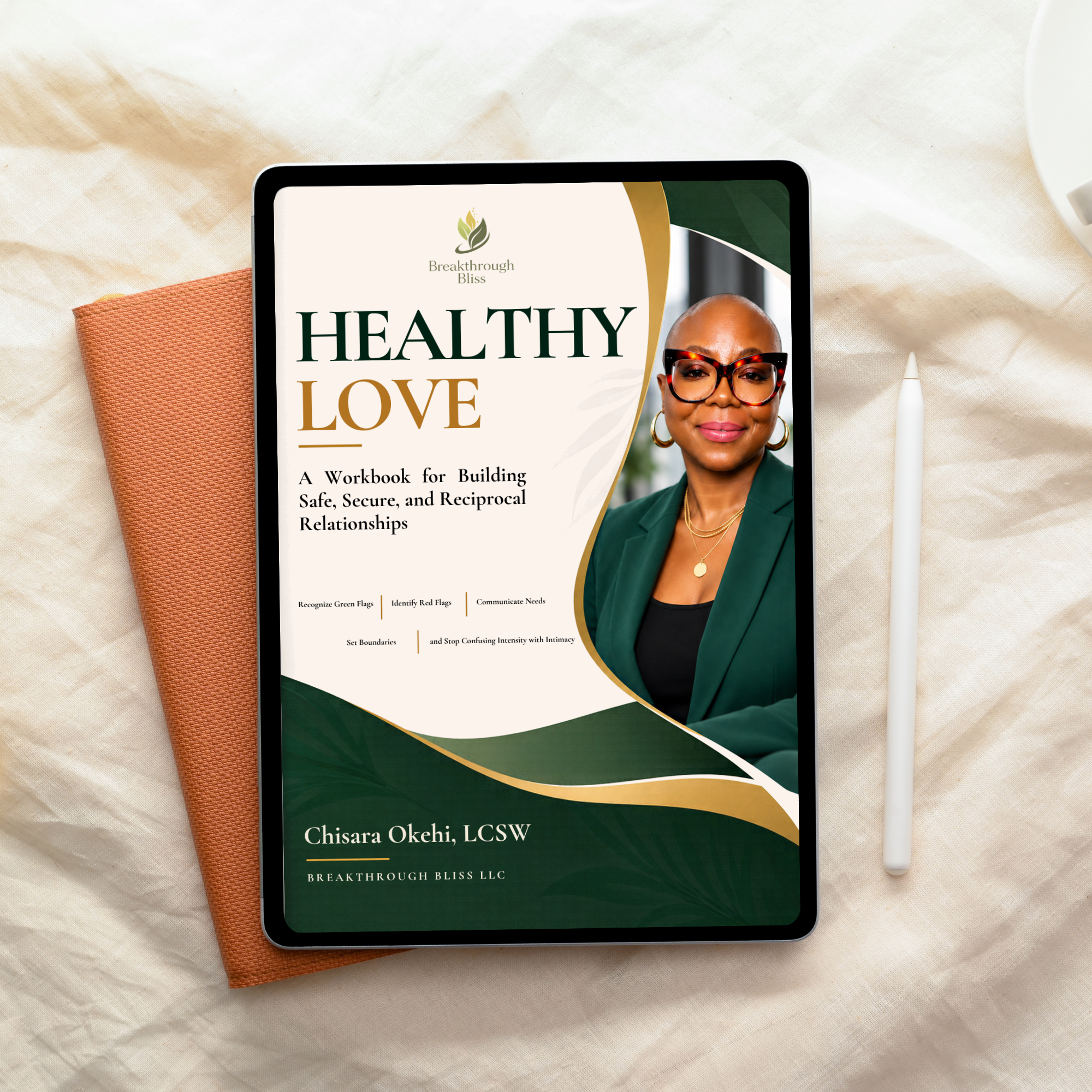

Have you ever felt deeply connected to someone but still found yourself anxious, confused, unheard, or unsure where you stood?
Maybe the chemistry felt undeniable, but consistency was missing. Maybe you kept explaining away behavior that hurt you, waiting for potential to become participation, or questioning whether your needs were simply “too much.”
Healthy love should not repeatedly require you to shrink, chase clarity, ignore your body, abandon your needs, or surrender your dignity to preserve connection.
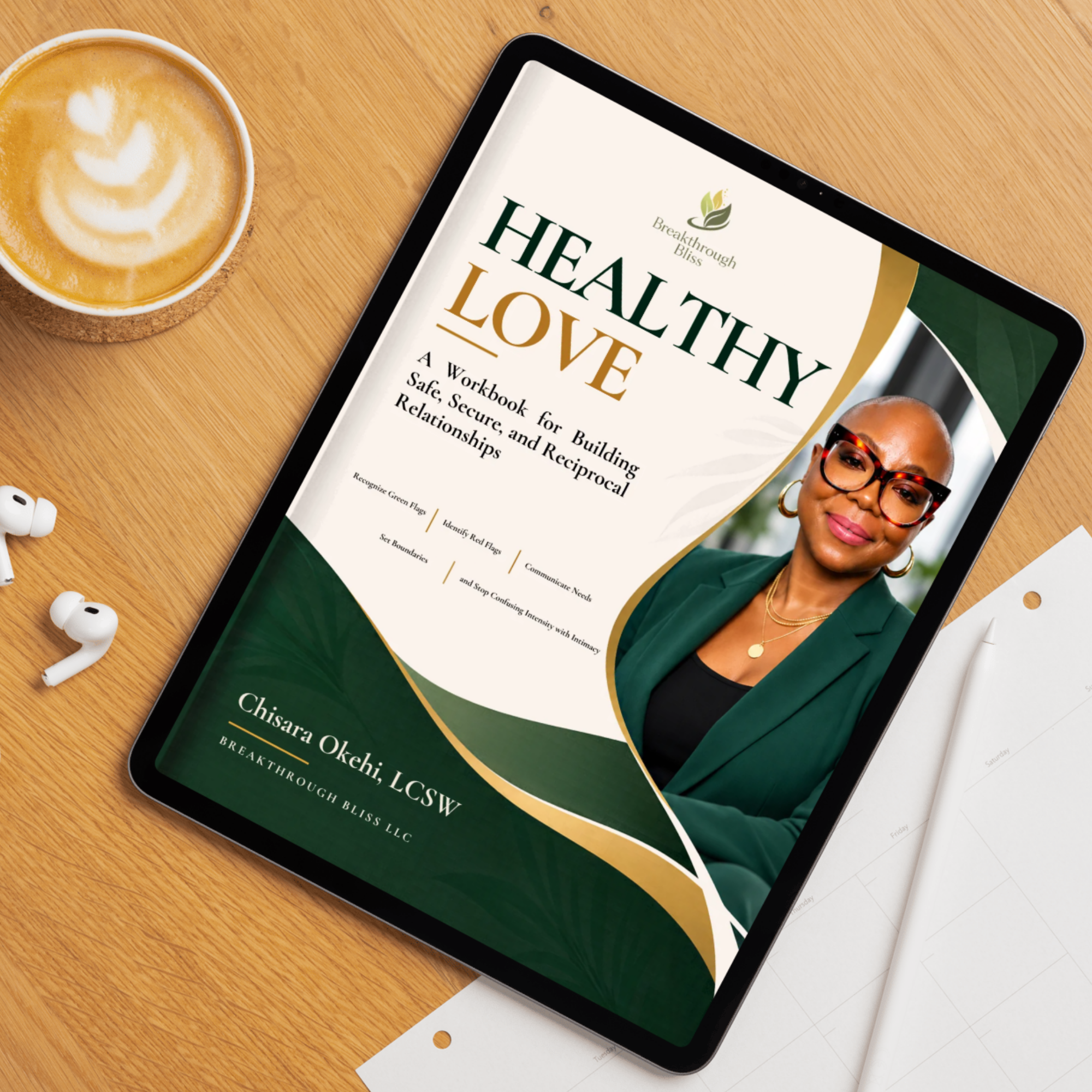
Healthy Love is a 43-page, trauma-informed relationship workbook created by Chisara Okehi, LCSW, to help women recognize the difference between emotional intensity and genuine intimacy, attraction and compatibility, conflict and concerning harm.
Whether you are dating, evaluating a current relationship, processing a past relationship, or preparing to make healthier choices in the future, this workbook will help you look beyond words and chemistry to examine what someone’s behavior consistently reveals.
This is not a workbook about finding a perfect person. It is about learning how to recognize relationships where respect, safety, reciprocity, trust, autonomy, communication, and repair are present.
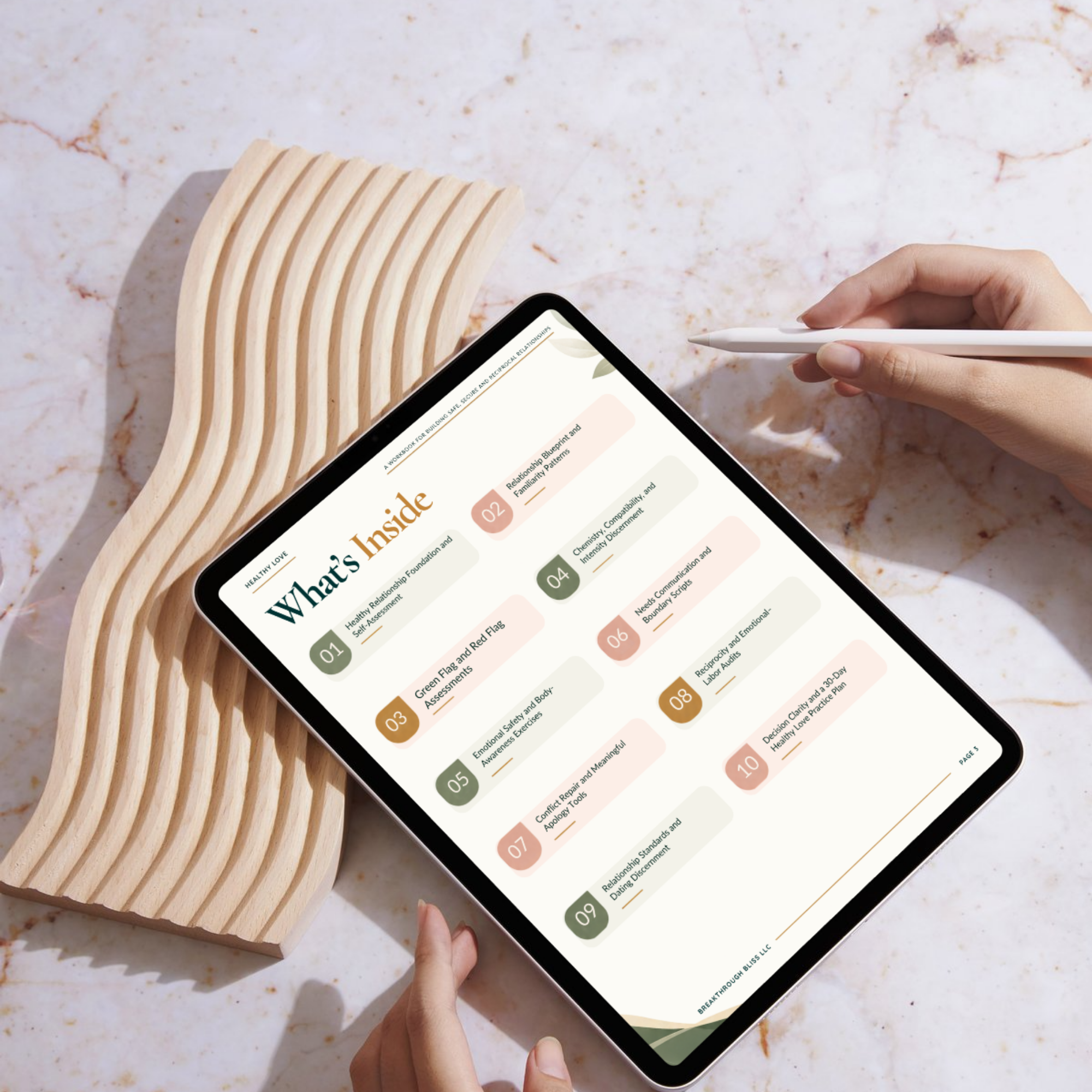
• The seven foundations of a healthy relationship
• Your early relationship blueprint and what love taught you
• Why familiar relationship patterns can feel attractive, even when they are unhealthy
• Green flags that develop through consistent behavior over time
• Red flags and concerning relationship dynamics
• Chemistry versus compatibility
• Emotional intensity versus genuine intimacy
• Body activation versus secure connection
• How to communicate your needs clearly and respectfully
• How to establish and maintain healthier boundaries
• What another person’s response to your boundaries may reveal
• The difference between ordinary conflict and concerning harm
• Accountability, meaningful apologies, and genuine repair
• Reciprocity and emotional labor
• Relationship standards and non-negotiables
• Decision clarity and relationship check-ins
• A practical 30-day Healthy Love plan
• Healthy Love affirmations and a personal relationship manifesto
• Feel more confused than grounded in your relationship
• Repeatedly become attached to inconsistent or emotionally unavailable partners
• Have mistaken anxiety, uncertainty, or emotional intensity for chemistry
• Struggle to express your needs or maintain boundaries
• Find yourself minimizing or explaining away concerning behavior
• Give significantly more emotional labor, care, or effort than you receive
• Feel pressured to abandon yourself to keep a relationship
• Want to strengthen your relationship standards and self-trust
• Are preparing to date with greater clarity and intention
• Want a structured resource to use independently or alongside therapy
• A 43-page printable Healthy Love workbook
• A fillable digital workbook version
• Healthy relationship and emotional safety assessments
• Green flag and red flag assessments
• Guided reflection exercises
• Communication formulas and boundary scripts
• Conflict-repair and meaningful-apology tools
• Emotional labor and reciprocity audits
• Relationship standards and decision-clarity exercises
• A 30-day Healthy Love practice plan
• Immediate digital access
Healthy Love does more than give you a list of red flags. It helps you examine the patterns you may have learned, the behaviors you may have normalized, and the emotional experiences you may have confused with love.
You will be encouraged to look at what is actually happening in your relationships, not only what you hope will happen.
Because potential is not participation. Chemistry is not compatibility. Intensity is not intimacy. And being chosen is not the same as being emotionally safe, respected, or genuinely valued.
Download the workbook immediately after purchase. Print it at home or through a professional printing service, or use the fillable version on a compatible phone, tablet, or computer.
Move through the exercises at your own pace. Complete the workbook independently, revisit particular sections when relationship concerns arise, or bring selected pages to therapy for deeper exploration.
This workbook discusses coercion, sexual pressure, intimidation, emotional harm, and other potentially activating relationship experiences. Pause when needed and seek appropriate professional or crisis support if you feel unsafe or overwhelmed.
This is an instant digital download. No physical product will be mailed.
Your purchase is licensed for individual personal use. This workbook may not be copied, shared, reproduced, distributed, resold, posted online, or used with clients, groups, courses, or commercial programs without written permission.
Healthy Love provides psychoeducation, guided reflection, and emotional wellness tools. It is not psychotherapy, diagnosis, medical advice, legal advice, crisis intervention, or a substitute for individualized professional care.
Created by Chisara Okehi, LCSW
Licensed Clinical Social Worker, author, and emotional wellness educator
Breakthrough Bliss LLC
You do not have to keep losing yourself to experience love. You can learn to choose connection without abandoning yourself.
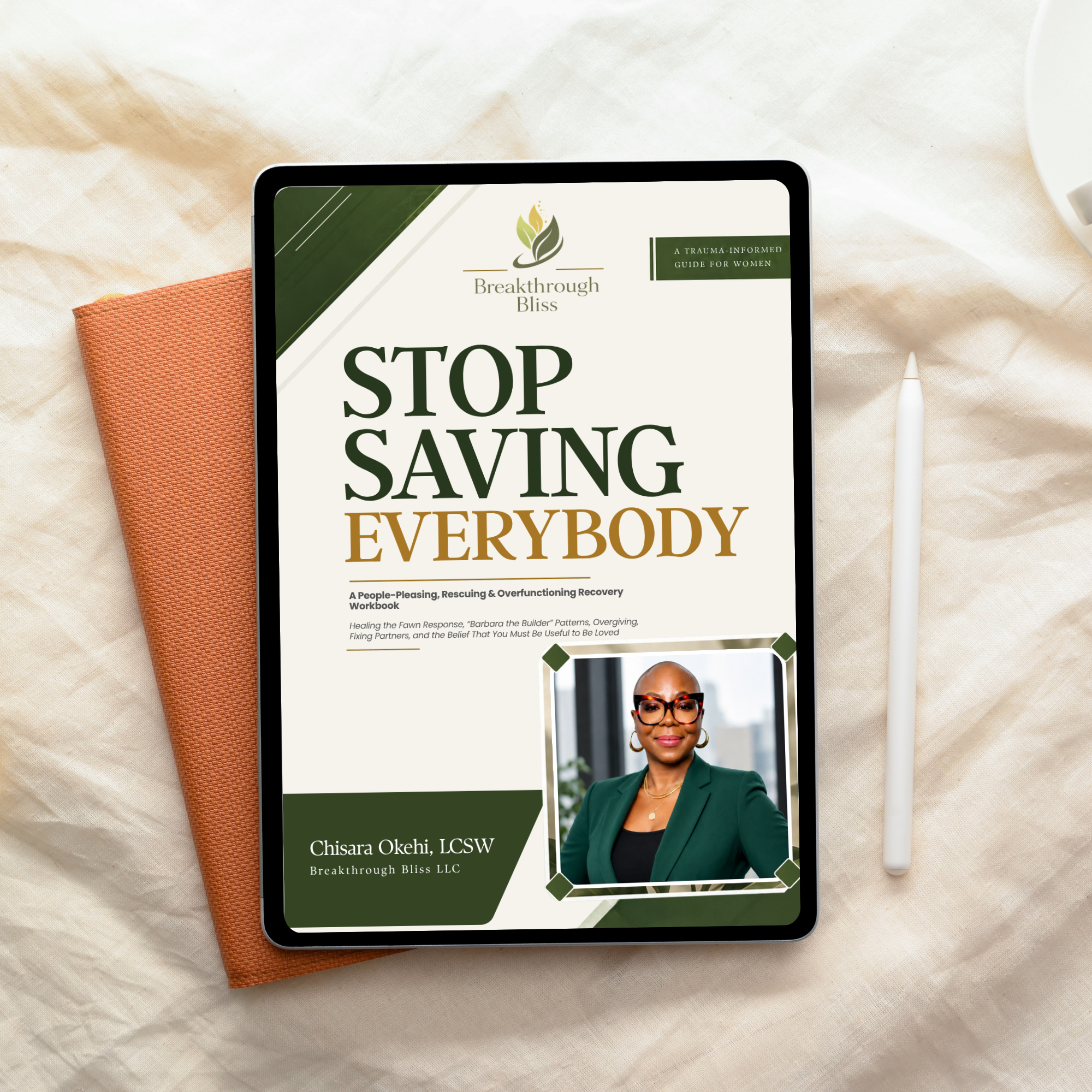
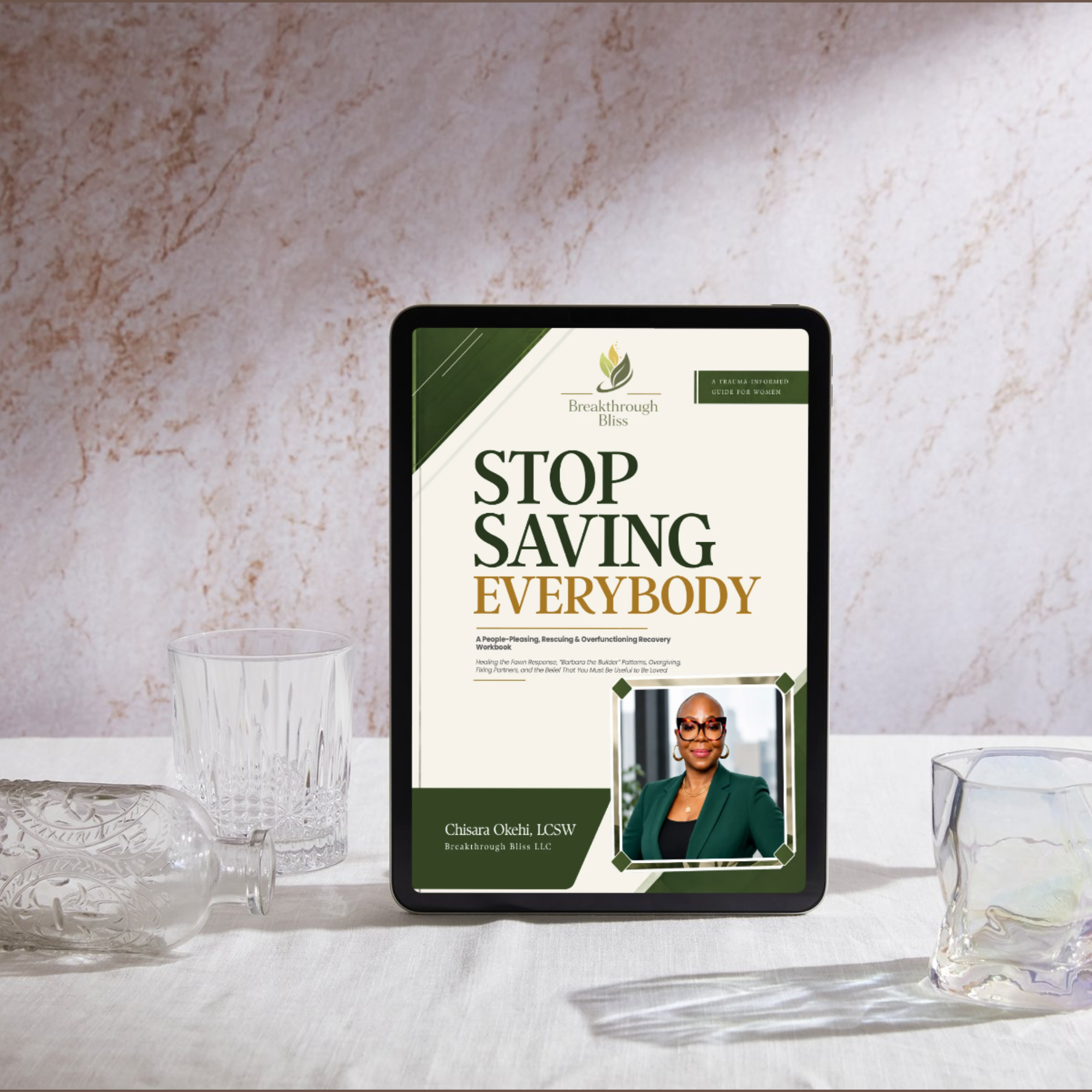
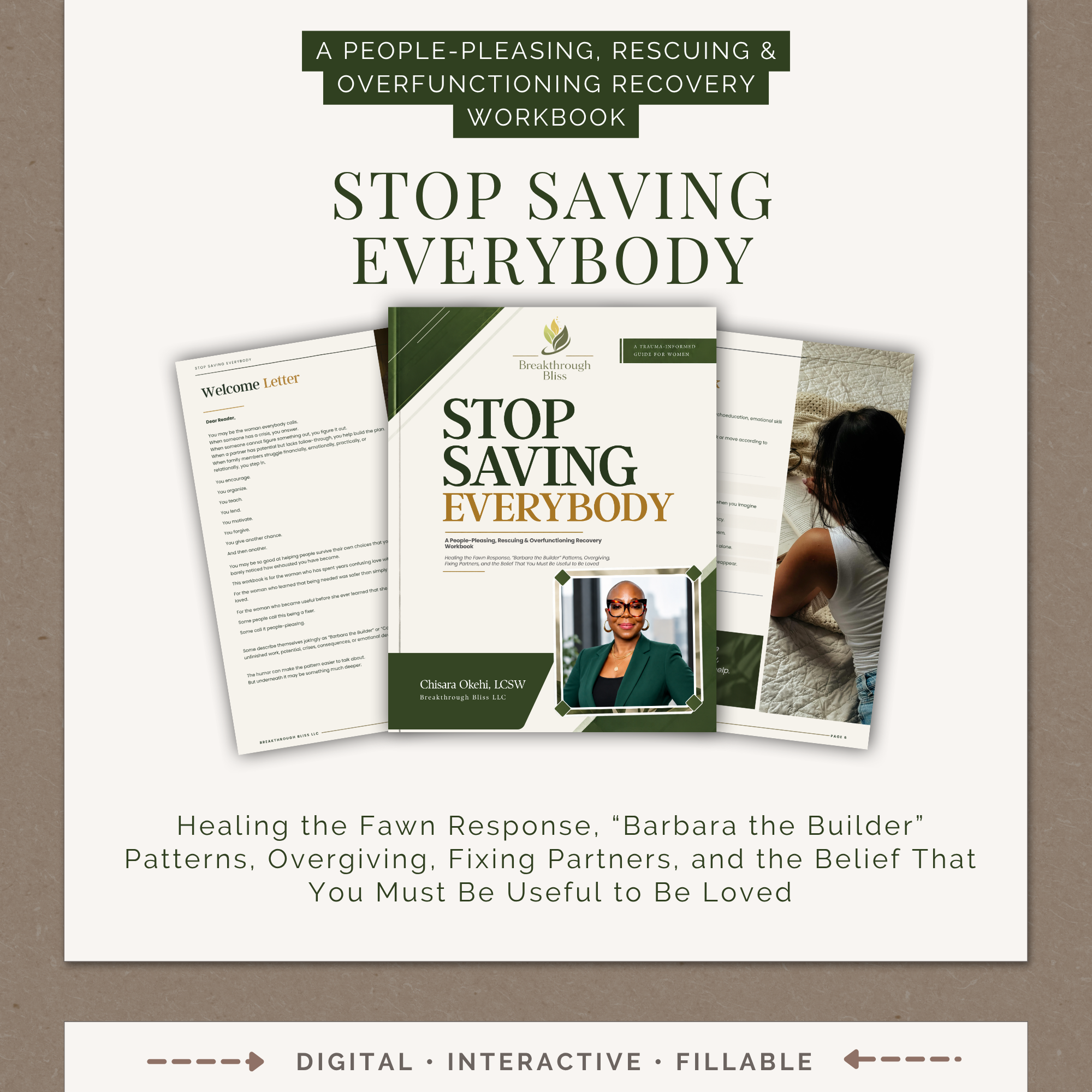
Are you always the person others call when something goes wrong? Do you solve problems, manage crises, fix partners, overgive, and take responsibility for other adults, only to end up exhausted or resentful?
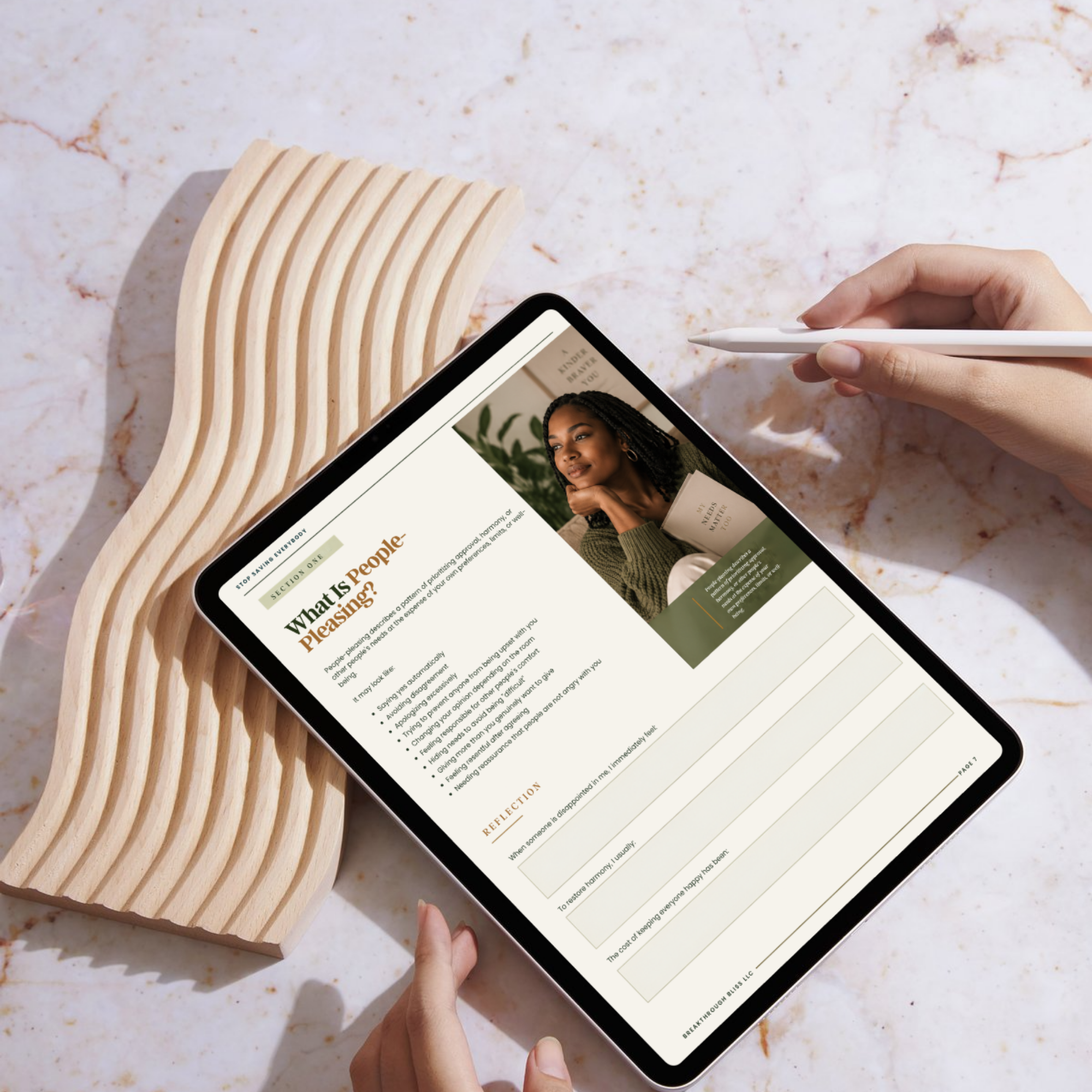
Stop Saving Everybody is a 40-page, trauma-informed emotional wellness workbook created by Licensed Clinical Social Worker Chisara Okehi. It is designed for women who are ready to understand why being needed can feel like being loved and begin separating genuine care from rescuing, overfunctioning, and self-abandonment.
This workbook explores the deeper beliefs and survival patterns that can keep women trapped in cycles of overgiving, including the fawn response, people-pleasing, earning love through usefulness, “Barbara the Builder” relationships, fixing partners, emotional labor, and difficulty tolerating other people’s disappointment.
People-pleasing self-assessment
Fawn-response psychoeducation
“Barbara the Builder” relationship-pattern worksheet
“Captain Save a Hoe” reflection
Helper versus rescuer assessment
Rescuer-anxiety exercise
Fixing-partners pattern assessment
Potential versus participation reflection
Overfunctioning inventory
Emotional-labor audit
Overgiving assessment
Relationship reciprocity audit
Resentment reflection
Boundary scripts for recovering rescuers
24-hour rescue rule
Receiving-without-reciprocating practice
Self-worth restoration prompts
Personalized stop-rescuing plan
Weekly overfunctioning review
Guided journaling pages
Affirmations for recovering people-pleasers and rescuers
Feel responsible for fixing other people’s problems
Say yes before checking your emotional or practical capacity
Feel guilty when you set boundaries
Become attached to someone’s potential instead of their participation
Carry most of the emotional or practical labor in relationships
Feel anxious when someone you love is struggling
Have difficulty receiving without immediately giving something back
Question who you are when no one needs you
Believe you must be useful, helpful, or needed to deserve love
Want to care for others without abandoning yourself
40-page digital workbook
Printable PDF
Designed for personal, self-paced reflection
Can be used independently or alongside therapy
Trauma-informed and culturally responsive
Created by a Licensed Clinical Social Worker
Formatted for standard US Letter printing
Digital download only
No physical product will be mailed
This is a standard printable PDF and does not contain fillable form fields. It may be imported into compatible PDF annotation or note-taking applications for handwritten digital use.
Colors may vary slightly depending on your screen and printer settings. For best printing results, select “Fit to Page.”
This workbook is for educational and emotional wellness purposes. It is not a substitute for psychotherapy, medical treatment, diagnosis, or crisis care.
Your purchase is for individual use only. You may print a copy for yourself, but you may not reproduce, redistribute, share, modify, resell, upload, or use the workbook commercially.
You do not have to become cold or uncaring to stop rescuing everyone. You can keep your compassion and build healthier boundaries.
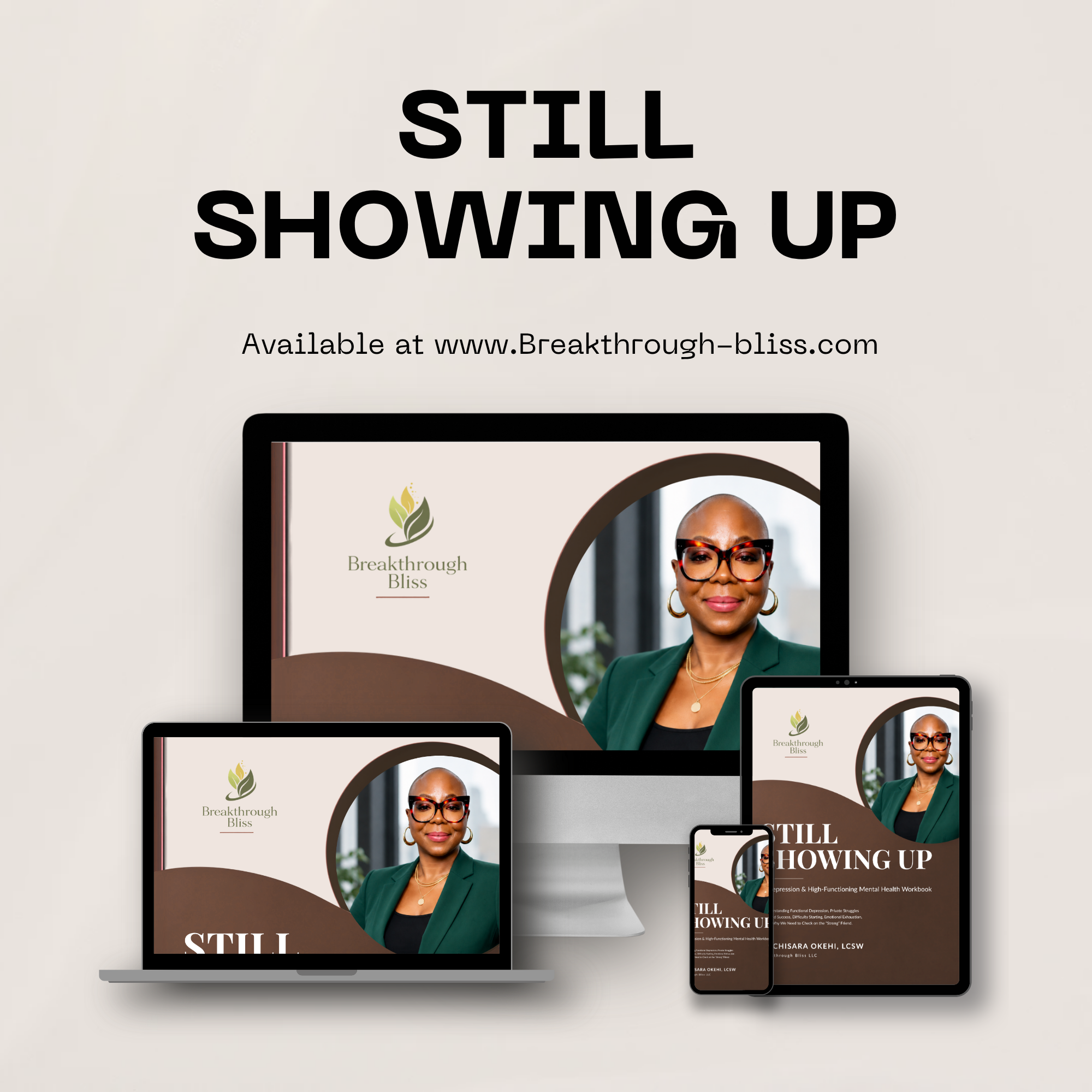


For the woman everyone thinks is doing fine.
You go to work.
You answer the messages.
You meet the deadlines.
You take care of everyone.
But privately, you may feel exhausted, disconnected, unmotivated or emotionally depleted.
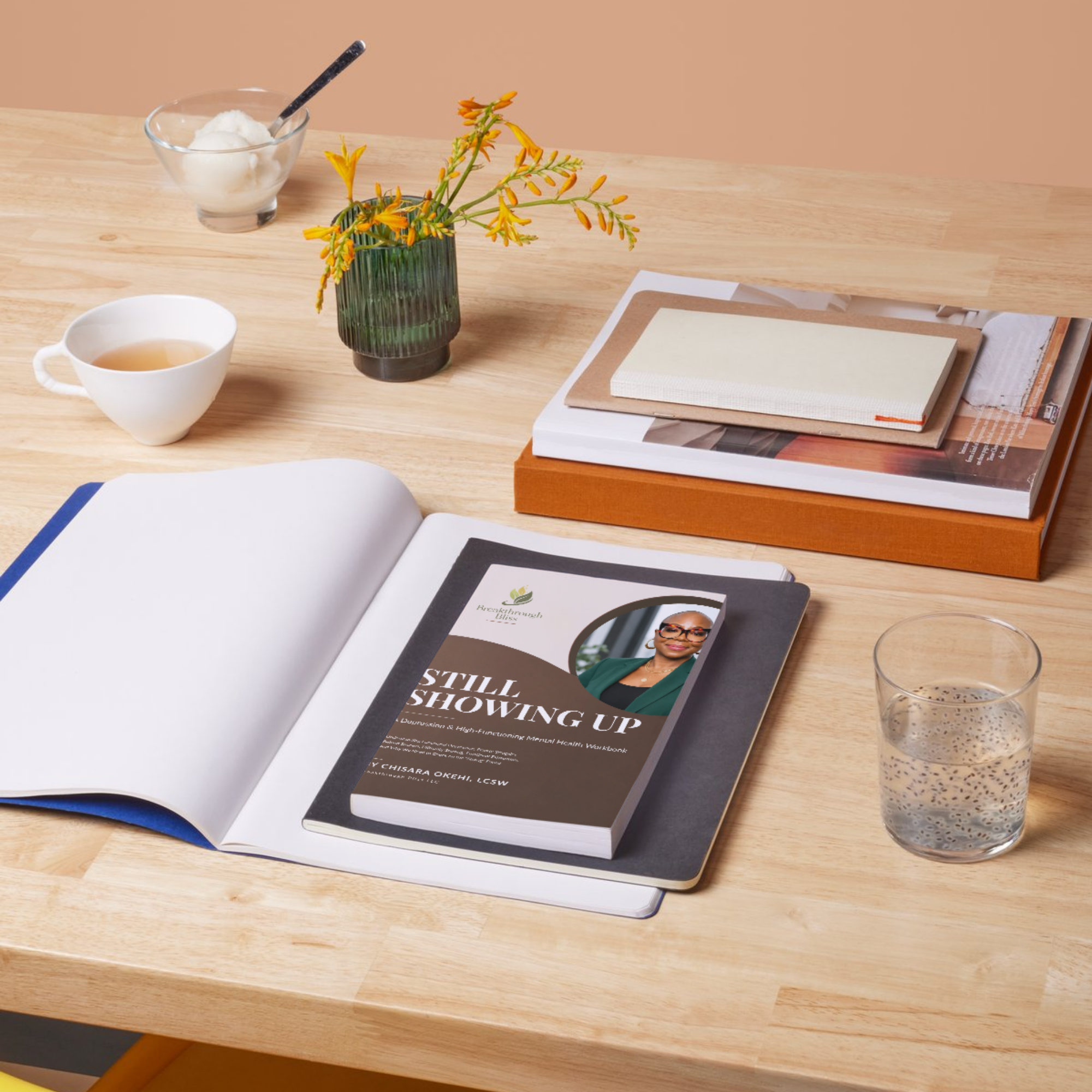
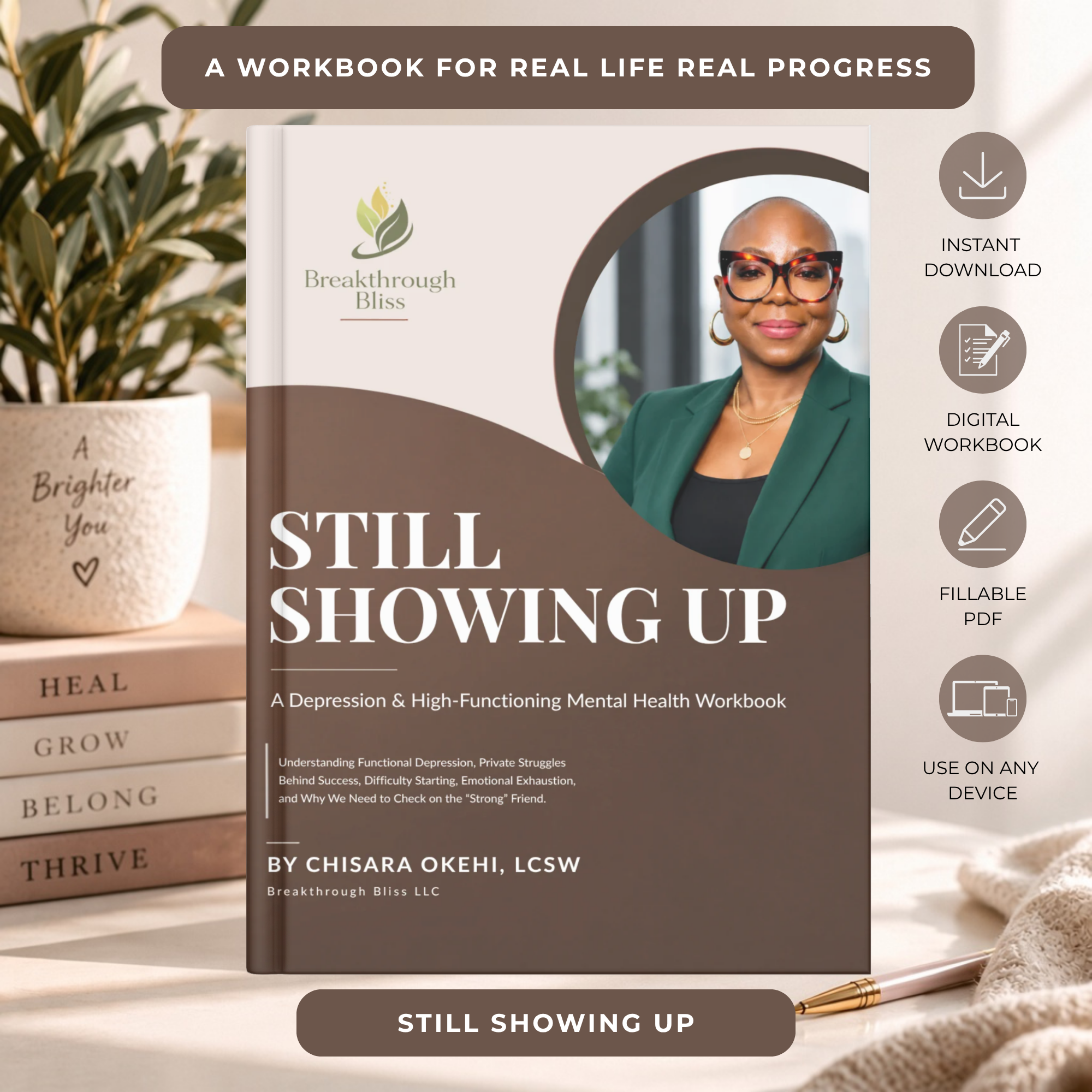
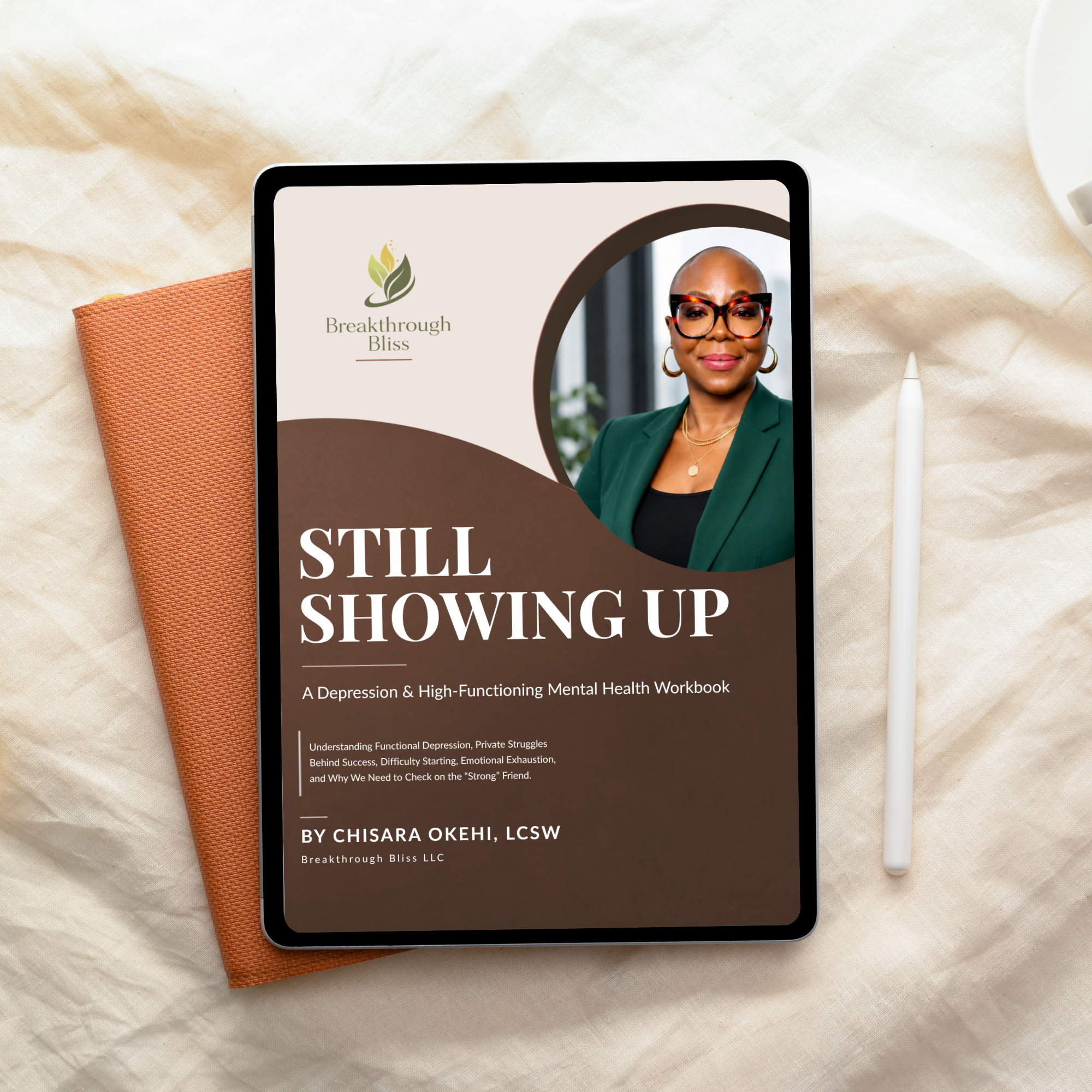
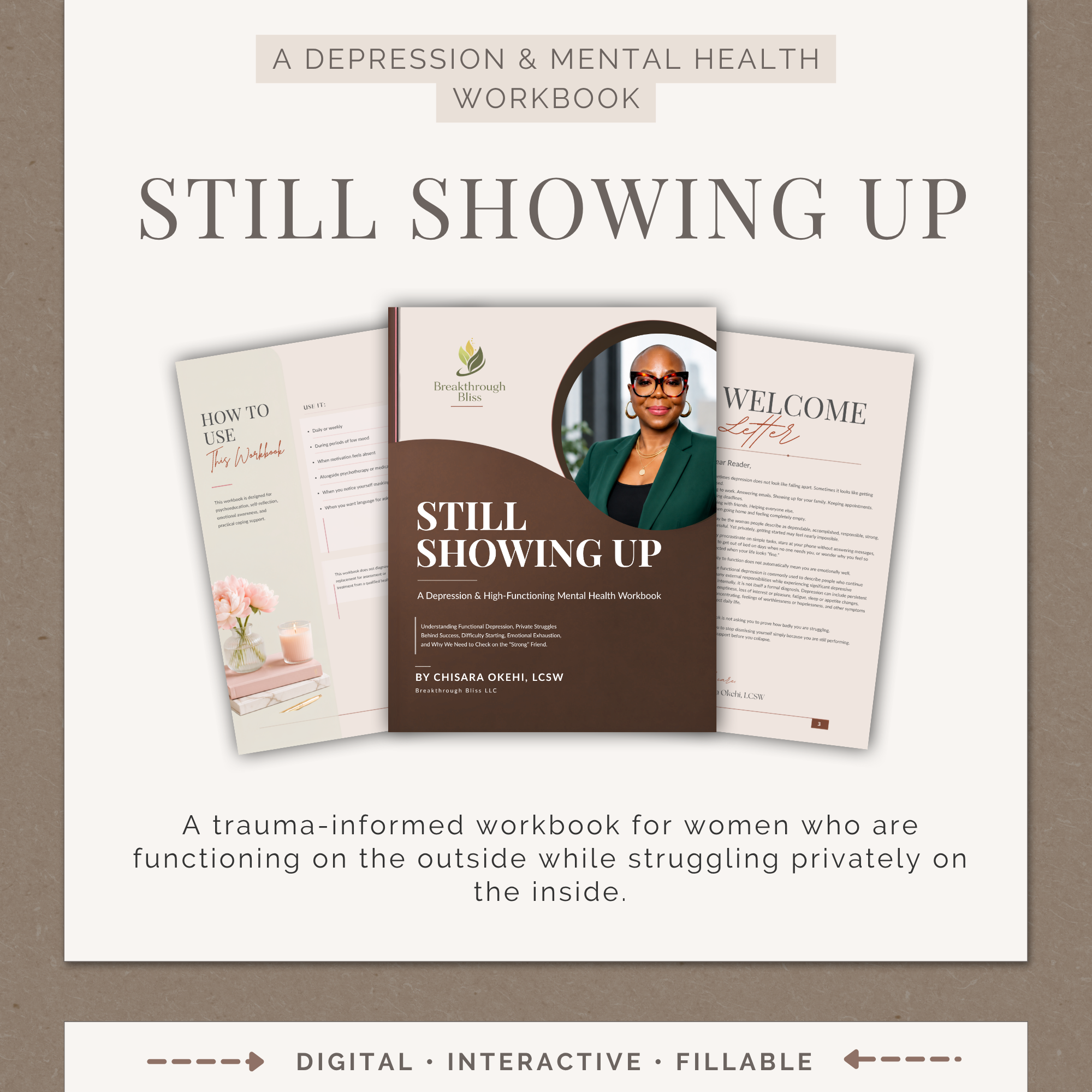
Still Showing Up is a 37 page digital mental health workbook created for women who may be functioning on the outside while struggling on the inside.
Created by Chisara Okehi, LCSW, this trauma informed workbook combines psychoeducation, guided self reflection and practical coping tools to help you better understand the emotional experience that can exist behind high functioning.
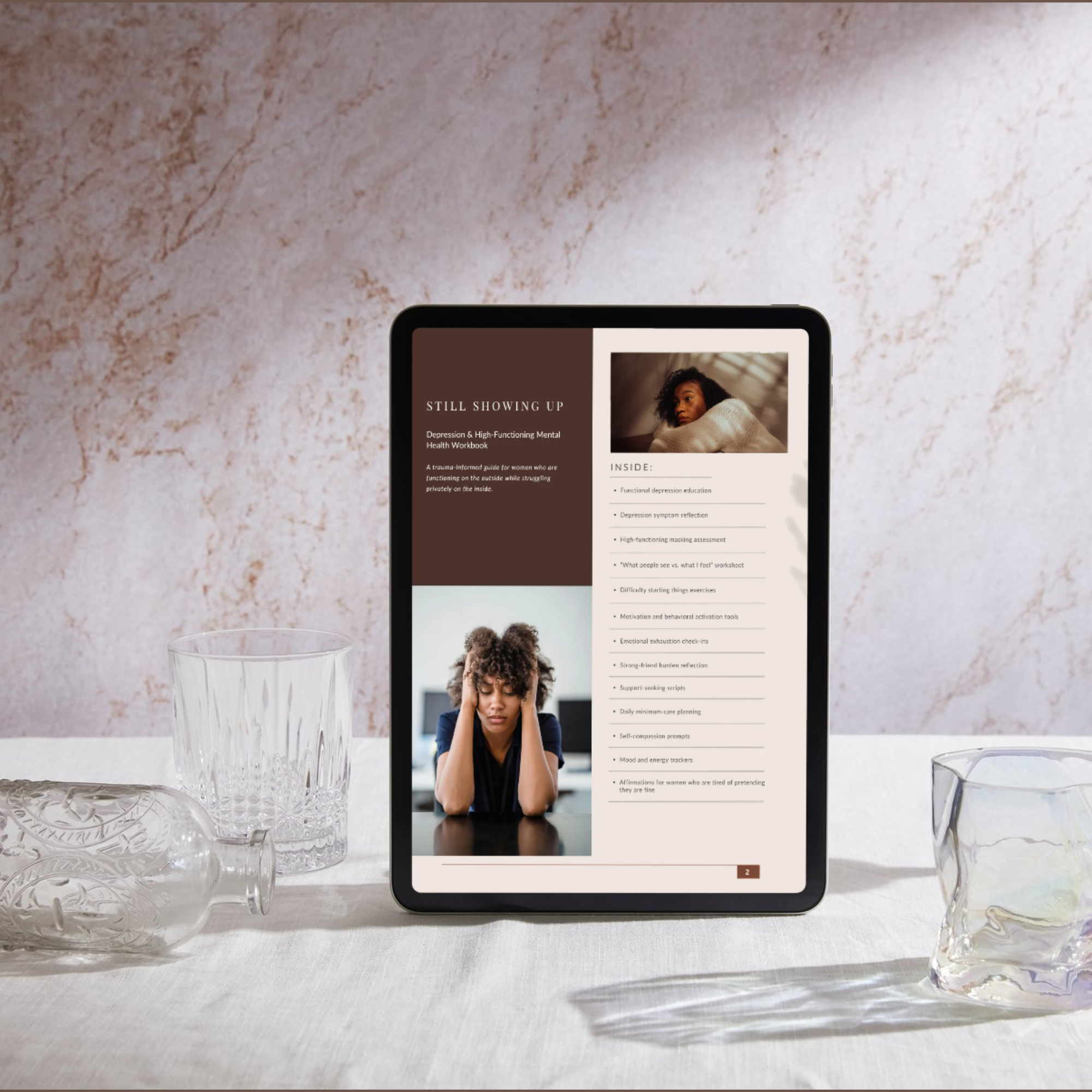
You’ll explore:
• Depression psychoeducation
• Depression symptom reflection
• High functioning masking assessment
• “What People See vs. What I Feel” worksheet
• Difficulty starting tasks
• The Tiny Start Method
• Behavioral activation exercises
• Emotional exhaustion and energy check ins
• The strong woman burden
• Support seeking scripts
• Emotional numbness and loss of pleasure
• Self criticism and self compassion
• Daily minimum care planning
• Rest vs. depressive withdrawal
• Professional support planning
• Early warning signs
• 7 Day Gentle Reconnection Plan
• Daily mood and functioning tracker
• Weekly functioning check in
• Affirmations for women who are still showing up
• Appear successful or productive while struggling privately
• Continue meeting responsibilities even when emotionally exhausted
• Have difficulty starting simple tasks
• Feel pressure to always be the strong one
• Hide how you really feel
• Feel guilty asking for support
• Experience low motivation or withdrawal
• Want structured exercises to help you better understand what you are carrying
1 digital PDF workbook
37 pages
Immediate digital access after purchase
Printable and compatible with PDF annotation apps
No physical product will be mailed.
This workbook is designed for psychoeducation, self reflection, emotional awareness and practical coping support.
It does not diagnose depression and is not a replacement for assessment or treatment from a qualified healthcare professional.
If you are experiencing a mental health crisis or thoughts of suicide, seek immediate professional or emergency support.
Licensed Clinical Social Worker
Founder, Breakthrough Bliss LLC
You deserve support before you collapse.


Receiving an autism or neurodivergence diagnosis as an adult can bring relief, confusion, grief, validation, and questions all at once. What Now? is a trauma-informed, culturally aware workbook designed to help women process their diagnosis with clarity, self-compassion, and practical next steps.
Created by Chisara Okehi, LCSW, this workbook acknowledges a reality many women experience, especially Black women and women of color: years of being misunderstood, misdiagnosed, or overlooked before finally receiving answers.
This guided workbook helps you:
• Process the emotional impact of late diagnosis
• Understand how autism presents differently in women
• Explore masking, burnout, and identity shifts
• Identify strengths and challenges with clarity
• Build a personalized sensory and regulation toolbox
• Practice self-advocacy and boundary setting
• Release shame and internalized self-criticism
• Develop affirmations rooted in acceptance and growth
This is not a clinical manual. It is a supportive companion for women navigating life after diagnosis and learning how to live in alignment rather than survival.
If you’ve ever wondered why everything felt harder than it should, this workbook offers language, validation, and direction.
Your diagnosis is not a limitation. It is information. And information can lead to freedom.


For many Black women, boundaries were never modeled, they were violated, ignored, or framed as selfish. From family roles to workplace expectations to intimate relationships, we are often conditioned to sacrifice ourselves to keep the peace.
Boundaries and Black Women was created as a sacred, affirming space to help you unlearn survival based patterns and begin choosing yourself.
Written by Chisara Okehi, LCSW, this workbook combines trauma informed care, somatic awareness, and culturally responsive reflection to support Black women in identifying their limits, expressing their needs, and protecting their energy.
This is not a workbook about becoming cold or distant.
It is about becoming clear, grounded, and emotionally safe.
✔ The cultural and family roots of boundary struggles in Black women
✔ How survival roles (helper, peacemaker, fixer, caregiver) shape boundary patterns
✔ Guided reflection to identify where and why your boundaries break down
✔ Boundary setting scripts you can actually use in real conversations
✔ Somatic boundary scans to help you listen to your body’s signals
✔ Journaling prompts to unpack guilt, fear, and self betrayal
✔ A communication planner for navigating difficult conversations
✔ Tools to help you say no without overexplaining or self abandoning
This workbook is for Black women who:
• Feel emotionally drained or burned out
• Struggle to say no without guilt
• Were taught to prioritize others over themselves
• Feel responsible for everyone’s comfort but their own
• Want to protect their peace without losing their softness
• Are ready to choose themselves without apology
This workbook is not generic boundary advice.
It speaks directly to the lived experiences of Black women, including cultural expectations, generational trauma, and survival based roles. It honors the reality that boundaries are not just personal, they are political, cultural, and deeply embodied.
The tone is affirming, direct, and compassionate. No shaming. No bypassing. Just truth and support.
• Digital fillable PDF workbook
• Immediate download after purchase
• Printable or usable on your device
• 9 thoughtfully designed pages
• Can be used independently or alongside therapy or coaching
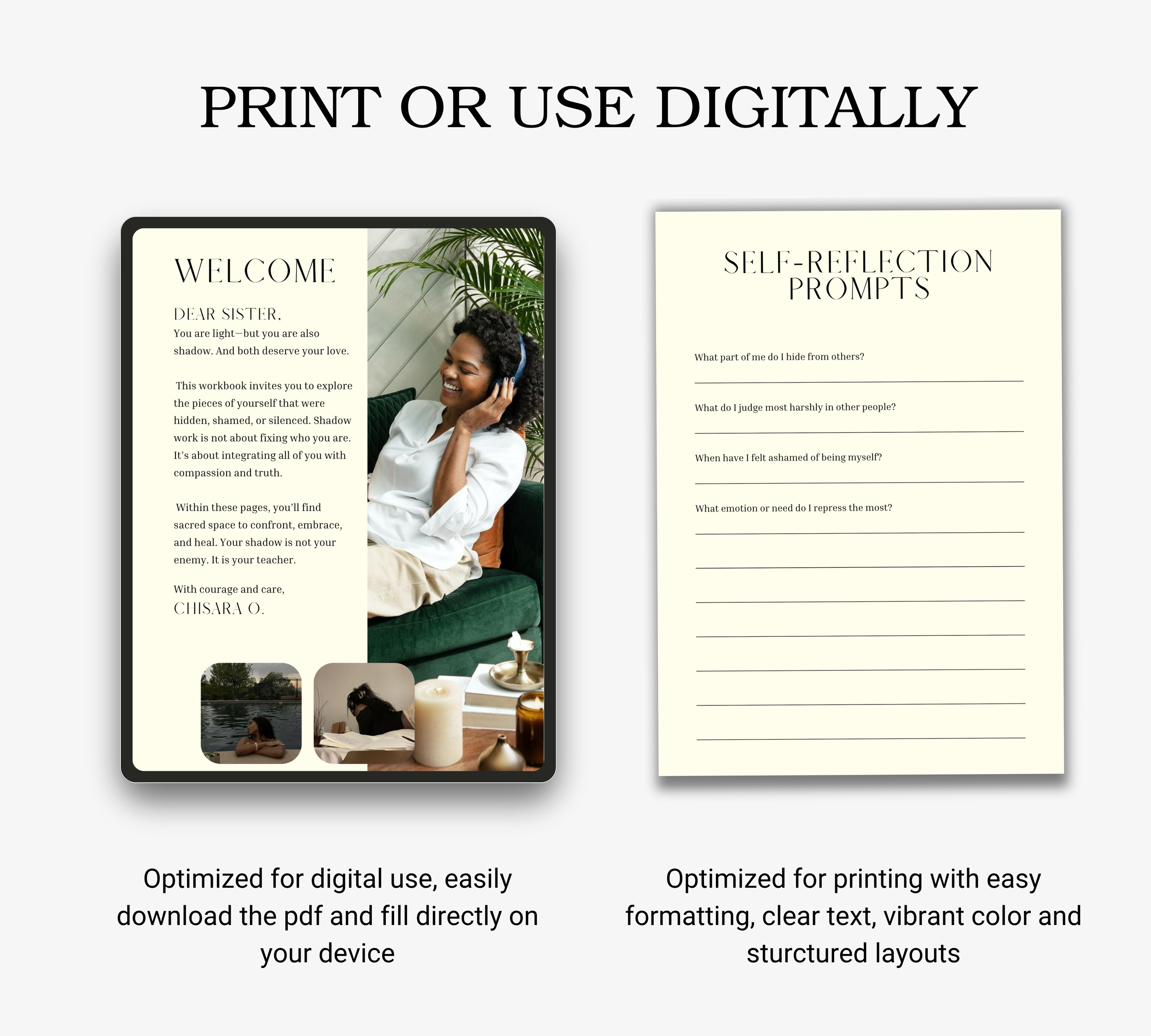


Black women are often taught which parts of themselves are acceptable and which must be suppressed to survive. Over time, the rejected parts do not disappear, they show up as triggers, projections, self-criticism, emotional reactivity, and disconnection from authenticity.
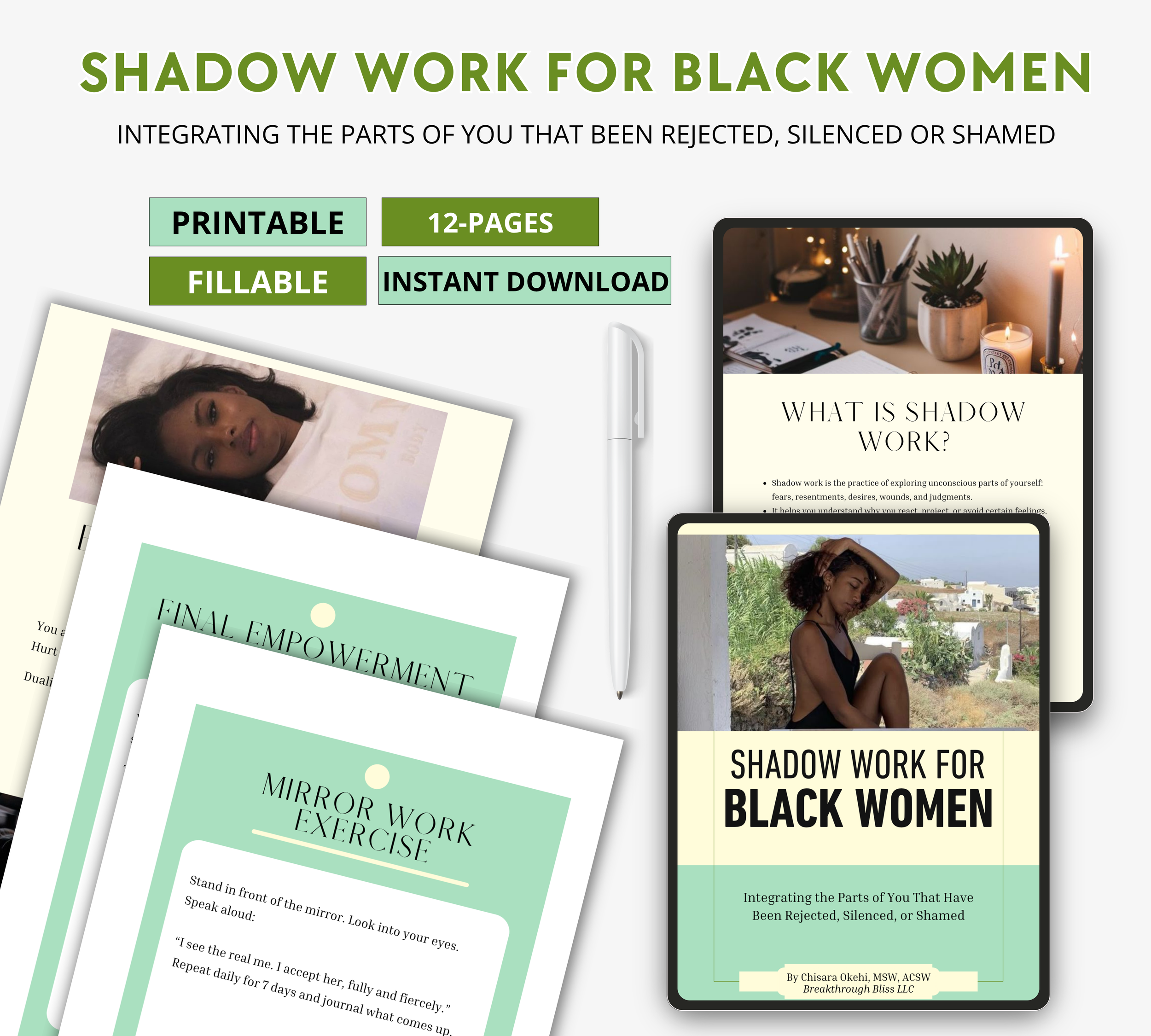
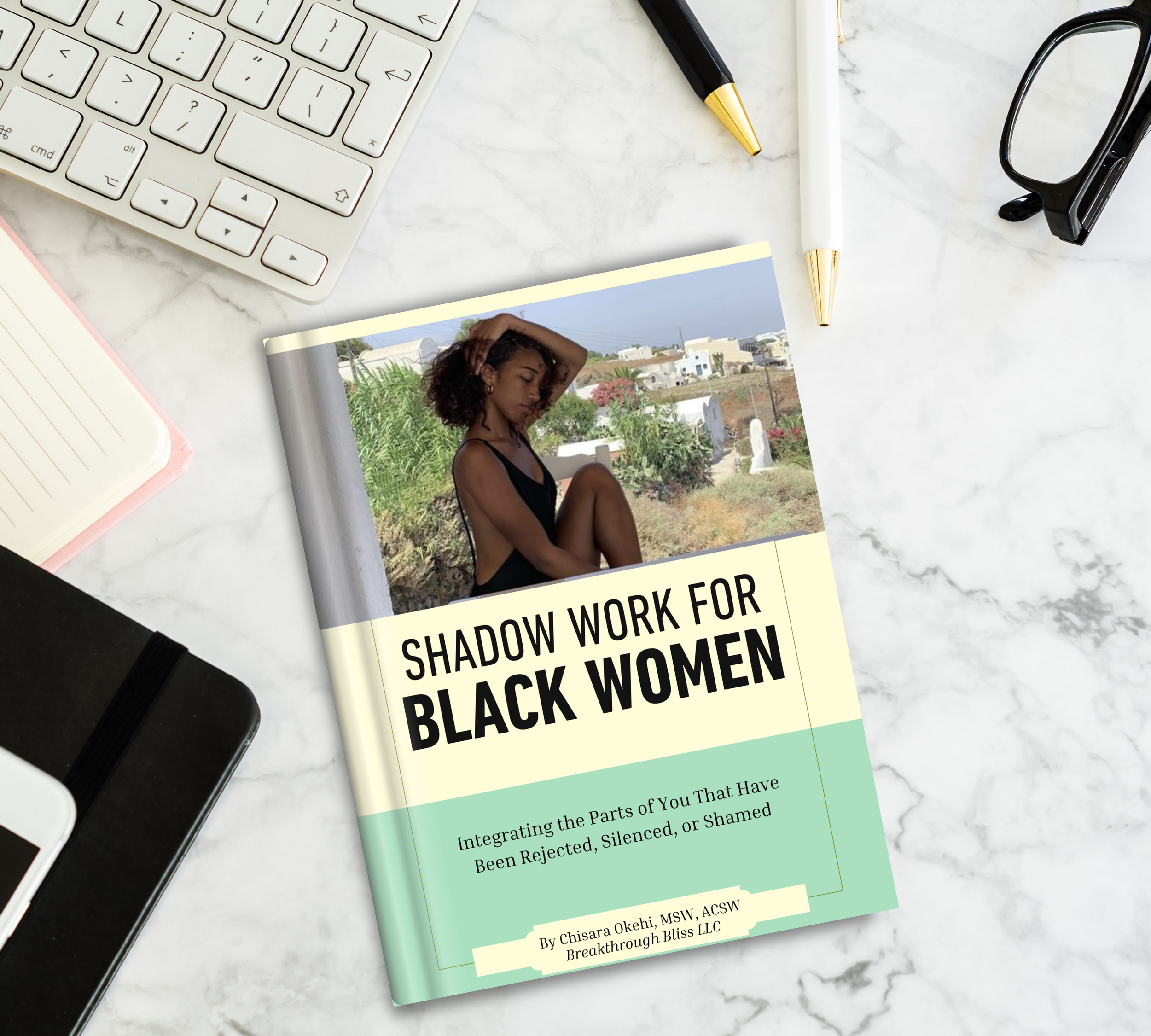
Shadow Work for Black Women was created to bring those hidden parts back into the light with compassion and truth.
Written by Chisara Okehi, LCSW, a licensed clinical social worker, emotional wellness coach, and founder of Breakthrough Bliss LLC, this workbook blends trauma-informed clinical insight with reflective and integrative practices. With over 15 years of experience supporting Black women through complex trauma, grief, and identity wounds, Chisara guides you through shadow work in a way that feels emotionally safe, culturally responsive, and empowering.
Shadow work is not about fixing yourself.
It is about reclaiming the parts of you that hold wisdom.
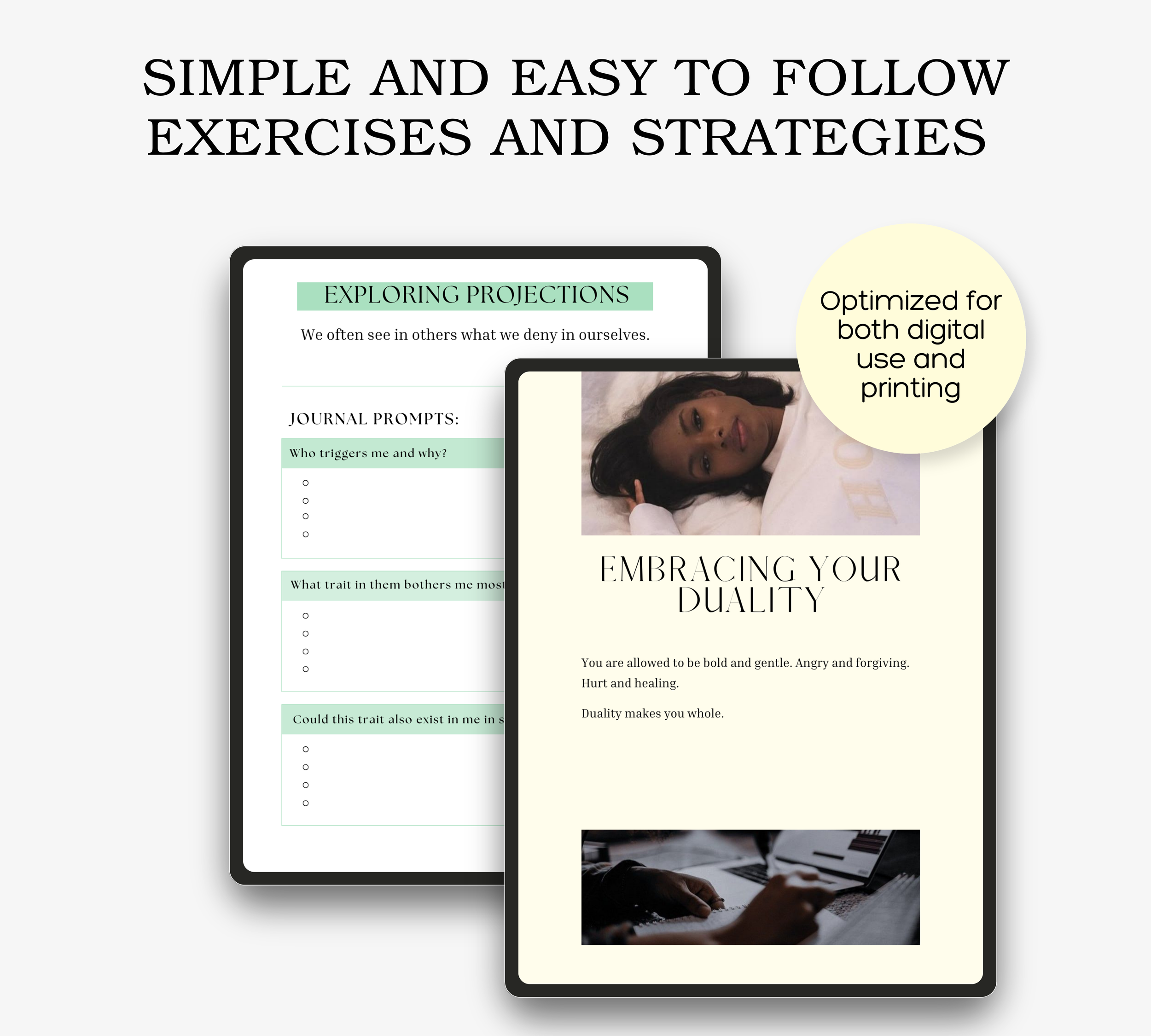
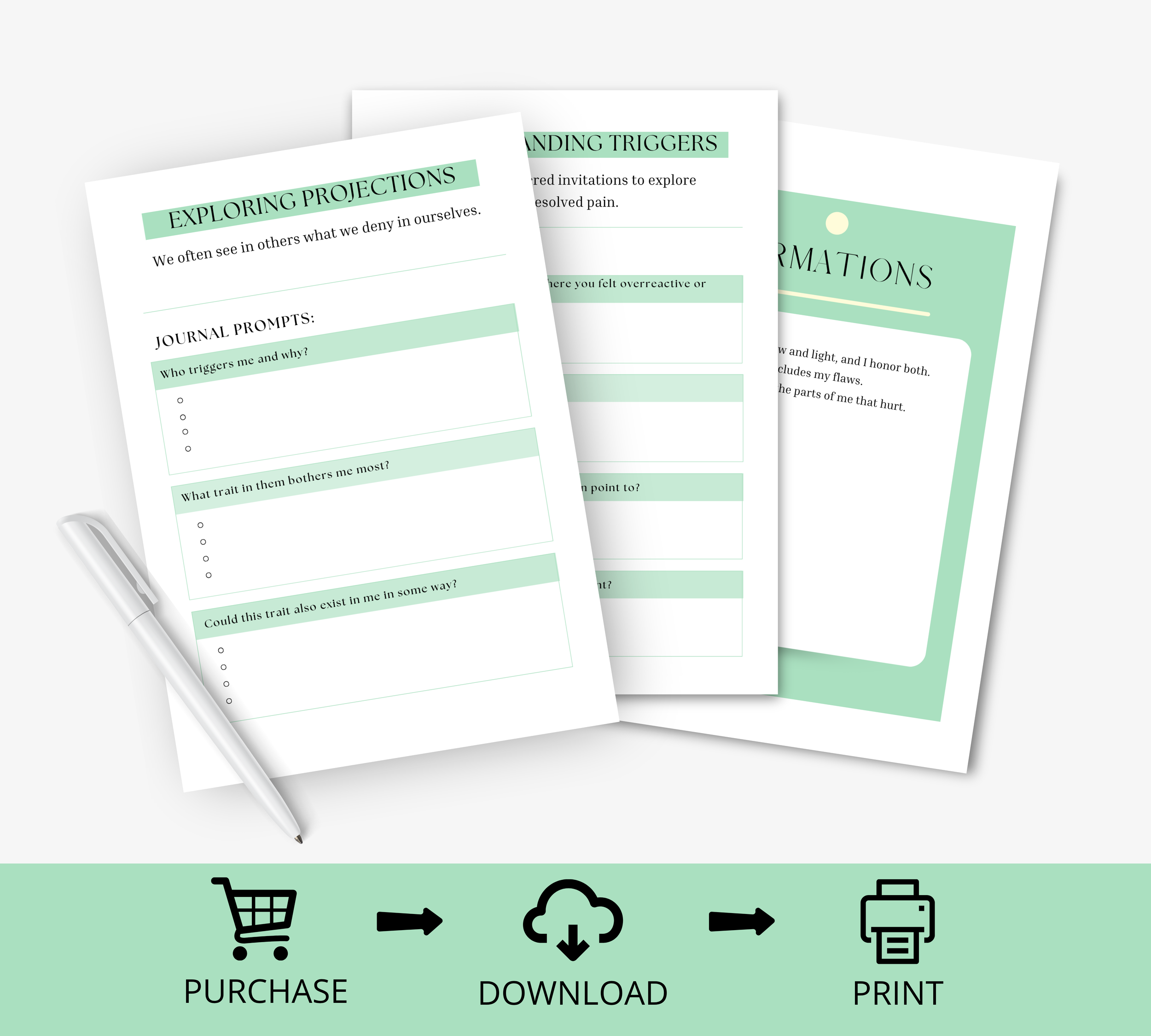
✔ A clear, accessible explanation of what shadow work is and why it matters
✔ Reflection prompts to explore hidden fears, shame, resentment, and unmet needs
✔ Exercises to identify emotional triggers and link them to unresolved wounds
✔ Projection journaling to understand what others awaken within you
✔ Guided questions to explore identity, repression, and self-judgment
✔ Practices to embrace emotional duality, anger and softness, grief and healing
✔ Mirror work exercises to strengthen self-acceptance and integration
✔ Affirmations that honor both your light and your shadow
✔ A closing empowerment reflection to anchor wholeness and self-trust
Each section is intentionally paced to support insight without emotional overwhelm.
This workbook is for Black women who:
• Feel disconnected from parts of themselves
• Struggle with shame, emotional triggers, or harsh self-judgment
• Want to understand their reactions rather than suppress them
• Are ready to heal beyond surface-level self-care
• Desire deeper self-acceptance without losing softness
• Want trauma-informed shadow work grounded in cultural awareness
This is not performative shadow work or aesthetic self-help.
Shadow Work for Black Women is grounded in trauma-informed clinical principles and written specifically with Black women’s lived experiences in mind. It recognizes how survival, patriarchy, racism, and generational trauma shape what parts of self get silenced.
The tone is honest, affirming, and emotionally safe. No shaming. No spiritual bypassing. No pressure to “heal faster.”
• Digital fillable PDF workbook
• Immediate download after purchase
• Printable or usable on your device
• 12 thoughtfully designed pages
• Can be used independently or alongside therapy or coaching
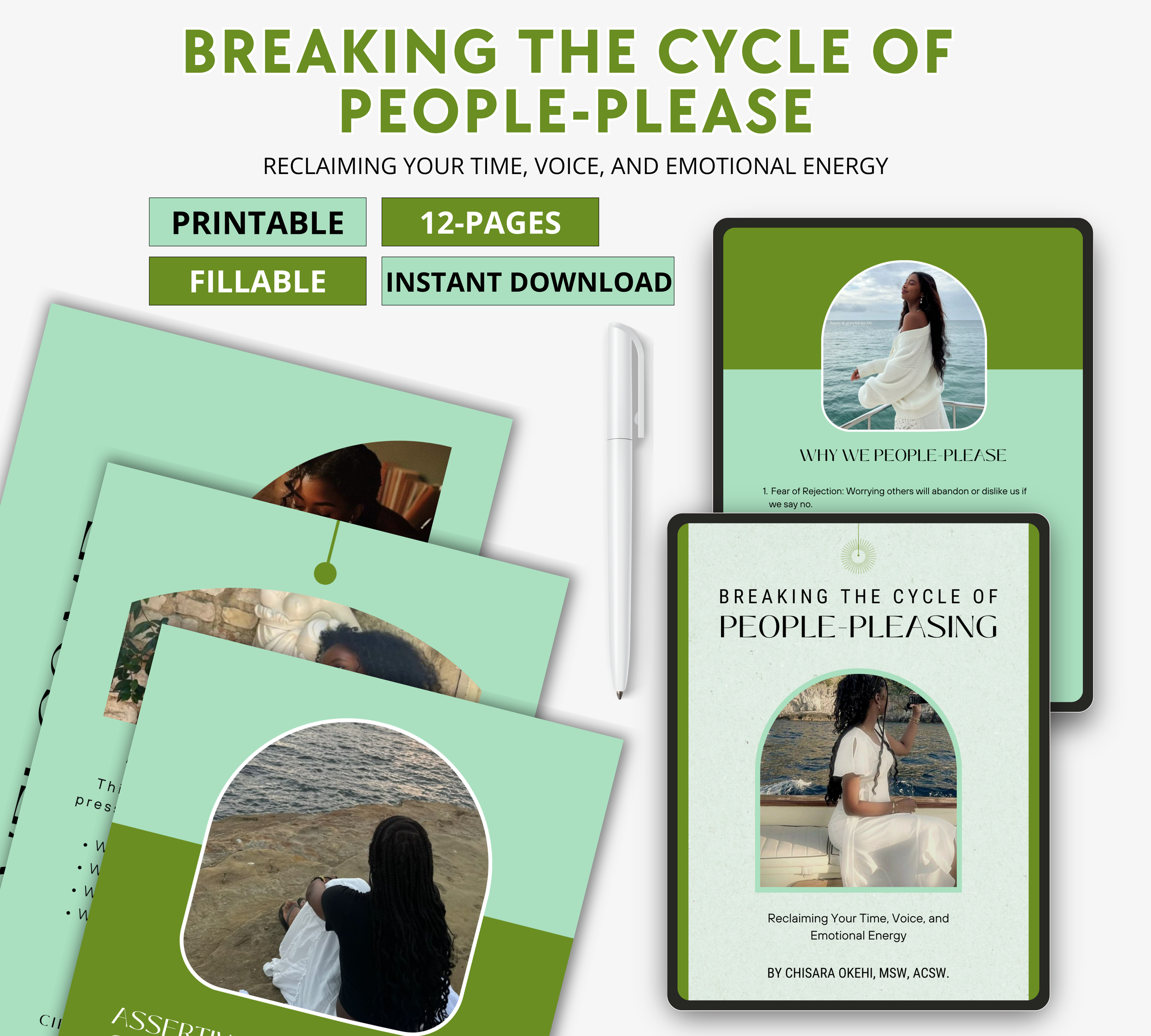
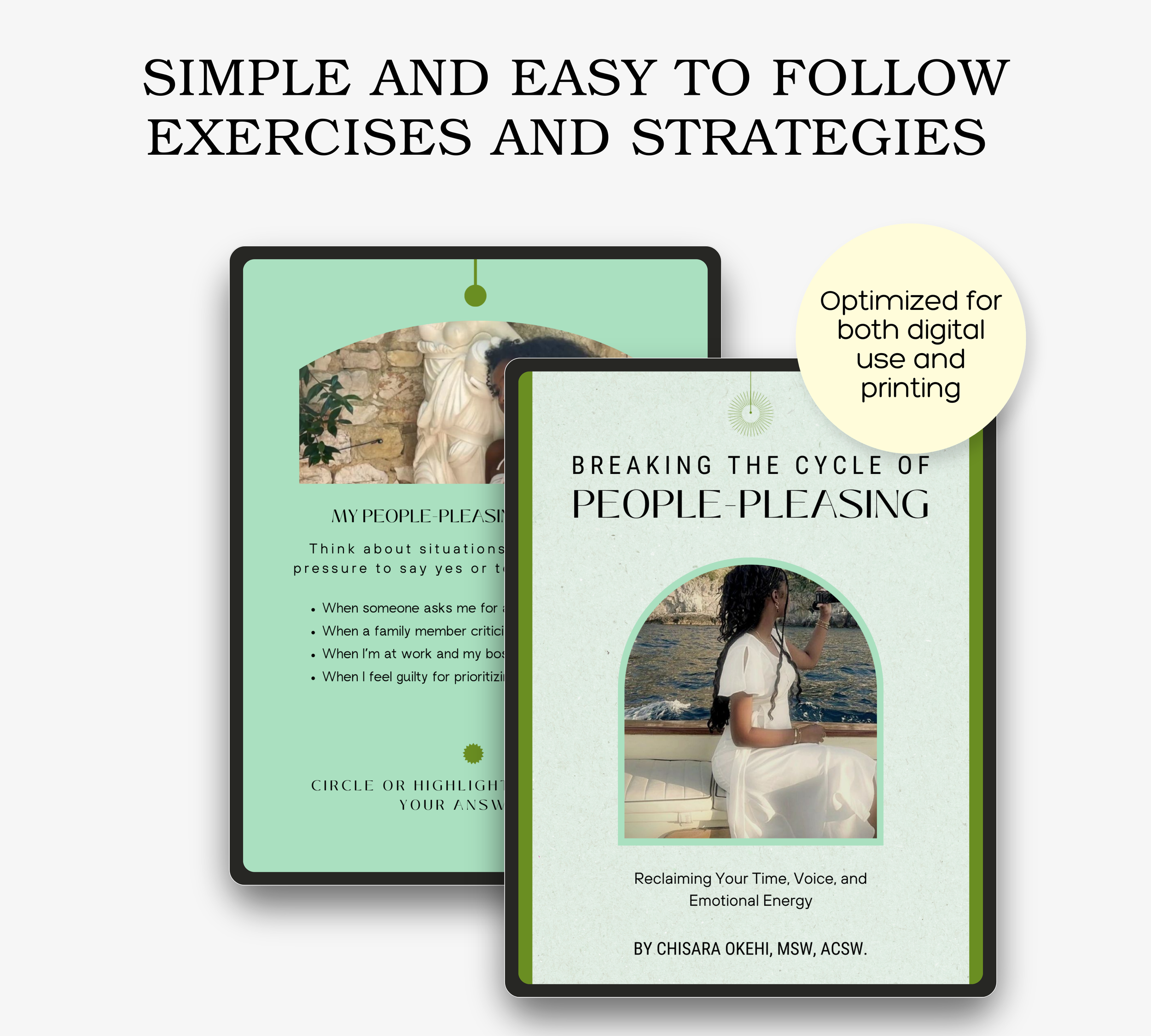
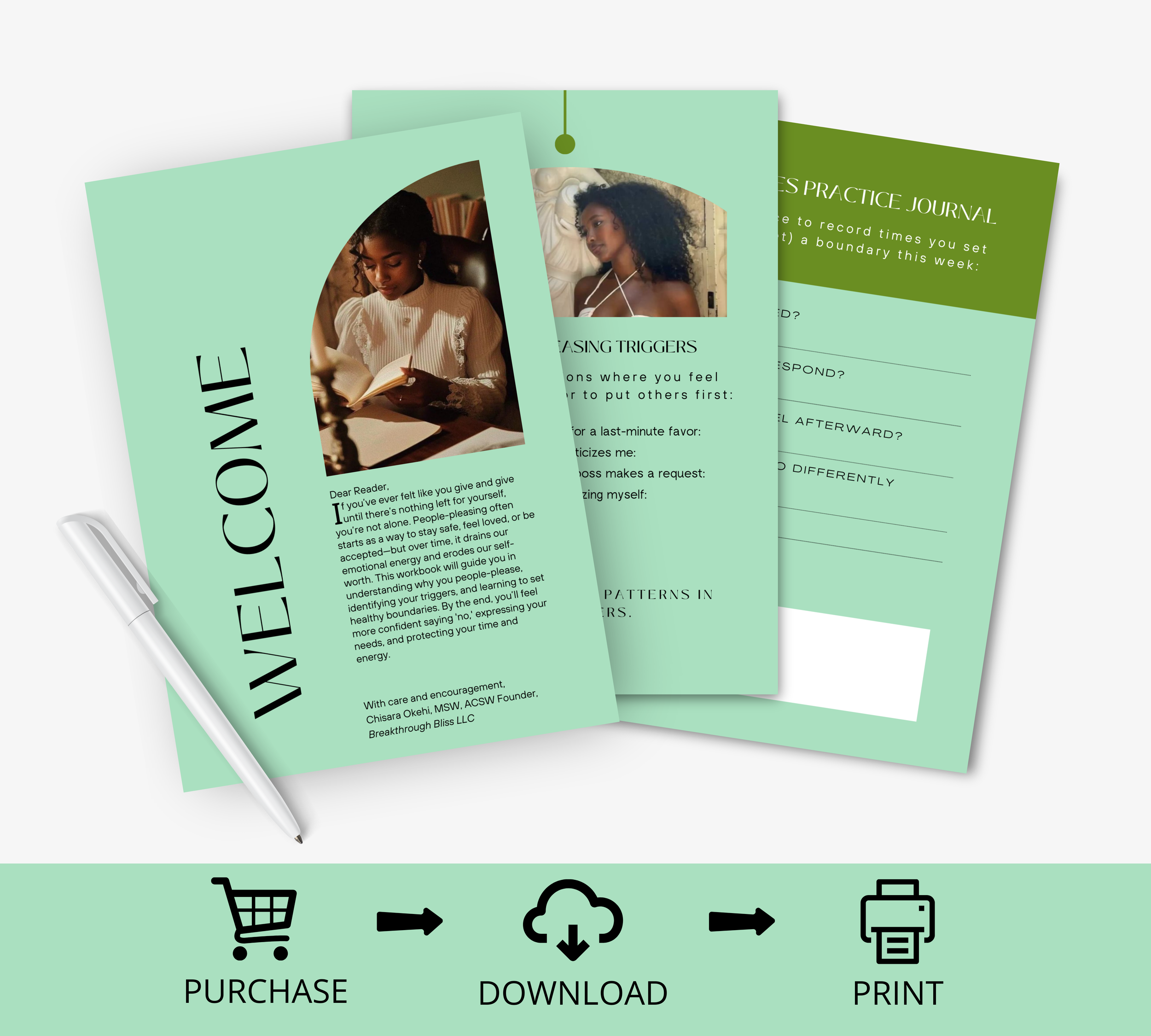

People-pleasing often begins as a way to stay safe, feel loved, or avoid conflict. Over time, it becomes exhausting. Many women find themselves saying yes when they mean no, prioritizing others at their own expense, and tying their worth to being helpful or agreeable.
Breaking the Cycle of People-Pleasing offers a compassionate, structured path out of that pattern.
Written by Chisara Okehi, LCSW, this workbook integrates trauma-informed care, boundary-setting skills, and reflective practices to help you understand the roots of people-pleasing and replace it with self-respect, clarity, and emotional balance.
This workbook does not teach you to become harsh or detached.
It teaches you how to be kind without self-betrayal.
✔ The psychological and emotional roots of people-pleasing
✔ How fear of rejection, approval-seeking, and childhood conditioning shape your behavior
✔ Identification of personal people-pleasing triggers in relationships, family, and work
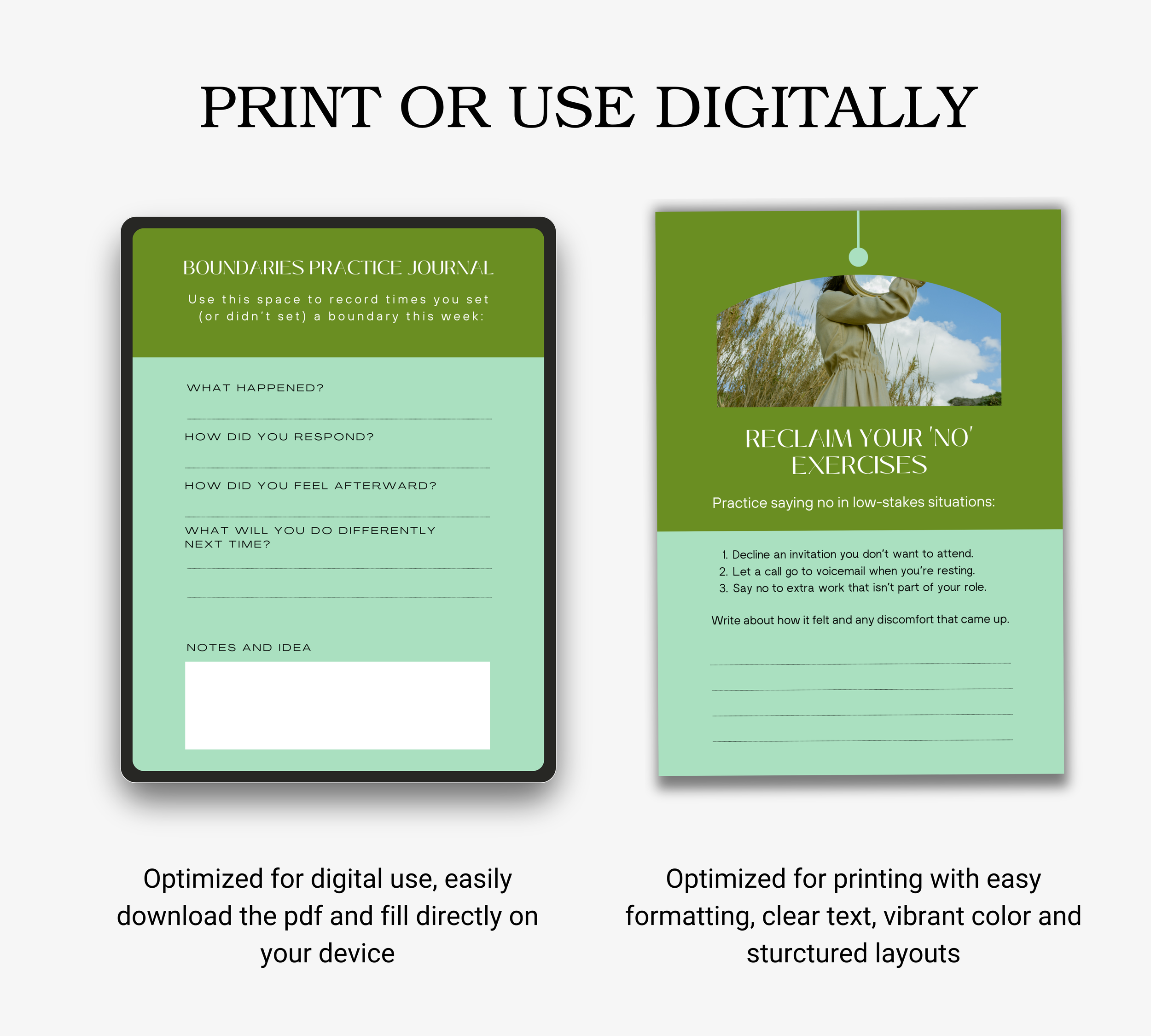
✔ Boundary practice journaling to reflect on real-life experiences
✔ Assertive communication scripts that are respectful and firm
✔ Visualization exercises to imagine life without overgiving
✔ Low-stakes “reclaim your no” exercises to build confidence gradually
✔ Daily mantras to reinforce self-respect and emotional worth
✔ Recommended books for continued growth and support
Each section is designed to help you shift from automatic overgiving to intentional, self-honoring choices.
This workbook is for women who:
• Feel drained from constantly meeting others’ needs
• Struggle to say no without guilt or anxiety
• Tie their worth to being helpful or agreeable
• Avoid conflict even when it costs them peace
• Want healthier boundaries without losing compassion
• Are ready to reclaim their time, voice, and energy
This is not surface-level advice or motivational talk.
This workbook recognizes people-pleasing as a trauma-informed survival response, not a character flaw. It offers practical tools, emotional insight, and realistic exercises that meet you where you are, without pressure or shame.
The tone is gentle, honest, and grounded in clinical understanding.
• Digital fillable PDF workbook
• Immediate download after purchase
• Printable or usable on your device
• 12 thoughtfully designed pages
• Can be used independently or alongside therapy or coaching
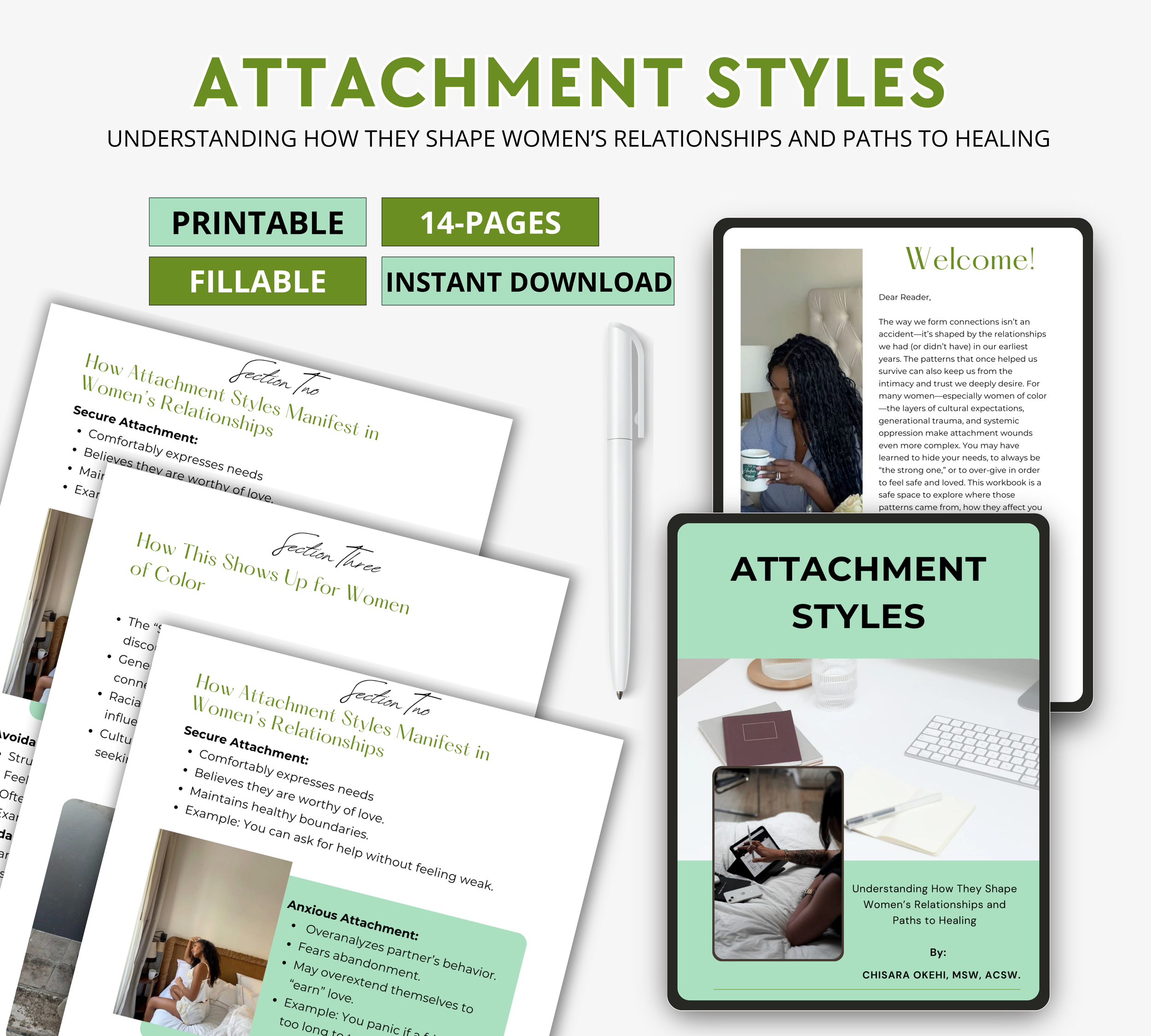
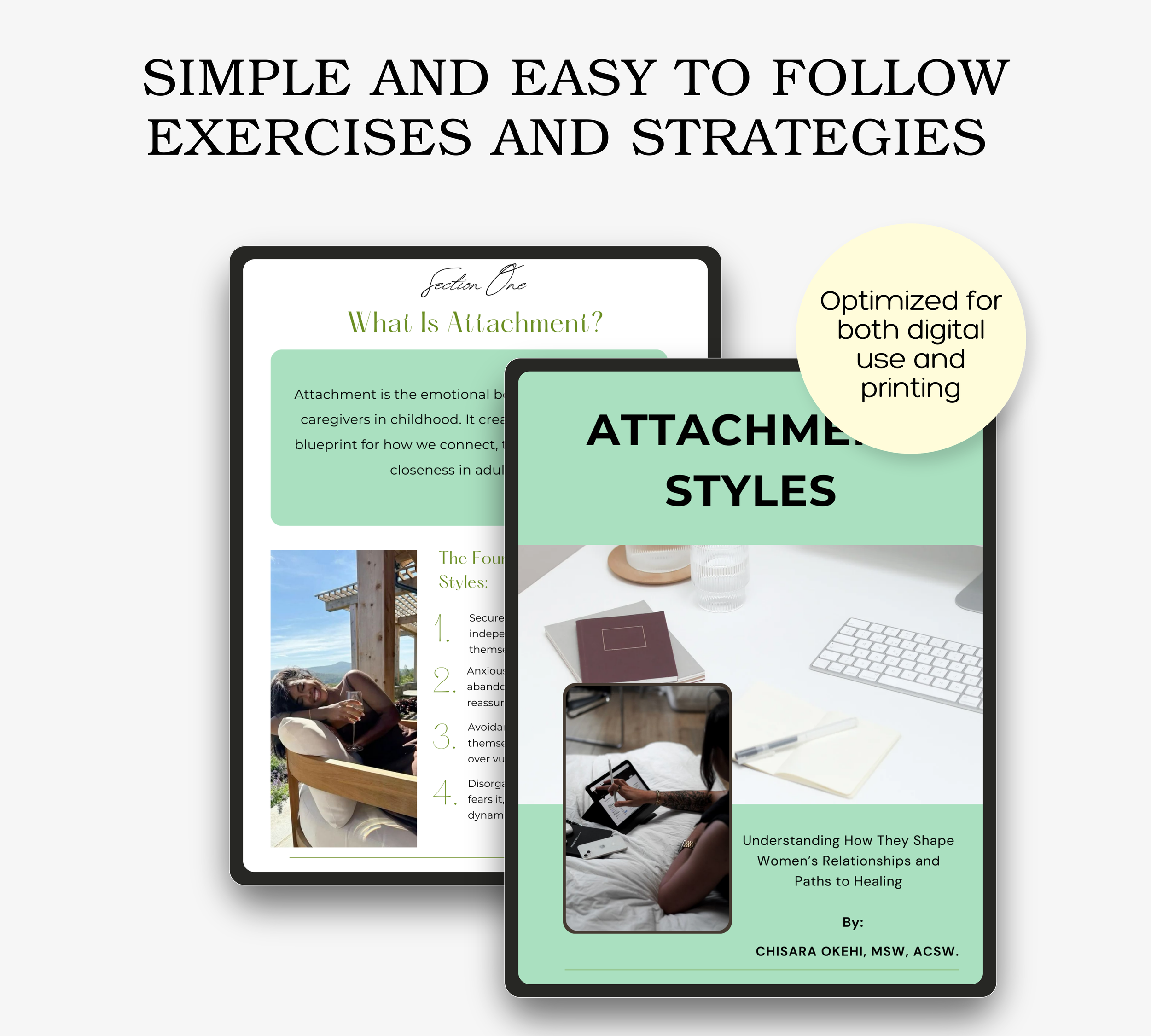
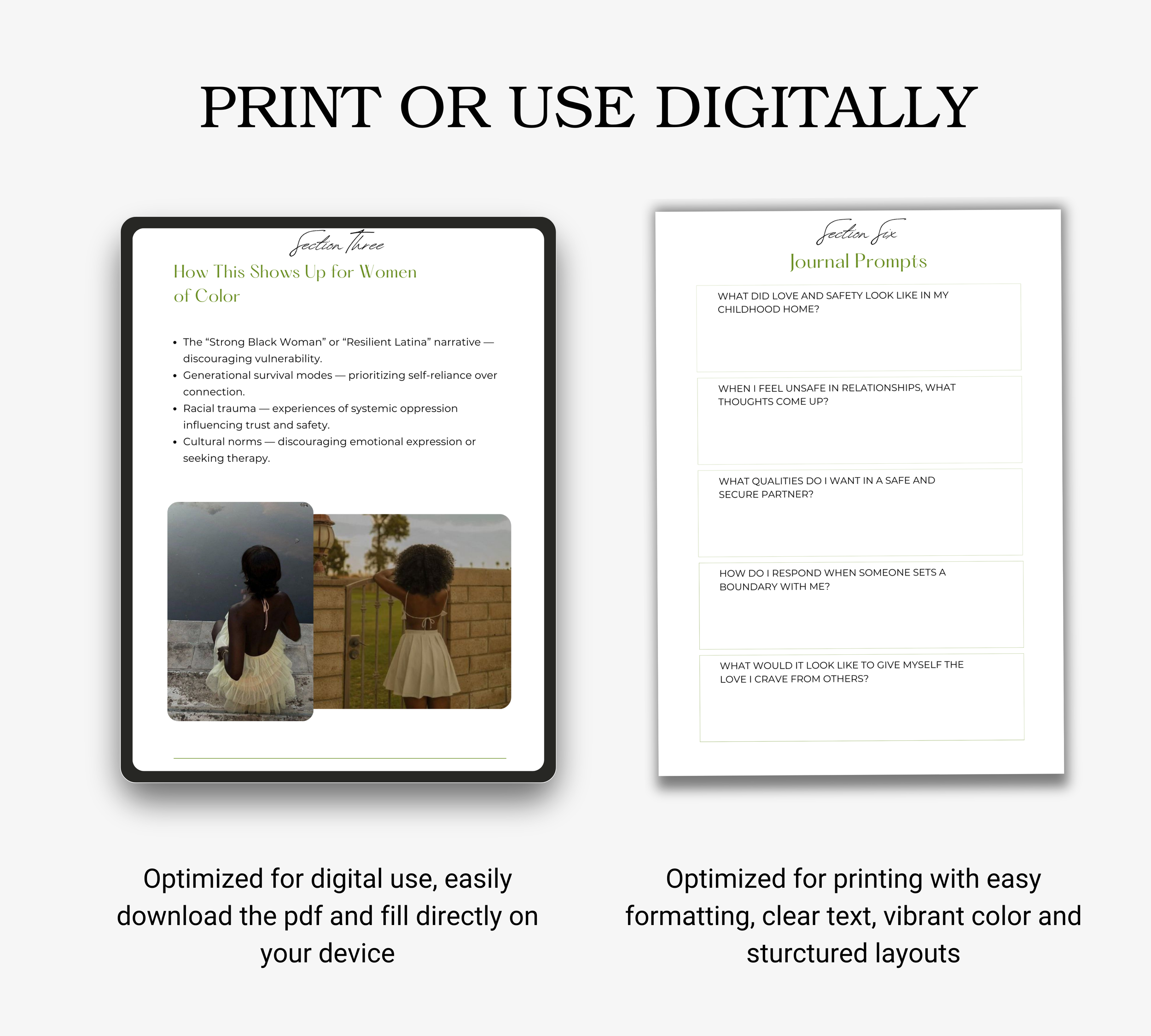
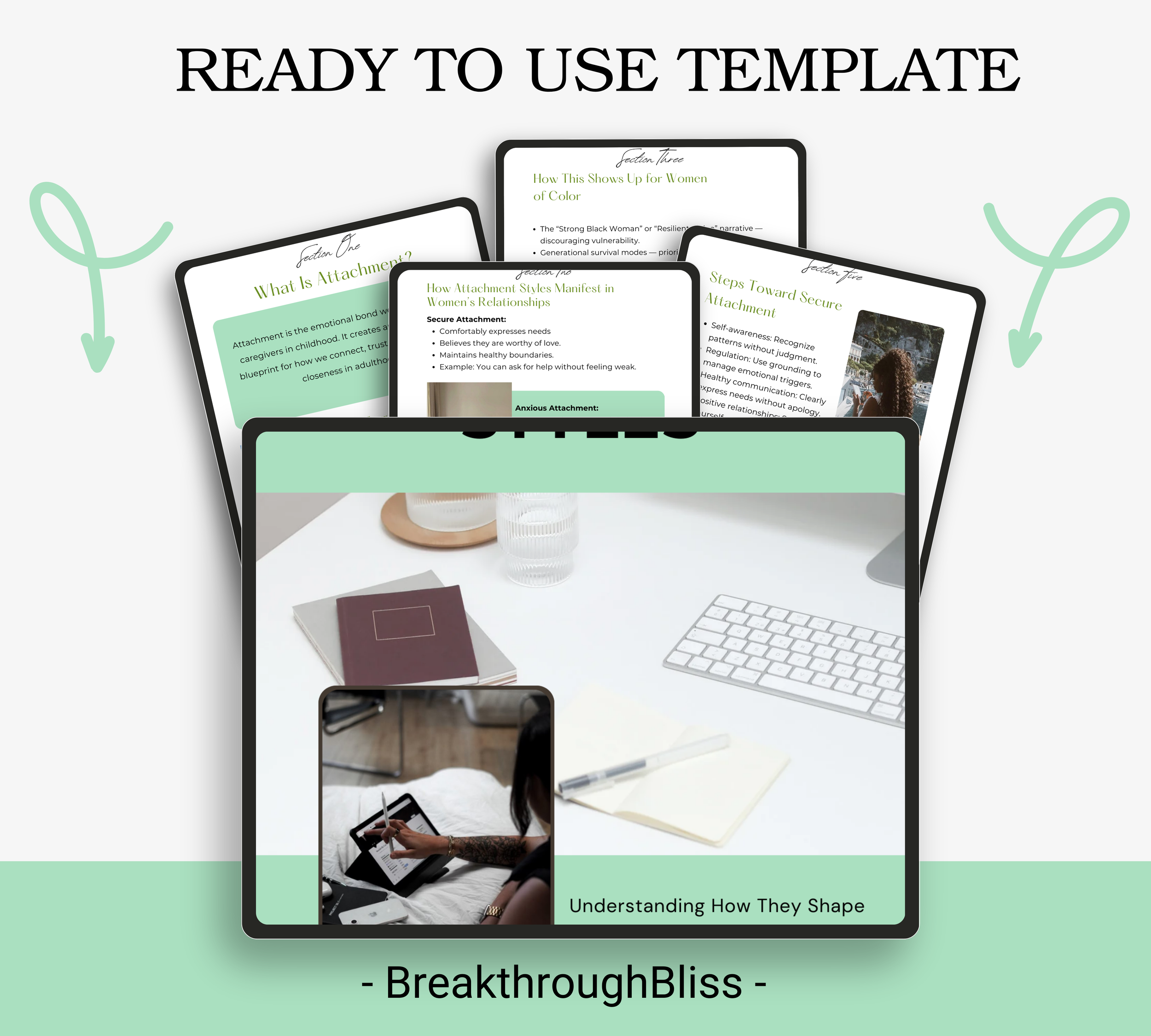
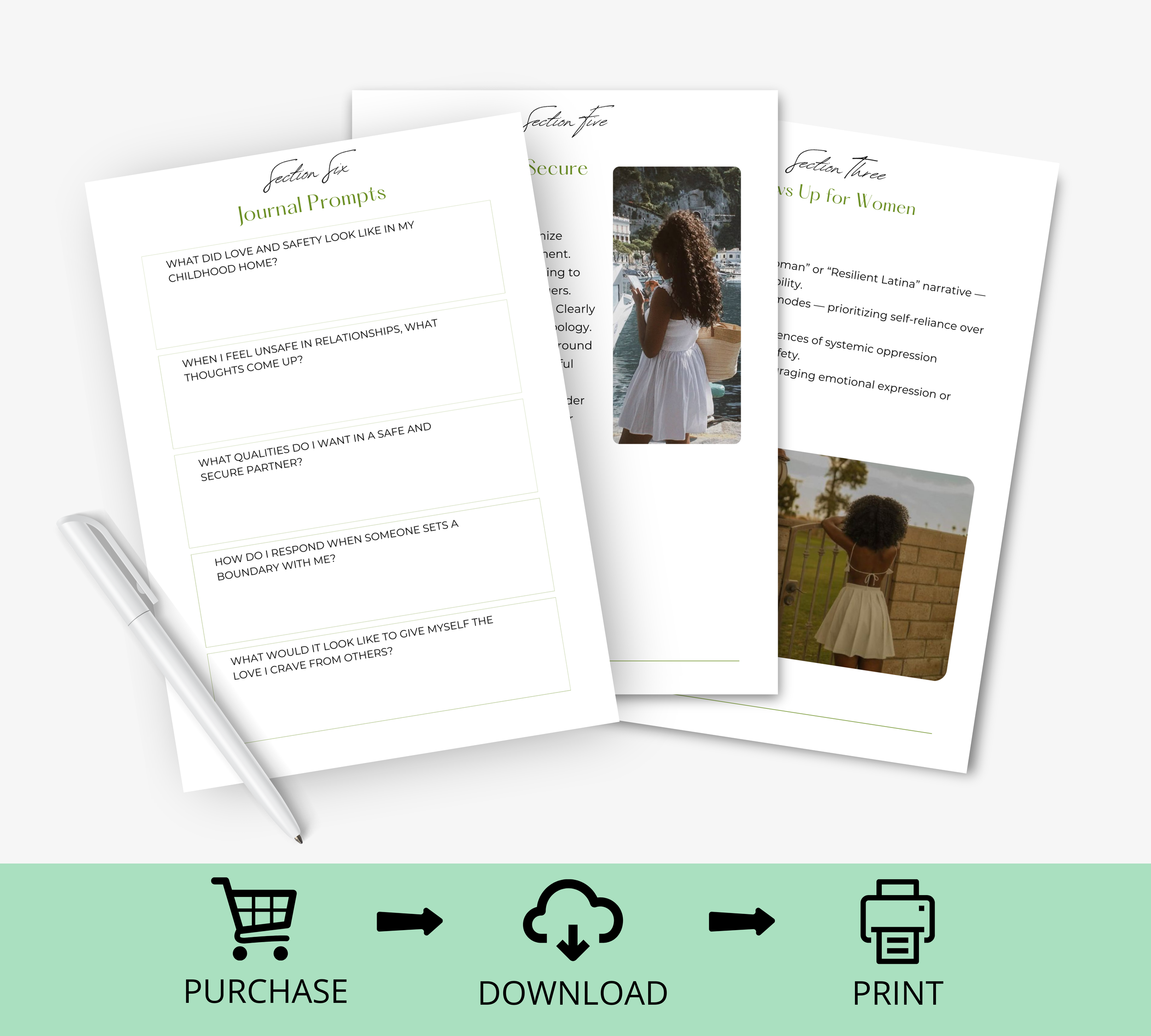


The way you connect to others is shaped long before adulthood. Attachment styles form in early childhood and quietly influence how you respond to intimacy, boundaries, conflict, and emotional safety. For many women, especially women of color, these patterns are further complicated by generational trauma, cultural expectations, and survival based roles that reward strength over vulnerability.
Attachment Styles is a guided workbook created to help you understand your attachment style, recognize how it shows up in your relationships, and begin the process of healing toward secure attachment.
Written by Chisara Okehi, LCSW, this workbook blends attachment theory, trauma informed care, and culturally responsive reflection to help you explore your emotional patterns with compassion rather than judgment. You will learn that your behaviors were once protective, even if they no longer serve you.
This workbook is not about fixing yourself. It is about understanding yourself.
✔ The four main attachment styles, secure, anxious, avoidant, and disorganized
✔ How attachment patterns develop and why they persist into adulthood
✔ How attachment styles commonly show up in women’s romantic relationships and friendships
✔ The unique impact of racial trauma, cultural expectations, and generational survival on attachment
✔ How to assess your own attachment style through guided self reflection
✔ Practical steps to move toward secure attachment
✔ Grounding and regulation tools for emotional triggers
✔ Journaling prompts to explore safety, boundaries, and emotional needs
✔ Affirmations to support secure attachment and self trust
✔ Resources for continued healing and therapeutic support
This workbook is for women who:
• Struggle with trust, closeness, or emotional safety
• Find themselves overgiving, withdrawing, or fearing abandonment
• Feel conflicted about intimacy and independence
• Were raised to be “strong” but not emotionally supported
• Want healthier relationships but do not know where to start
• Are healing from childhood trauma or relational wounds
This workbook is especially affirming for Black women and women of color seeking culturally aware emotional wellness tools.
This is not a surface level attachment quiz.
This workbook is grounded in clinical knowledge and written with deep respect for lived experience. It acknowledges the role of trauma, oppression, and survival while offering realistic, compassionate tools for change. The tone is validating, honest, and emotionally safe.
• Digital fillable PDF workbook
• Immediate download after purchase
• Printable or usable on your device
• 14 thoughtfully designed pages
• Can be used independently or alongside therapy or coaching


This workbook was created for the moments you feel stuck in what could have been, should have happened, or never unfolded the way you hoped. Radical acceptance is not approval and it is not giving up. It is the practice of acknowledging reality as it is, without self betrayal, shame, or emotional punishment.
The Radical Acceptance Companion blends trauma informed care, mindfulness, and evidence based therapeutic practices to help you gently release resistance and reconnect with yourself. Through reflective exercises, grounding tools, and real life case examples, this workbook guides you toward acceptance as a path to peace, not avoidance.
Inside this companion, you will learn how to grieve what you lost without losing yourself, how to quiet the inner critic, and how to live according to your values even when your past feels heavy.
Written by Chisara Okehi, LCSW, this workbook is especially supportive for women healing from childhood trauma, relationship wounds, grief, emotional abandonment, and life transitions.
✔ Understanding what radical acceptance truly is and what it is not
✔ Case studies that reflect real emotional healing journeys
✔ Mindful reflection prompts to identify resistance and emotional control patterns
✔ Values clarification exercises to anchor your healing in what matters most
✔ Cognitive defusion practices to loosen the power of painful thoughts
✔ Present moment awareness tools to regulate your nervous system
✔ Grounding techniques including breathwork, visualization, and body scans
✔ A guided letter exercise to help you release “what could have been”
✔ A closing empowerment reflection to support emotional integration
Each exercise is designed to be completed at your own pace. There is no right timeline and no pressure to perform healing.
This workbook is for you if:
• You replay past events and struggle to let go
• You feel emotionally stuck despite doing “the work”
• You carry grief, regret, or unresolved disappointment
• You want peace without denying your pain
• You are healing from trauma, heartbreak, or unmet emotional needs
• You want tools that feel supportive, not overwhelming
This is especially helpful for Black women and women of color seeking culturally attuned, compassionate healing support.
This is not a generic self help workbook.
It integrates trauma informed care, mindfulness, acceptance based practices, and emotional regulation tools, written by a licensed clinical social worker with over 15 years of experience. The tone is grounded, affirming, and realistic. No toxic positivity. No bypassing. Just honest healing support.
• Digital PDF workbook
• Immediate download after purchase
• Printable or fillable on your device
• 12 thoughtfully designed pages
• Use alone or alongside therapy or coaching


Shame often develops early, through moments of rejection, silence, criticism, trauma, or being made to feel “too much” or “not enough.” Over time, that shame does not stay in the mind alone. It settles into posture, breath, muscle tension, pain, and emotional numbing.
The Shame Body Workbook was created to help you reconnect with your body and release shame without force, judgment, or retraumatization.
Written by Chisara Okehi, LCSW, a licensed clinical social worker, emotional wellness coach, and founder of Breakthrough Bliss LLC, this workbook integrates trauma-informed care, somatic awareness, and self-compassion practices. With over 15 years of experience supporting women through complex trauma, shame, and identity wounds, Chisara guides this work with gentleness, clarity, and deep respect for the body’s wisdom.
This workbook does not ask you to “get over” shame.
It teaches you how to listen to your body and soften what has been carried for too long.
✔ A clear explanation of what the shame body is and how shame manifests physically
✔ Psychoeducation on internalized guilt, rejection, and inherited shame
✔ Somatic journaling prompts to explore where shame, safety, and tension live in your body
✔ Emotional body mapping exercises using color and symbolism to track shame, anger, sadness, peace, and numbness
✔ Guided “Rewrite the Story” exercises to reframe painful memories with compassion and truth
✔ Daily compassion practices to replace self-judgment with kindness
✔ Affirmations that reinforce worth, softness, and self-acceptance
✔ Closing reflections that frame shame healing as an ongoing return to worthiness
Each exercise is intentionally gentle and body-centered, allowing insight without overwhelm.
This workbook is for women who:
• Carry shame in their body as tension, pain, or numbness
• Struggle with harsh self-judgment or feeling fundamentally flawed
• Want somatic, body-based healing rather than talk-only approaches
• Are healing from trauma, emotional neglect, or chronic invalidation
• Want to reconnect with their body in a safe, compassionate way
• Are ready to release shame without forcing forgiveness or positivity
This is not cognitive reframing alone.
The Shame Body Workbook centers the body as an essential part of healing. It recognizes that shame is learned relationally and stored somatically, and that healing must involve gentleness, presence, and compassion rather than correction or self-control.
The tone is soft, validating, and trauma-informed, without bypassing pain or rushing resolution.
• Digital fillable PDF workbook
• Immediate download after purchase
• Printable or usable on your device
• 10 thoughtfully designed pages
• Can be used independently or alongside therapy or coaching
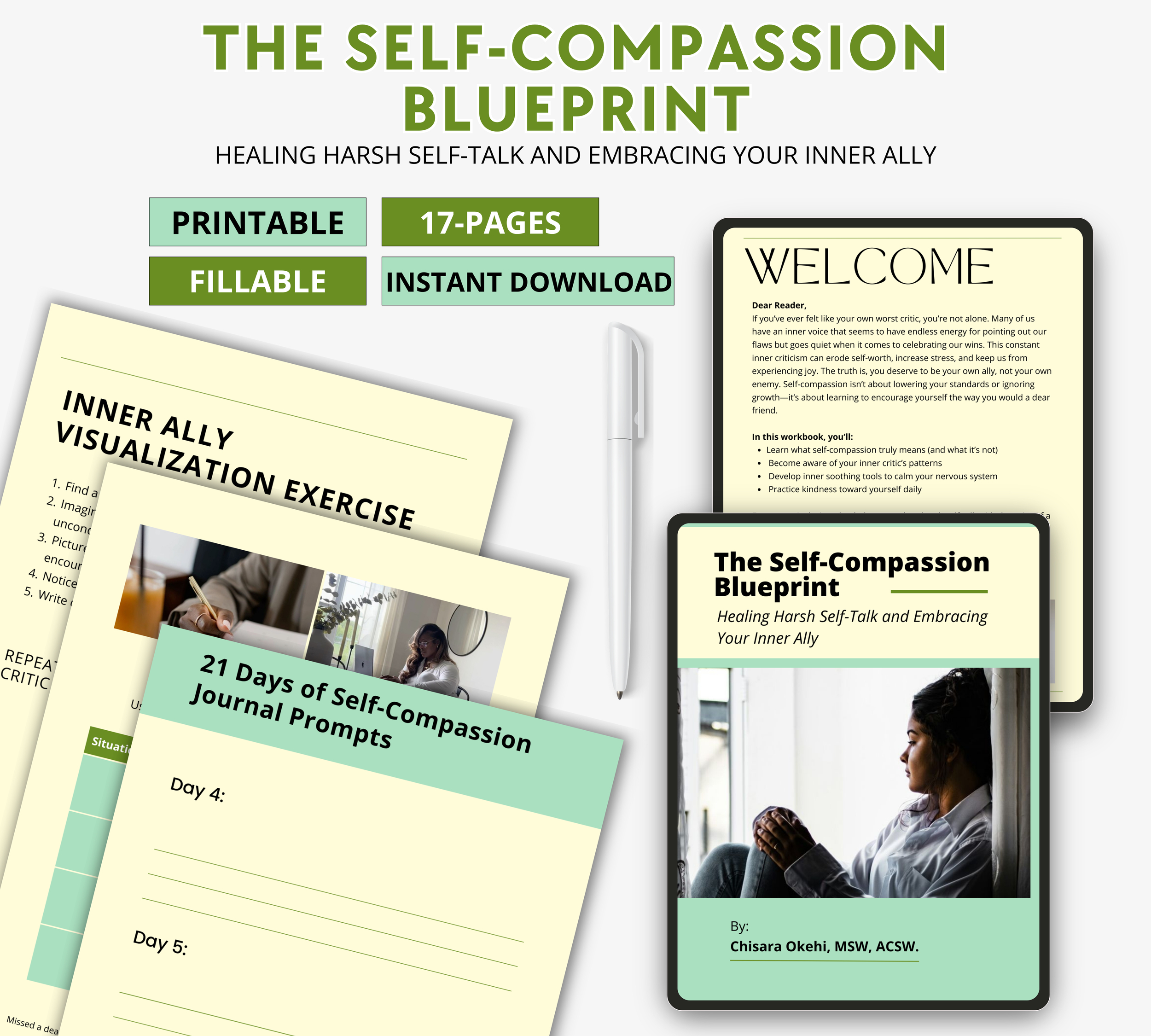

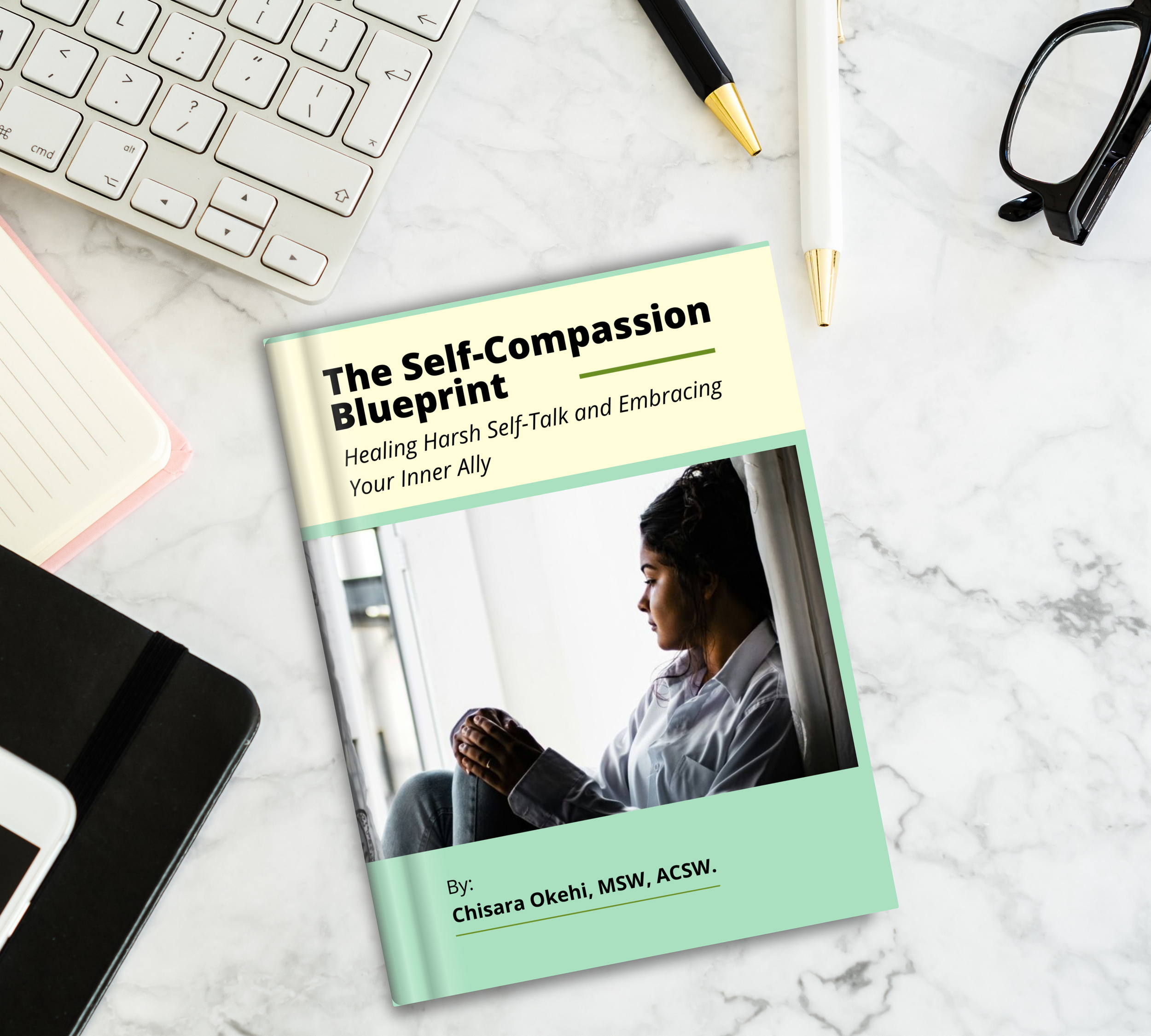
Many women live with an inner critic that is relentless, unforgiving, and deeply internalized. This voice often develops as a survival response to trauma, criticism, or conditional love. Over time, it erodes self-worth, increases anxiety, and keeps healing just out of reach.
The Self-Compassion Blueprint was created to help you interrupt that cycle.
Written by Chisara Okehi, LCSW, a licensed clinical social worker, emotional wellness coach, and founder of Breakthrough Bliss LLC, this workbook integrates trauma-informed clinical care, neuroscience-based self-compassion research, and reflective practices. With over 15 years of experience supporting women through trauma recovery and emotional healing, Chisara guides you step by step in learning how to become your own inner ally rather than your harshest critic.
Self-compassion is not self-indulgence.
It is emotional safety, accountability, and care working together.
✔ A clear explanation of what self-compassion is and what it is not, grounded in research by Kristin Neff (page 4)
✔ Education on the three core elements of self-compassion: self-kindness, common humanity, and mindfulness
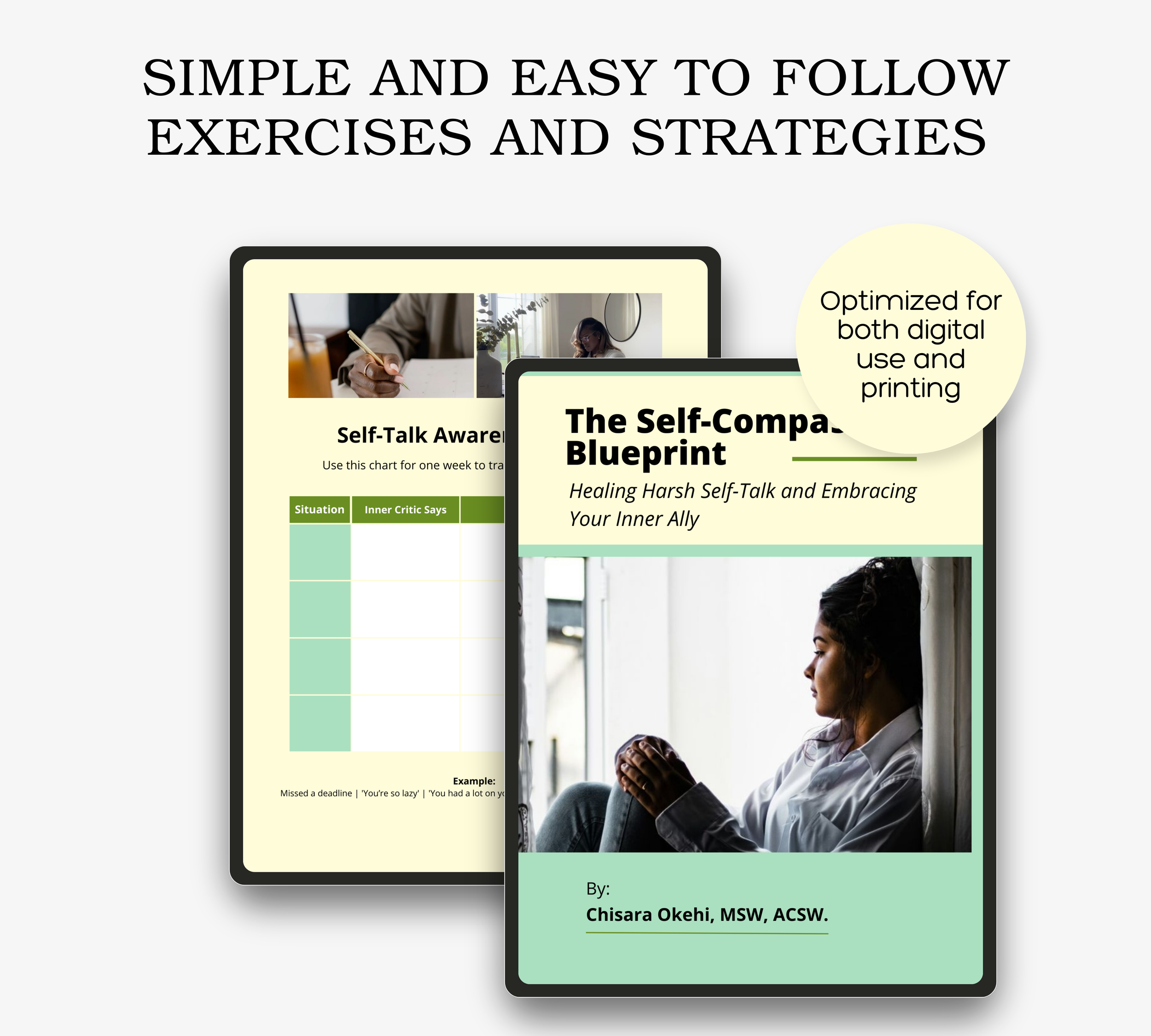
✔ A Self-Talk Awareness Chart to track inner critic language and practice reframing with an inner ally (page 5)
✔ An Inner Ally Visualization Exercise to support nervous system soothing and emotional regulation (page 6)
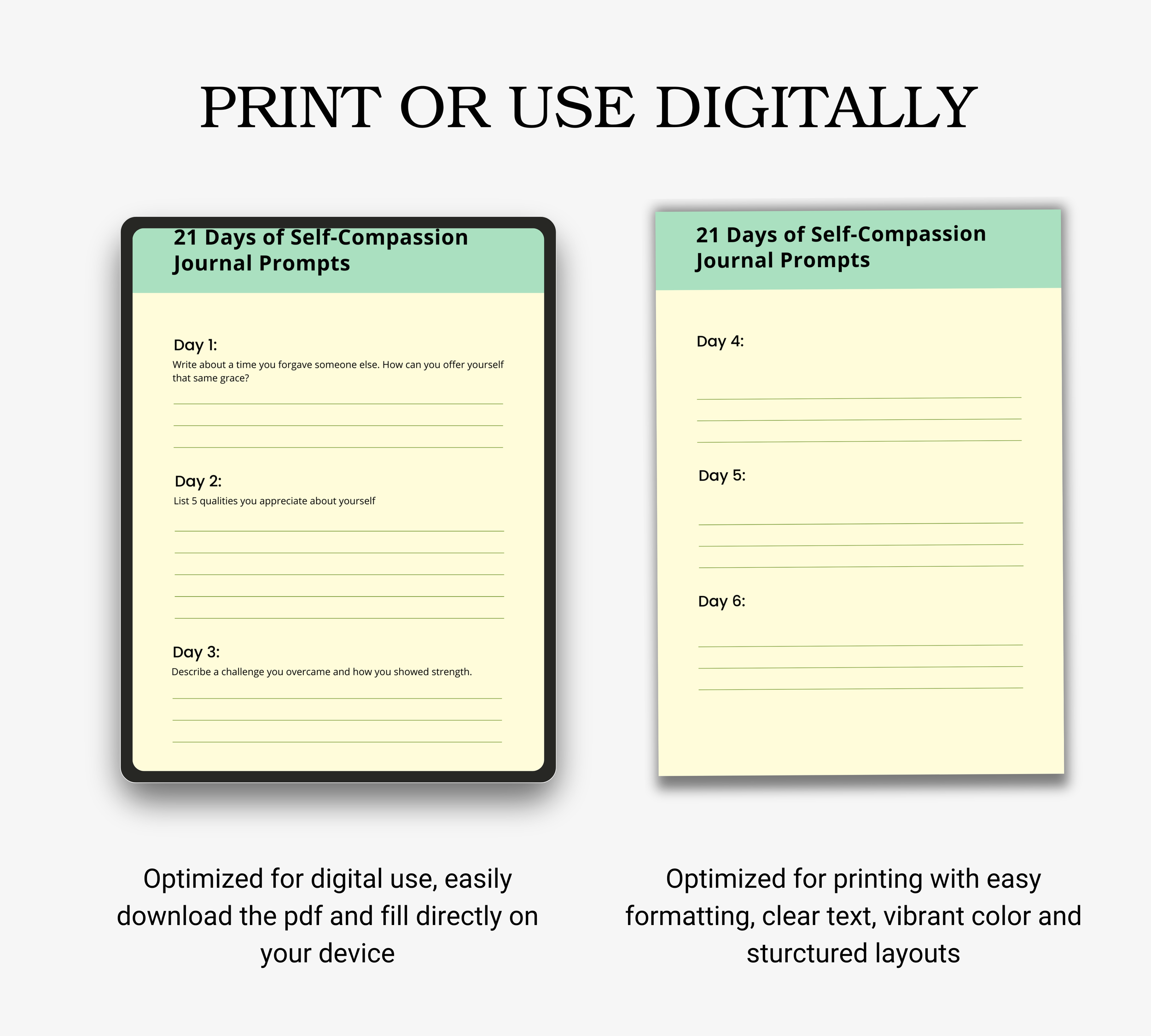
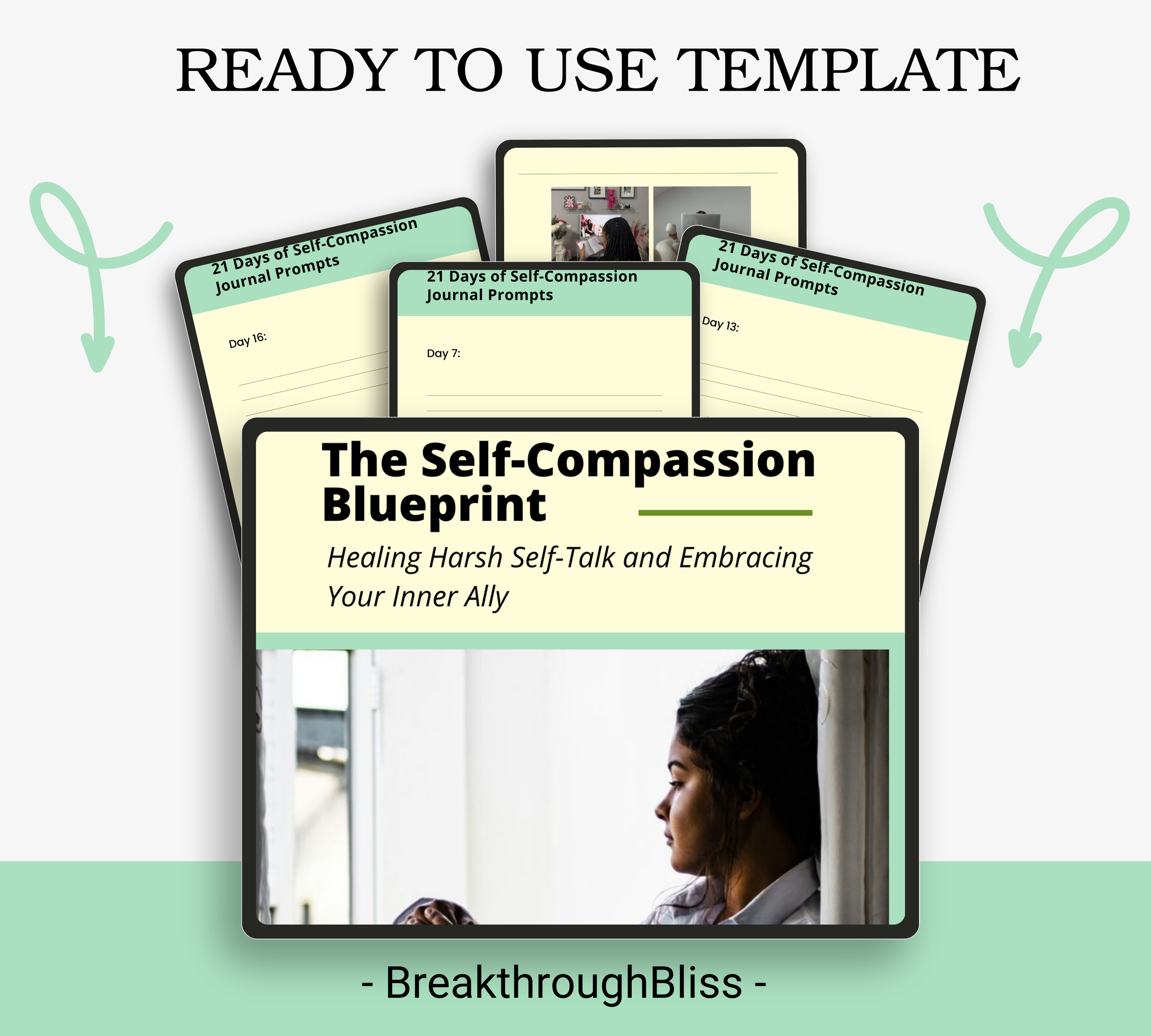
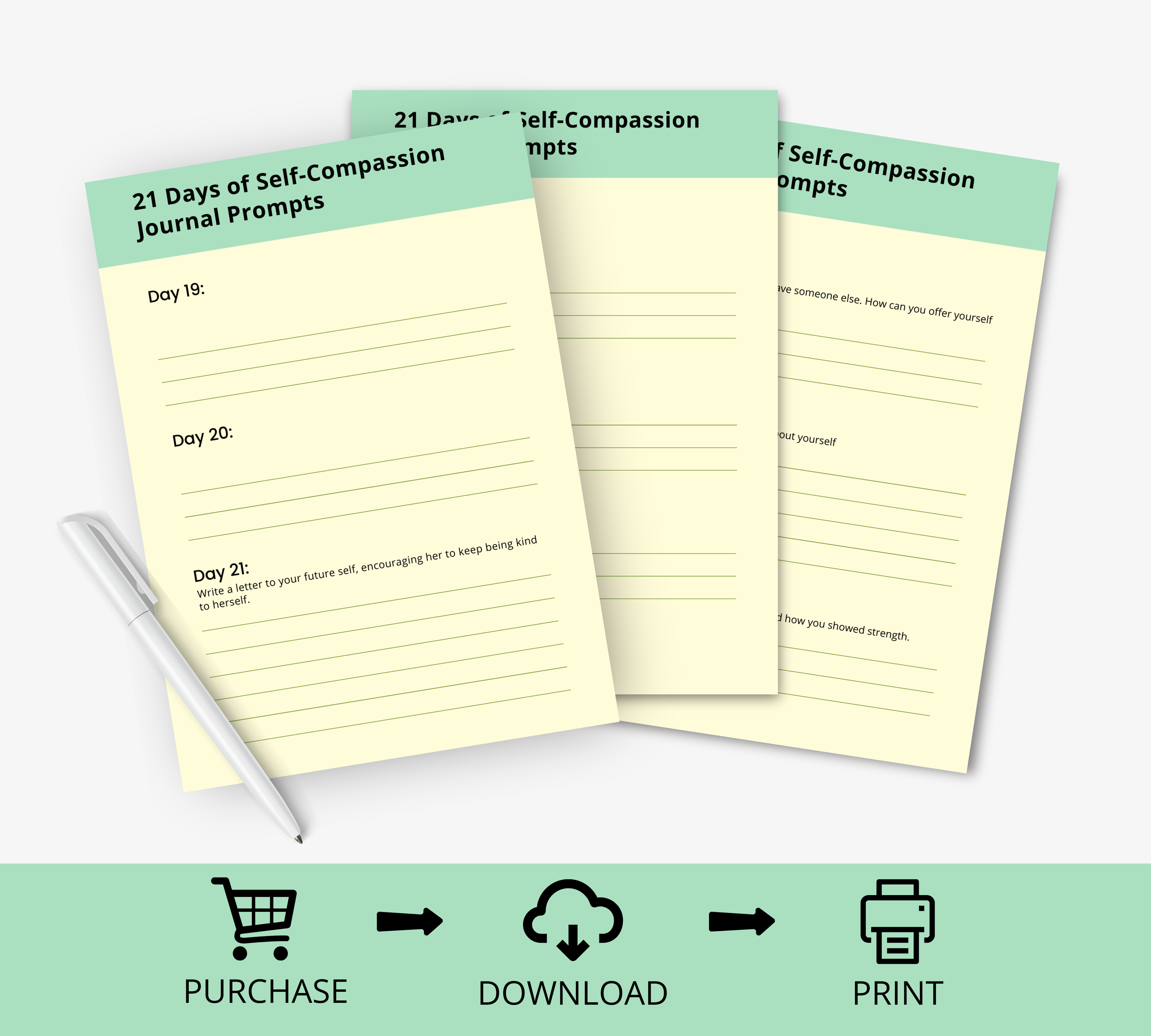
✔ A structured 21-Day Self-Compassion Journaling Practice to build consistency and emotional rewiring (pages 7–13)
✔ Daily mirror work practices to reinforce worth, safety, and self-trust (page 14)
✔ Compassion-focused affirmations to soften self-judgment and strengthen inner support (page 15)
✔ A Mind-Body-Soul self-care menu to integrate compassion into daily life (page 16)
✔ Curated book and app recommendations to support continued growth (page 17)
Each exercise is intentionally paced to support awareness without overwhelm.
This workbook is for women who:
• Struggle with harsh self-talk or chronic self-criticism
• Feel shame when they make mistakes or fall short
• Want to heal trauma without self-punishment
• Are learning to regulate their nervous system with kindness
• Desire accountability without cruelty
• Want self-compassion that is practical, grounded, and evidence-based
This is not surface-level self-love or motivational affirmations.
The Self-Compassion Blueprint is grounded in trauma-informed clinical practice and neuroscience. It recognizes that self-criticism often developed as protection and offers tools that honor that history while gently creating change.
The tone is validating, steady, and emotionally safe. No toxic positivity. No bypassing. No pressure to “fix yourself.”
• Digital fillable PDF workbook
• Immediate download after purchase
• Printable or usable on your device
• 17 thoughtfully designed pages
• Can be used independently or alongside therapy or coaching
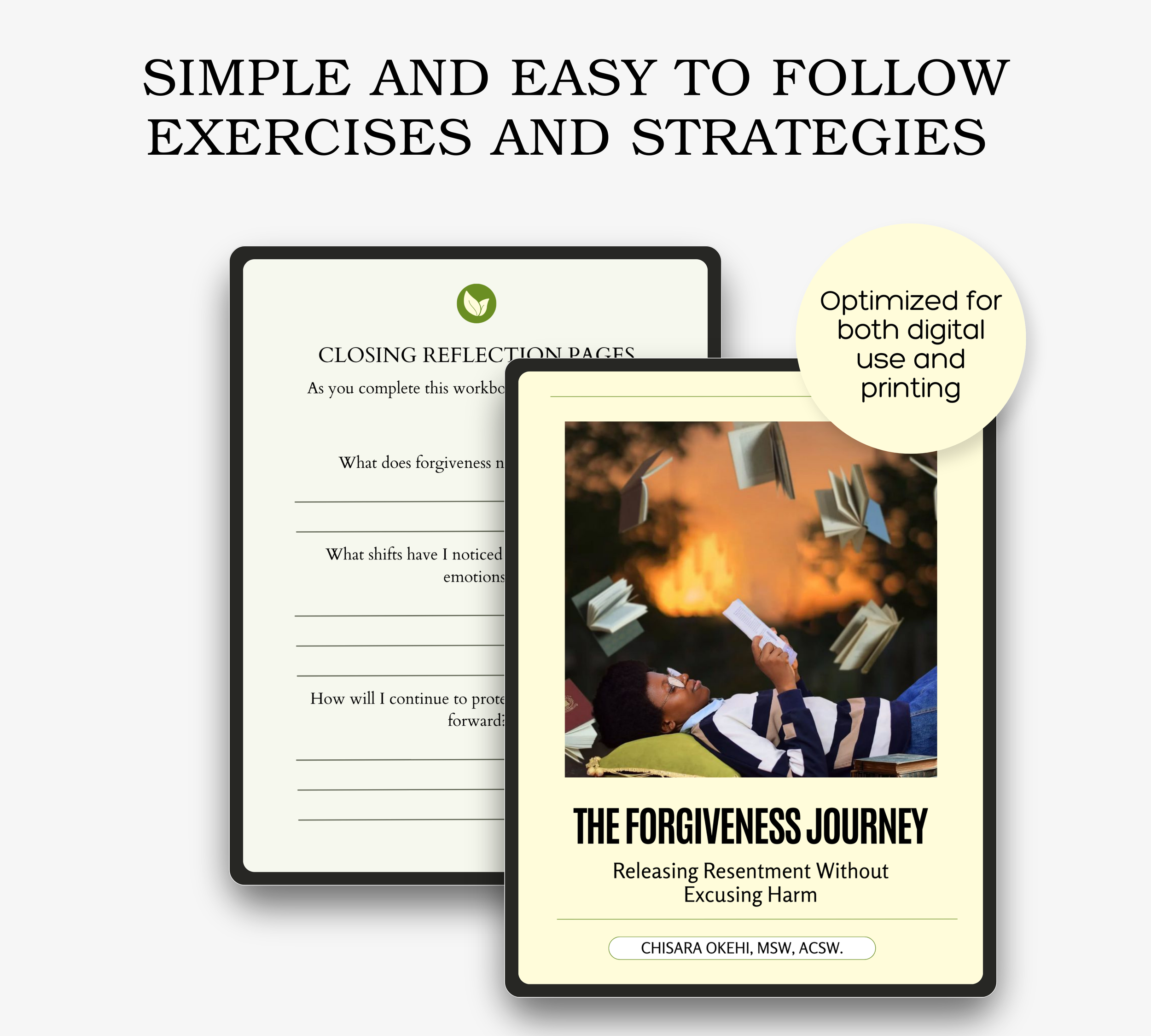
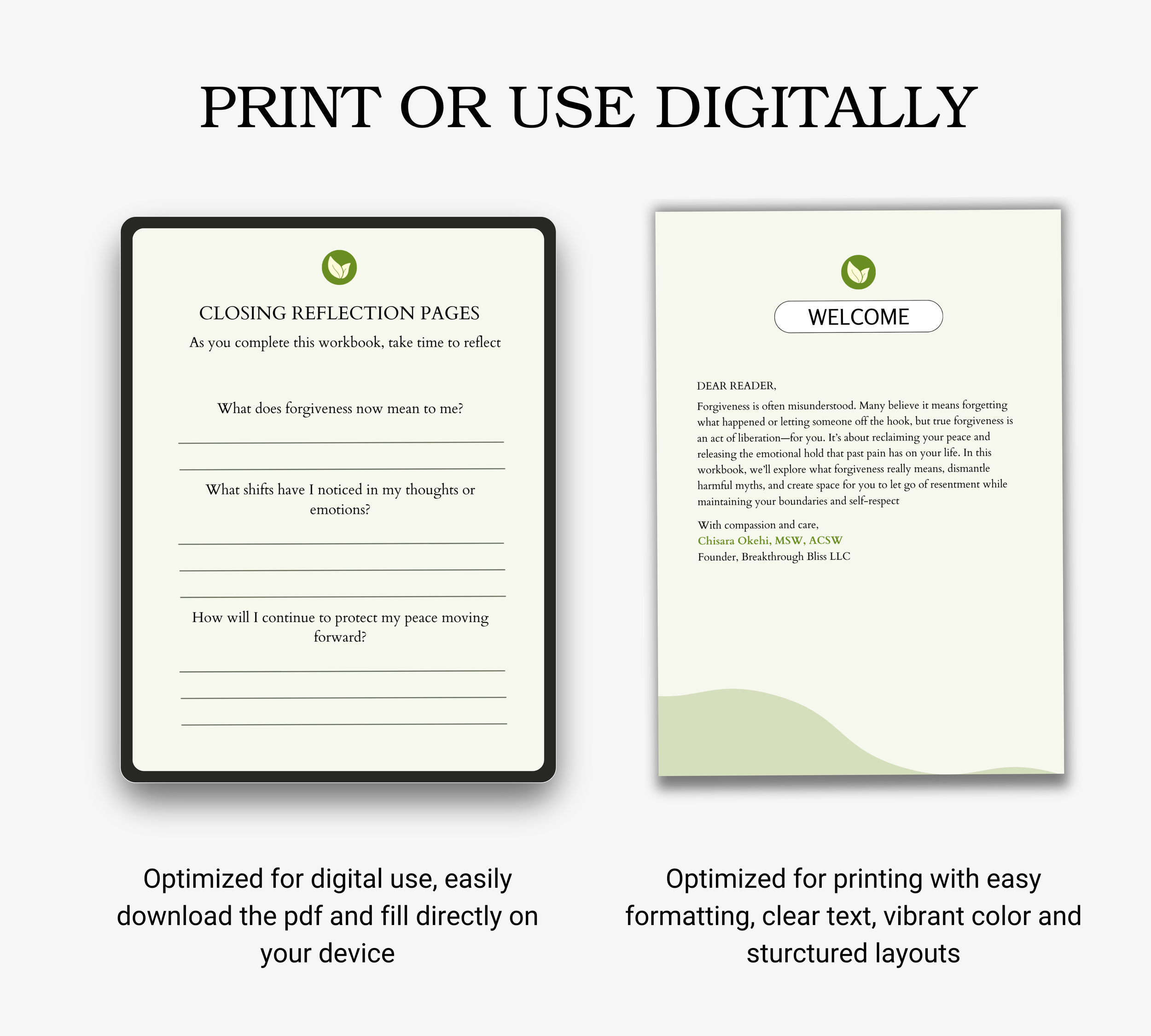
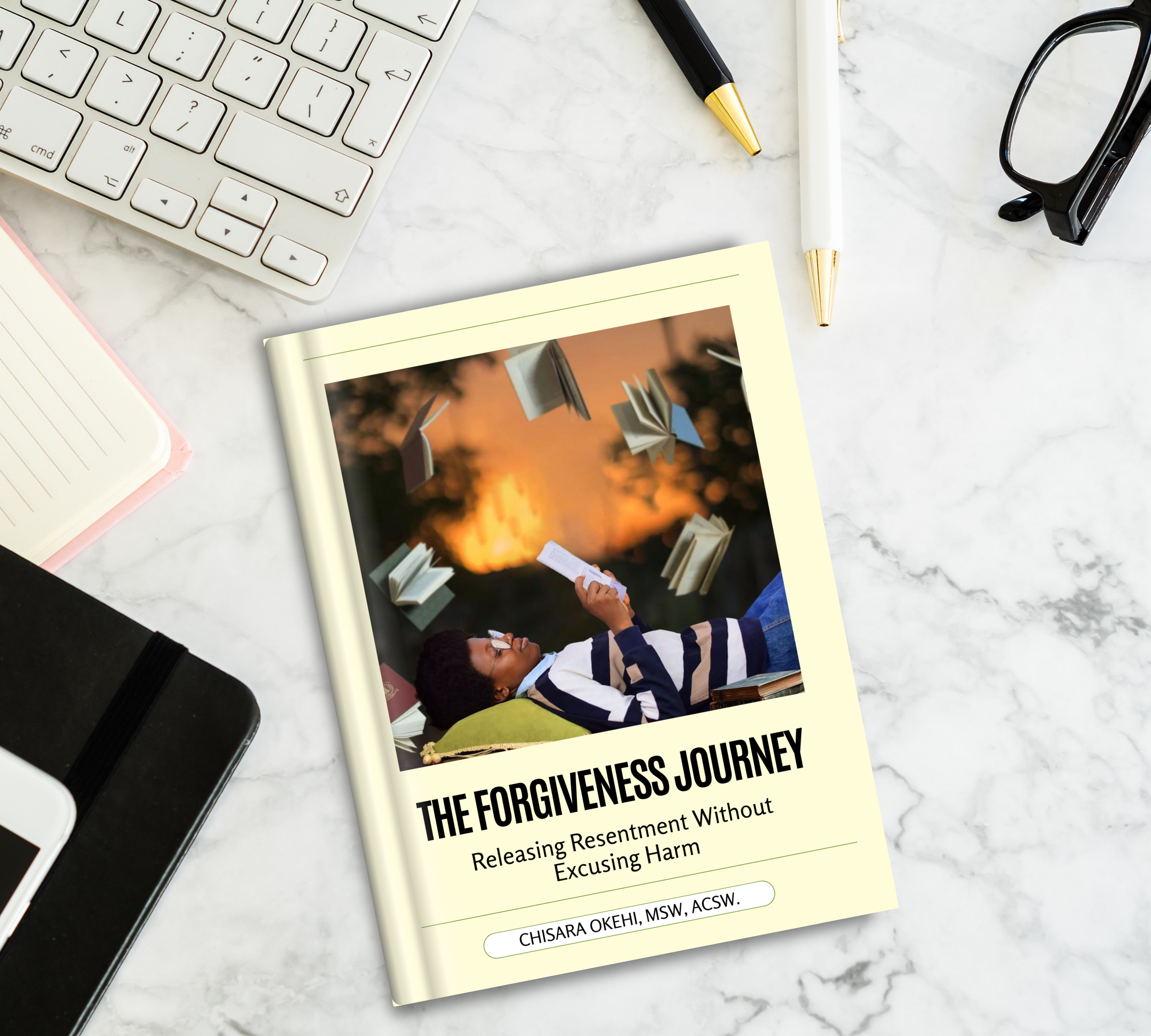
Forgiveness is one of the most misunderstood concepts in healing. Many people are pressured to forgive before they feel safe, validated, or ready, often leaving them emotionally stuck and retraumatized.
The Forgiveness Journey was created to change that narrative.
Written by Chisara Okehi, LCSW, a licensed clinical social worker, emotional wellness coach, and founder of Breakthrough Bliss LLC, this workbook offers a grounded, compassionate approach to forgiveness that prioritizes emotional safety, autonomy, and self-respect. With over 15 years of experience supporting women through trauma recovery, grief, and relational wounds, Chisara guides readers through forgiveness as an act of self-liberation, not obligation.
This workbook makes one thing clear:
You can release resentment without excusing harm, forgetting what happened, or reconnecting with someone unsafe.
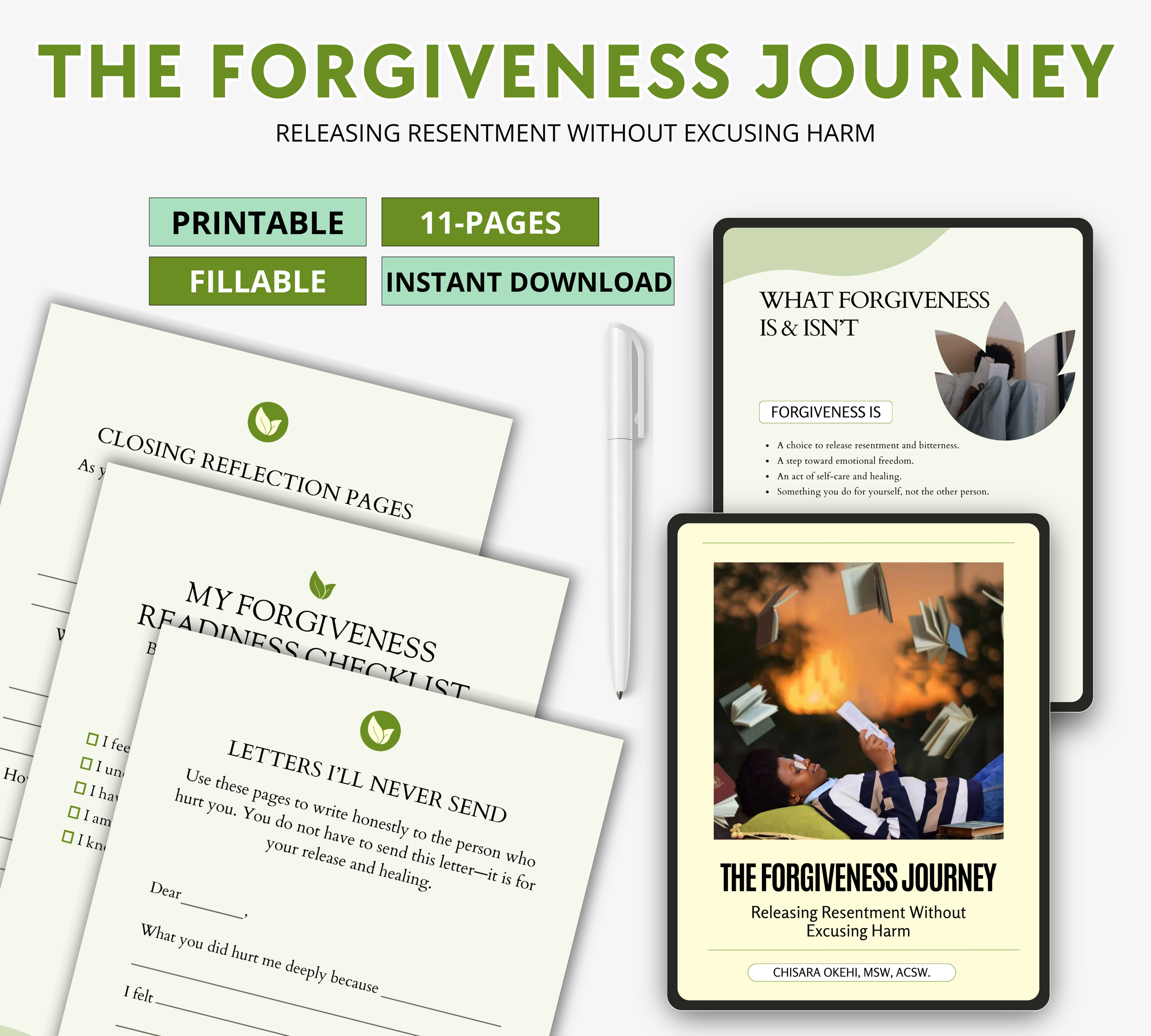
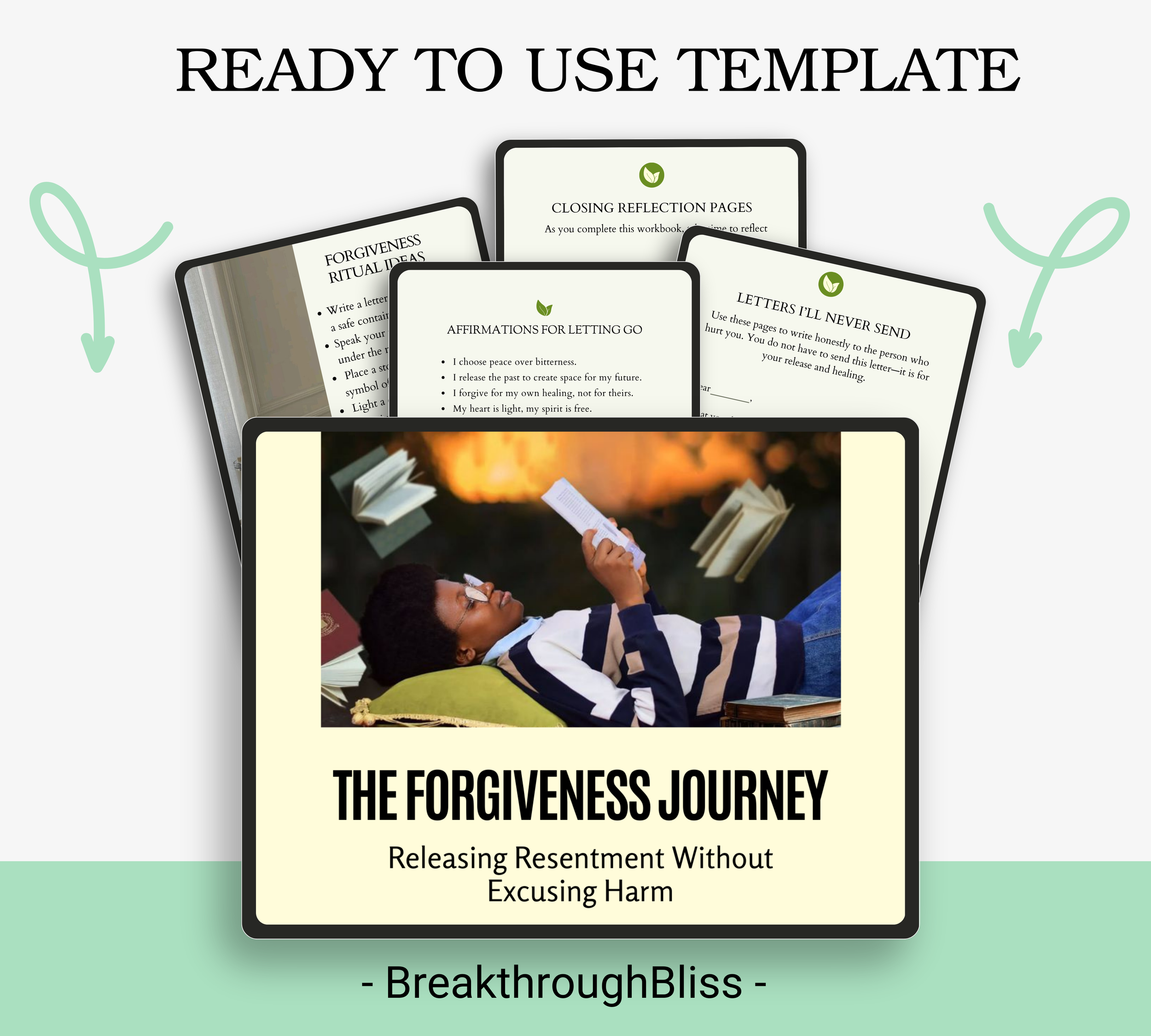
✔ A clear breakdown of what forgiveness is and is not to dismantle harmful myths (page 4)
✔ A Forgiveness Readiness Checklist to assess emotional safety and boundaries before beginning (page 5)
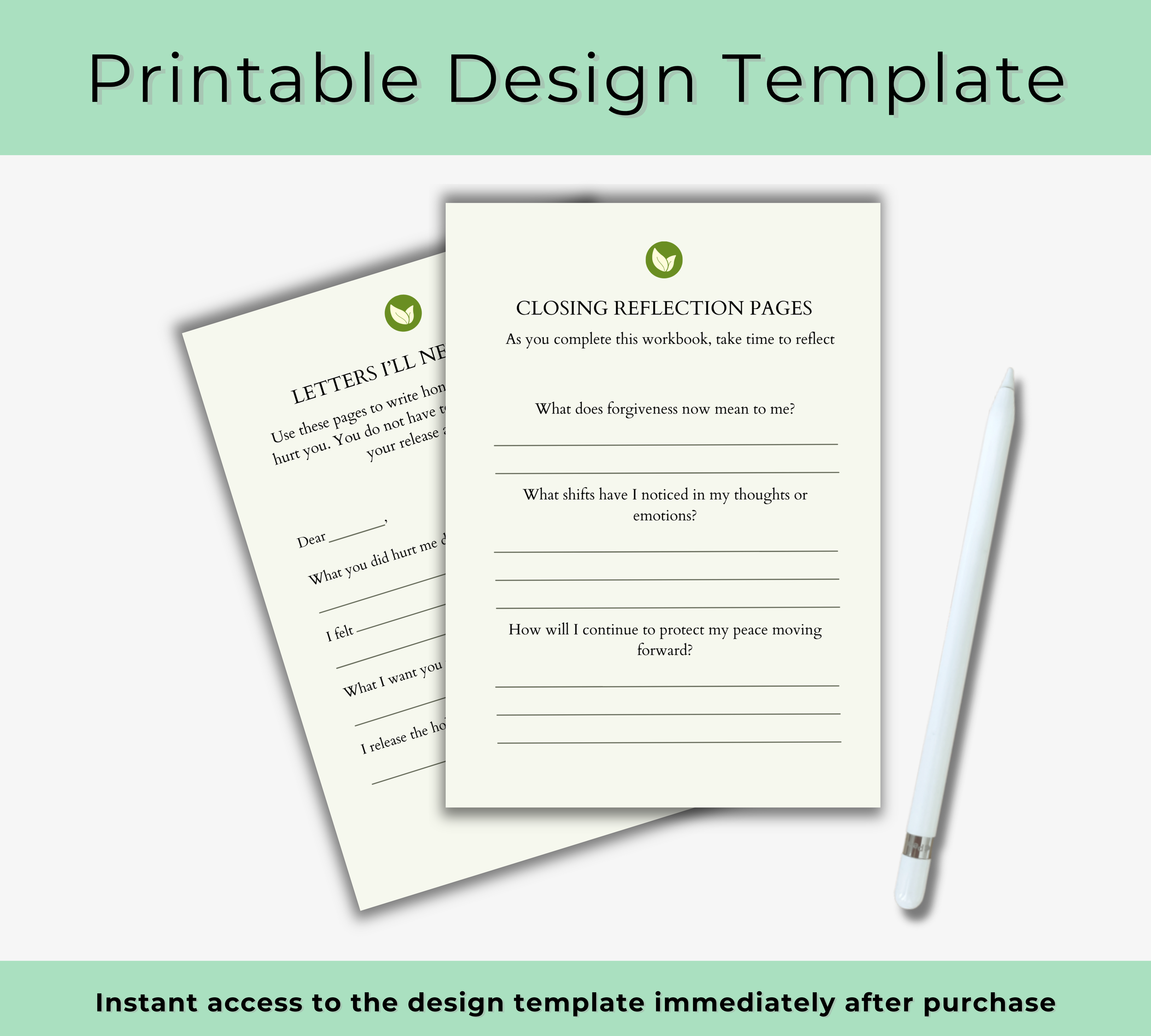
✔ Guided “Letters I’ll Never Send” exercises to express anger, grief, and truth without retraumatization (page 6)
✔ A trauma-informed guided meditation for emotional release and nervous system regulation (page 7)
✔ Forgiveness ritual ideas to symbolically release emotional ties in ways that feel grounding and safe (page 8)
✔ Affirmations to support letting go while protecting your peace (page 9)
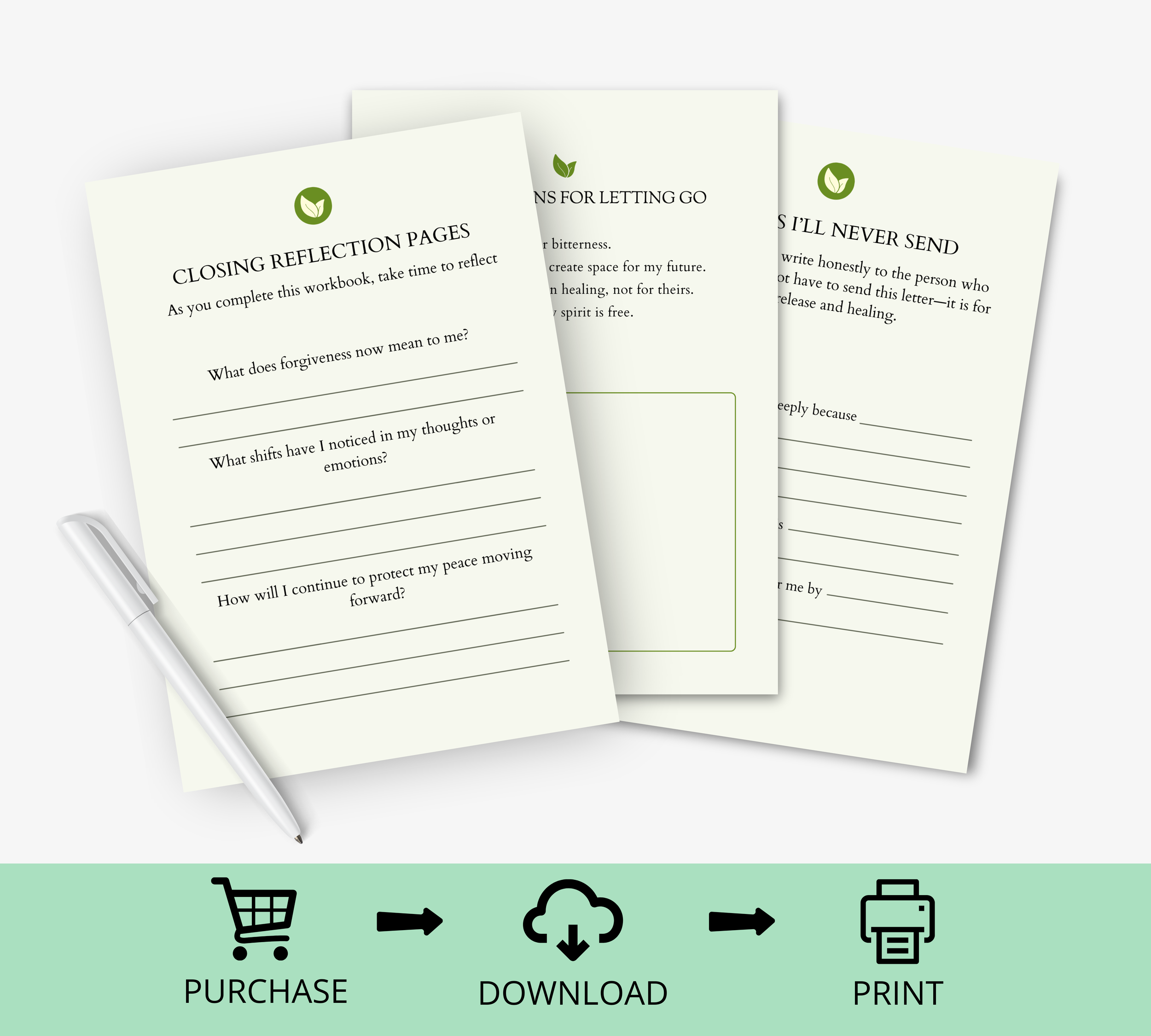
✔ Closing reflection prompts to integrate forgiveness into daily life without self-betrayal (page 10)
✔ Curated book, app, and therapeutic support recommendations for continued healing (page 11)
Each section is intentionally paced to honor emotional readiness and personal choice.
This workbook is for women who:
• Carry resentment, anger, or unresolved emotional pain
• Feel pressured to forgive before they feel ready
• Want peace without minimizing what they endured
• Are healing from relational trauma, betrayal, or abuse
• Need forgiveness framed as self-care, not obligation
• Want a trauma-informed, clinically grounded approach
This is not spiritual bypassing or forced forgiveness.
The Forgiveness Journey is grounded in trauma-informed clinical principles and explicitly states that forgiveness does not require forgetting, reconciliation, or excusing harm. The workbook centers boundaries, emotional safety, and self-agency.
The tone is validating, empowering, and deeply respectful of lived experience.
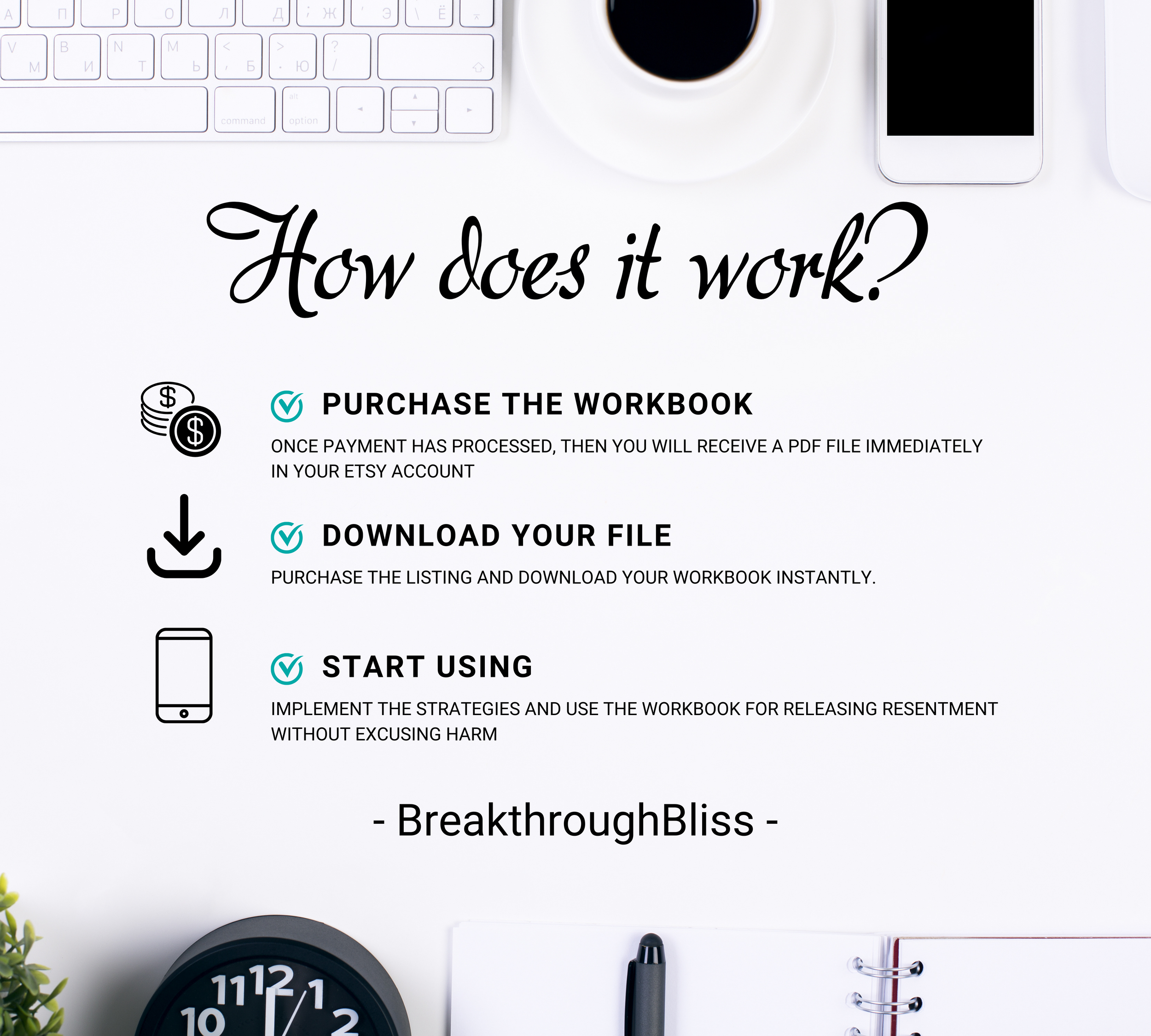
• Digital fillable PDF workbook
• Immediate download after purchase
• Printable or usable on your device
• 11 thoughtfully designed pages
• Can be used independently or alongside therapy or coaching


Many Black women carry invisible burdens rooted in childhood trauma, unmet emotional needs, and survival roles that required strength at a young age. Over time, this can turn inward, becoming self-blame, harsh inner criticism, and difficulty offering oneself grace.
From Pain to Peace was created to interrupt that cycle.
Written by Chisara Okehi, LCSW, this workbook blends trauma-informed care, self-compassion practices, and culturally attuned reflection to help you explore your past without judgment and move toward peace with intention.
This workbook does not ask you to excuse what happened or rush forgiveness.
It invites you to acknowledge your pain, honor your resilience, and choose compassion for yourself.
✔ Understanding what self-forgiveness truly means and why it matters in trauma healing
✔ Releasing guilt, shame, and self-blame rooted in childhood experiences
✔ Practicing radical acceptance without minimizing harm
✔ Creating a personal trauma timeline to identify patterns and resilience
✔ Writing letters to your inner child for healing and reconnection
✔ Reflective prompts to process emotions safely and honestly
✔ Affirmations designed to support self-compassion and emotional rewiring
✔ Gentle guidance to help you move forward at your own pace
Each exercise is designed to support healing that feels grounding, validating, and culturally affirming.
This workbook is for Black women who:
• Experienced childhood trauma, neglect, or emotional harm
• Carry guilt or shame for things that were never their fault
• Struggle with self-compassion or forgiveness toward themselves
• Want peace without denying their pain
• Are ready to soften their inner voice while honoring their strength
• Desire culturally responsive healing tools
This is not a generic self-help workbook.
From Pain to Peace centers Black women’s lived experiences and recognizes how trauma, systemic pressure, and survival intersect. It prioritizes emotional safety, cultural awareness, and compassion over quick fixes or forced positivity.
The tone is gentle, affirming, and grounded in clinical trauma-informed care.
• Digital fillable PDF workbook
• Immediate download after purchase
• Printable or usable on your device
• 9 thoughtfully designed pages
• Can be used independently or alongside therapy or coaching
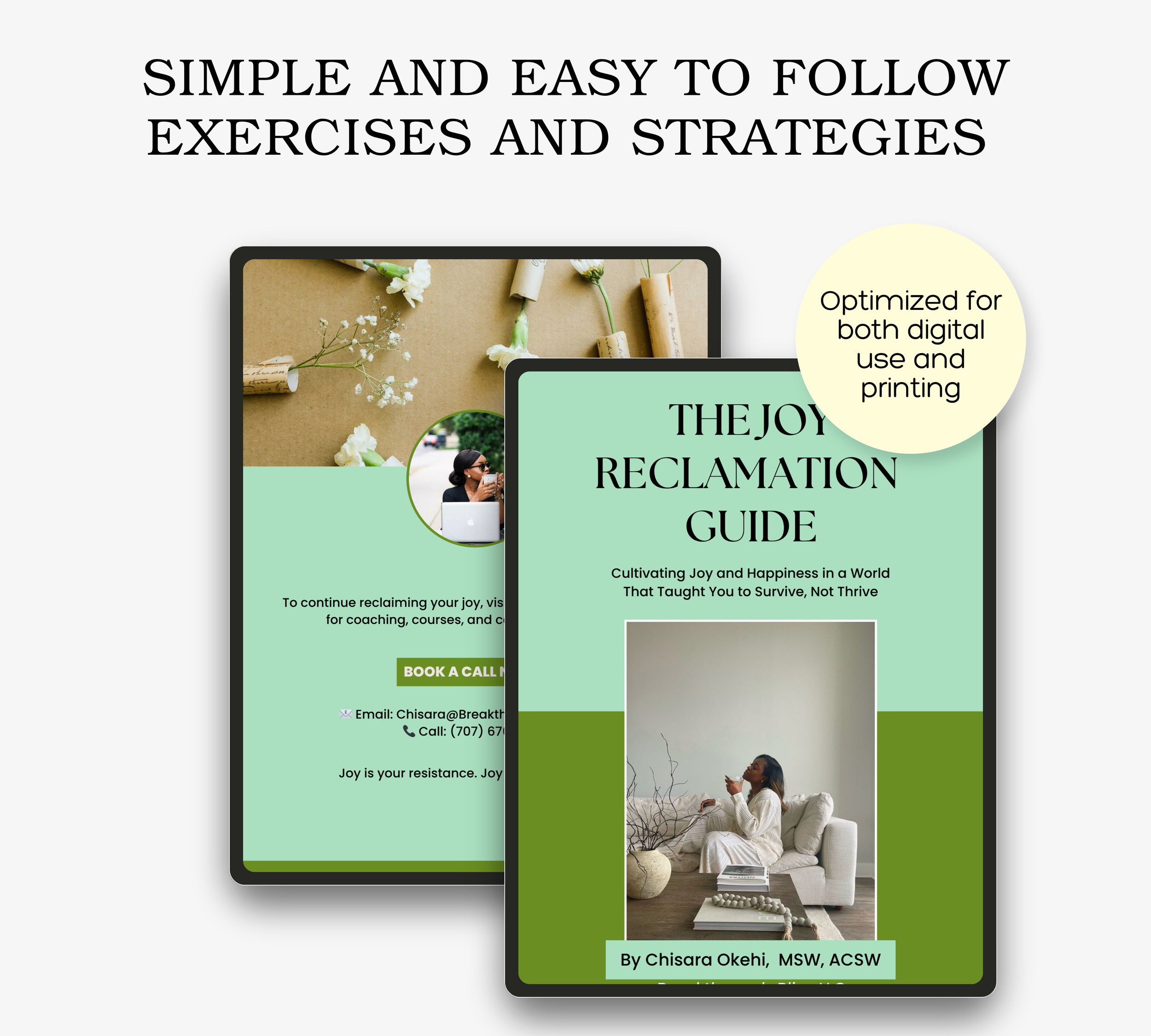

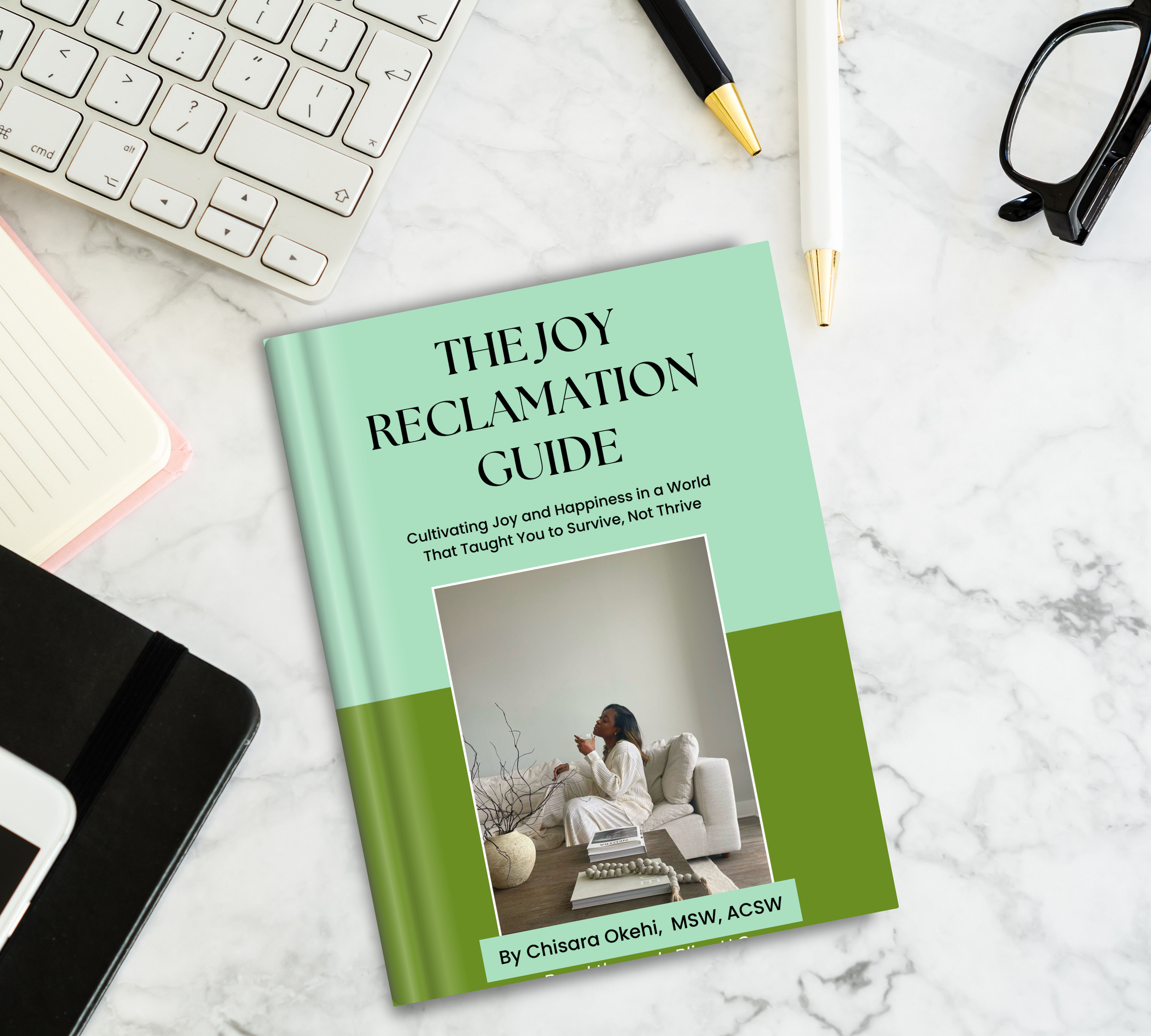
For many women, especially those shaped by trauma, responsibility, and chronic stress, joy can feel unfamiliar or even unsafe. Survival teaches the nervous system to stay alert, guarded, and prepared for threat. Pleasure becomes secondary. Happiness feels distant.
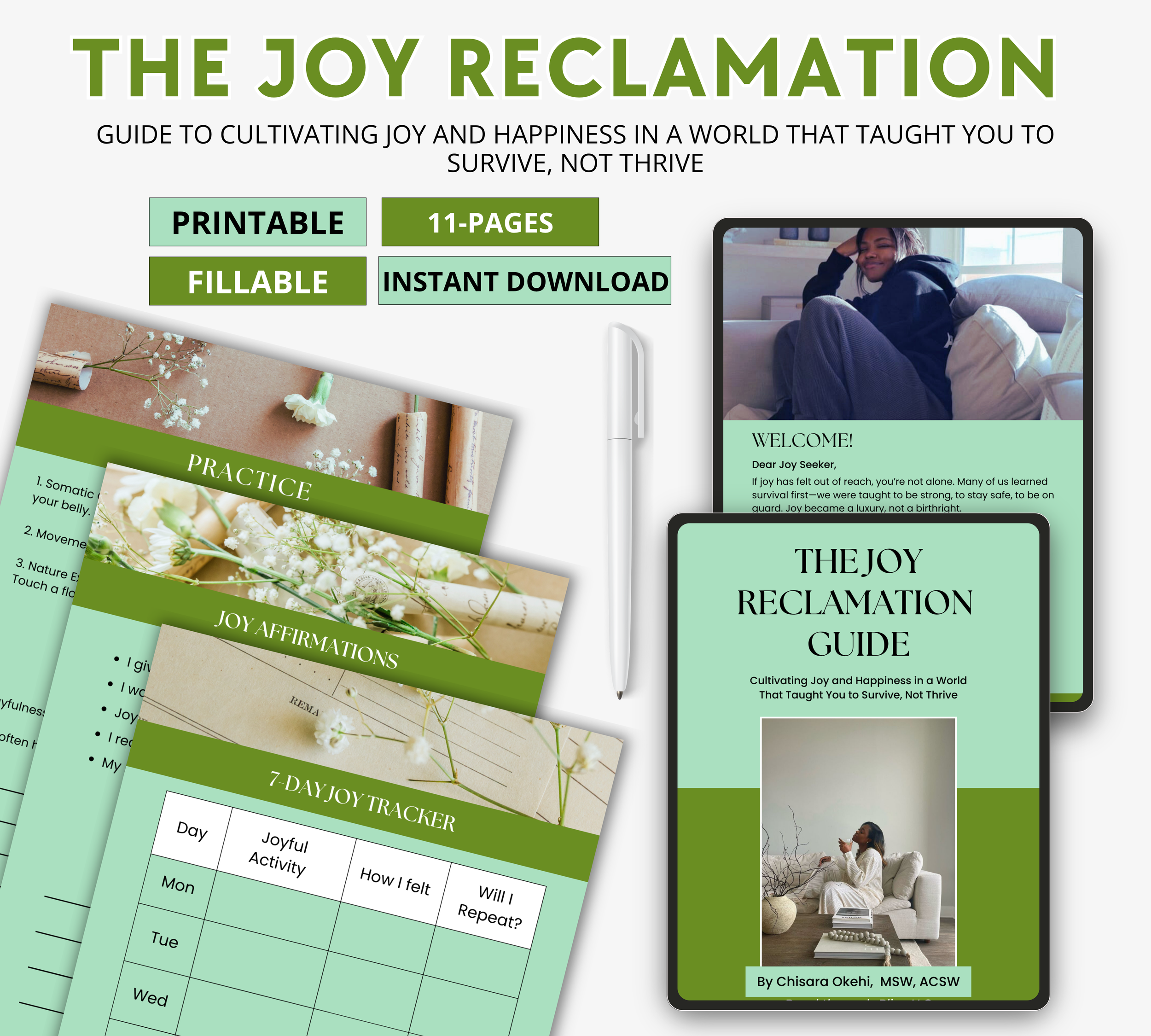
The Joy Reclamation Guide was created to help you slowly and safely reclaim joy as part of your healing.
Written by Chisara Okehi, LCSW, a licensed clinical social worker, emotional wellness coach, and founder of Breakthrough Bliss LLC, this workbook integrates trauma-informed neuroscience, nervous system regulation, and reflective practices. With over 15 years of experience supporting women through complex trauma, grief, and emotional exhaustion, Chisara reframes joy not as indulgence, but as resilience and repair.
This workbook does not force positivity.
It teaches your body that joy is safe again.
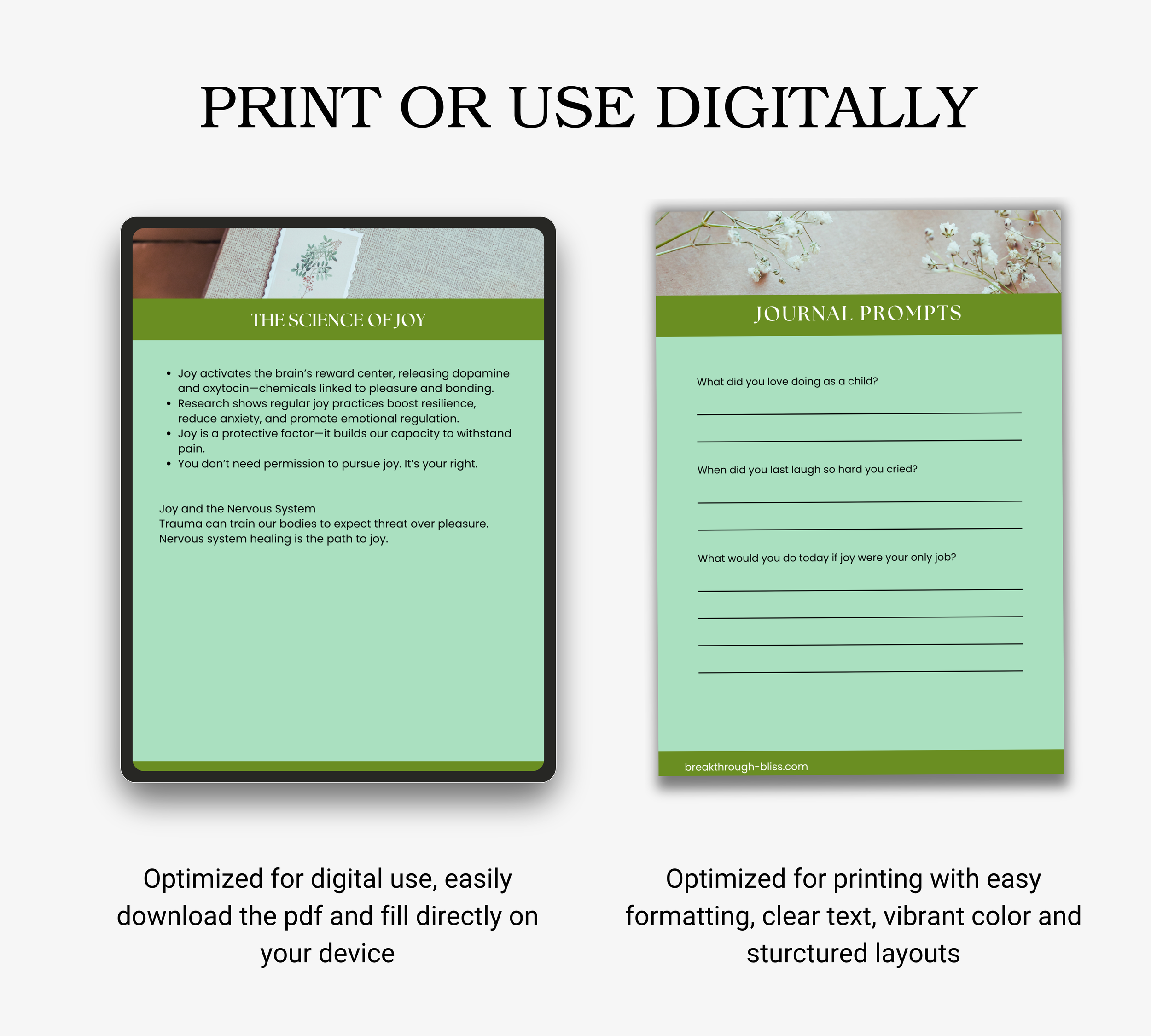
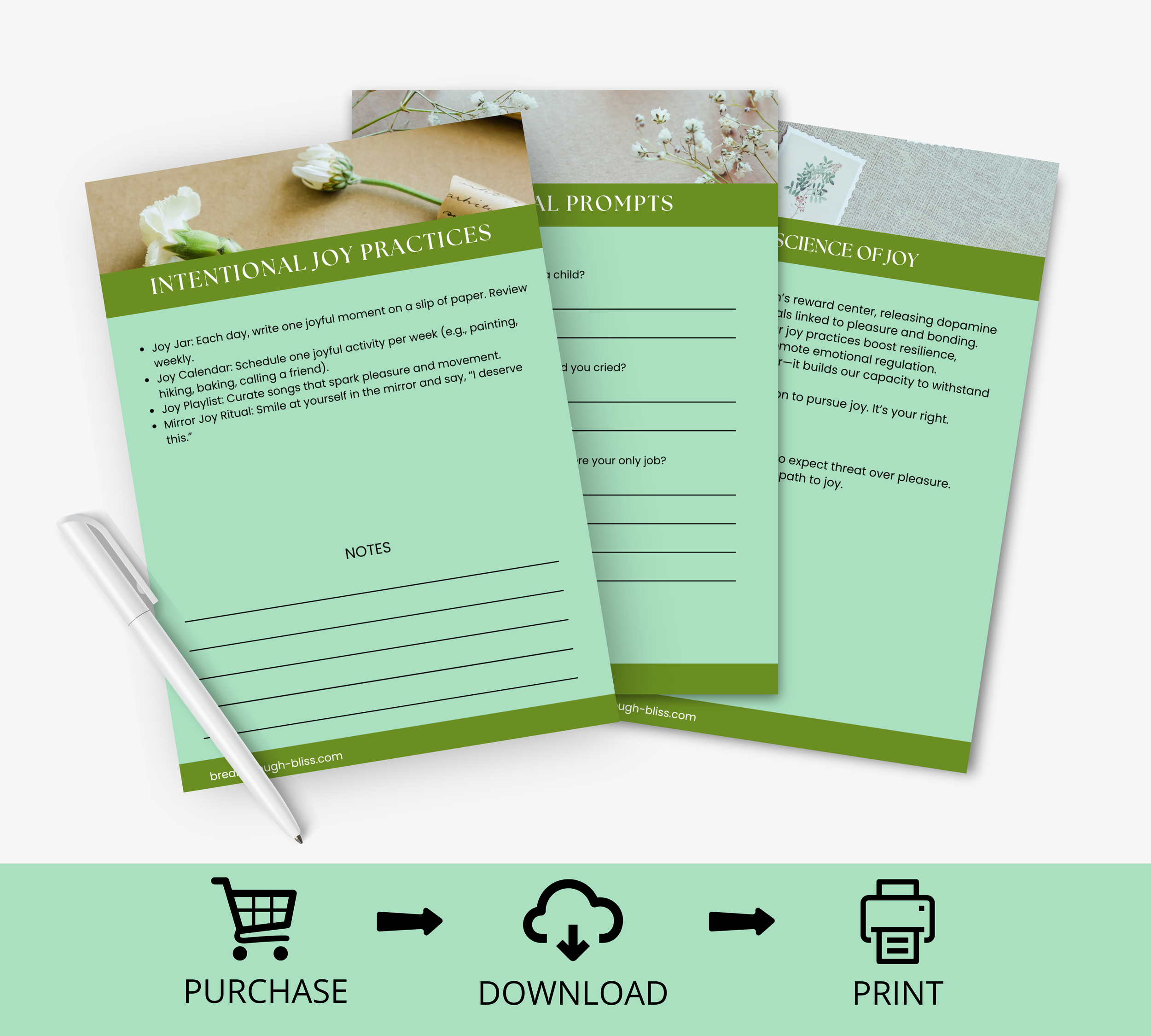
✔ An accessible explanation of the science of joy, including how joy activates dopamine and oxytocin and supports emotional regulation (page 4)
✔ Education on how trauma trains the nervous system to expect threat over pleasure
✔ Somatic grounding practices to help your body receive joy safely (page 5)
✔ Gentle movement, nature, and play-based exercises to reintroduce pleasure
✔ Reflective journaling prompts that reconnect you with laughter, curiosity, and childhood joy (page 6)
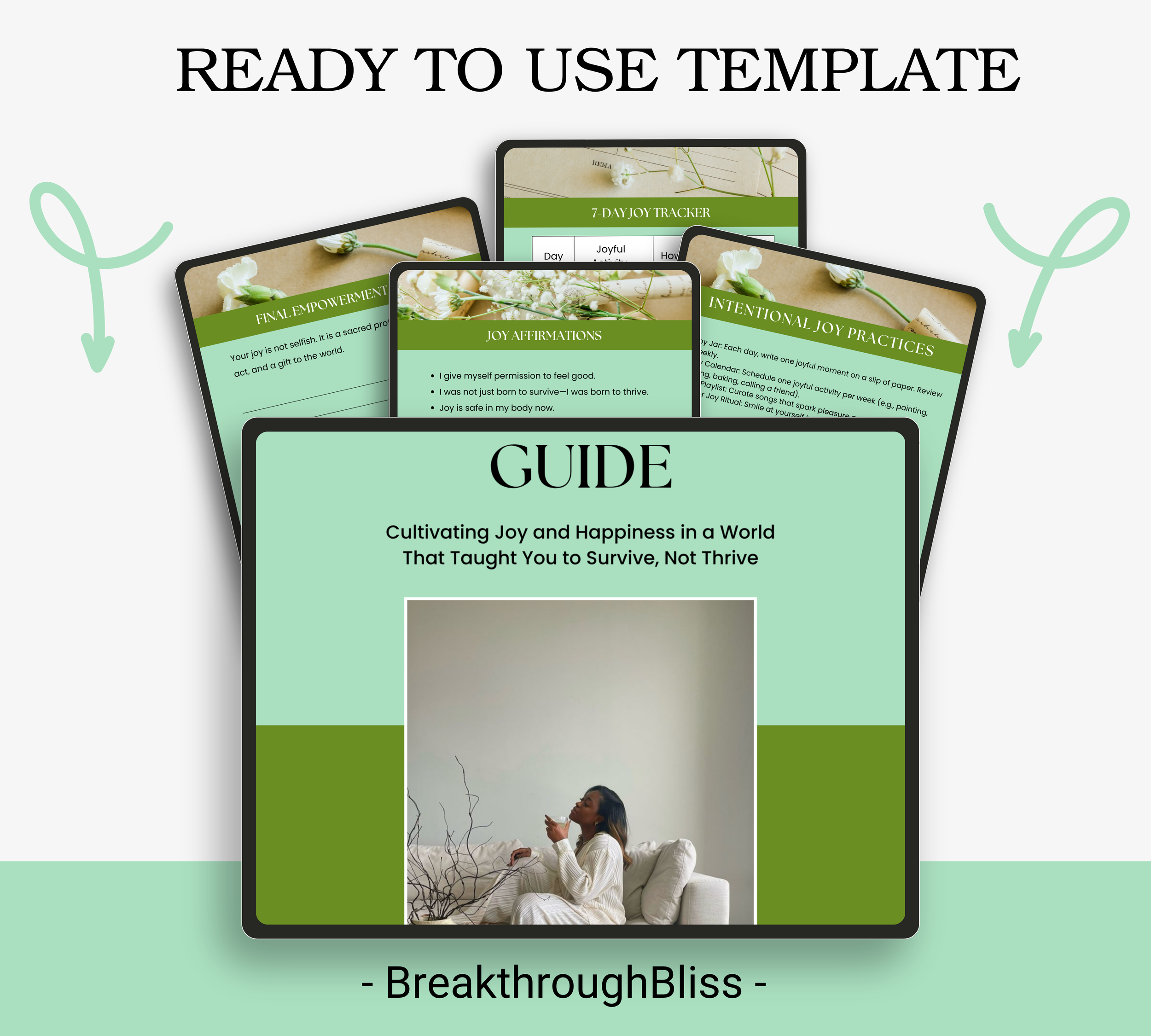
✔ Intentional joy practices such as a Joy Jar, Joy Calendar, playlist creation, and mirror rituals (page 7)
✔ A 7-Day Joy Tracker to help you notice how joy feels in your body and daily life (page 8)
✔ Affirmations that reinforce permission, worthiness, and delight (page 9)
✔ A final empowerment reflection reminding you that joy is resistance, healing, and self-honoring (page 10)
Each section is designed to move gently, honoring nervous system safety and emotional pacing.
This workbook is for women who:
• Feel emotionally exhausted or disconnected from joy
• Learned to prioritize survival, responsibility, and strength
• Struggle to rest or experience pleasure without guilt
• Want joy that feels embodied, not forced
• Are healing from trauma, burnout, or chronic stress
• Desire happiness that is sustainable and self-directed
This is not a “think positive” guide.
The Joy Reclamation Guide is grounded in trauma-informed clinical care and neuroscience. It recognizes that joy must be felt in the body, not just understood intellectually. The tone is gentle, validating, and culturally aware, with no pressure to bypass pain or perform happiness.
• Digital fillable PDF workbook
• Immediate download after purchase
• Printable or usable on your device
• 11 thoughtfully designed pages
• Can be used independently or alongside therapy or coaching
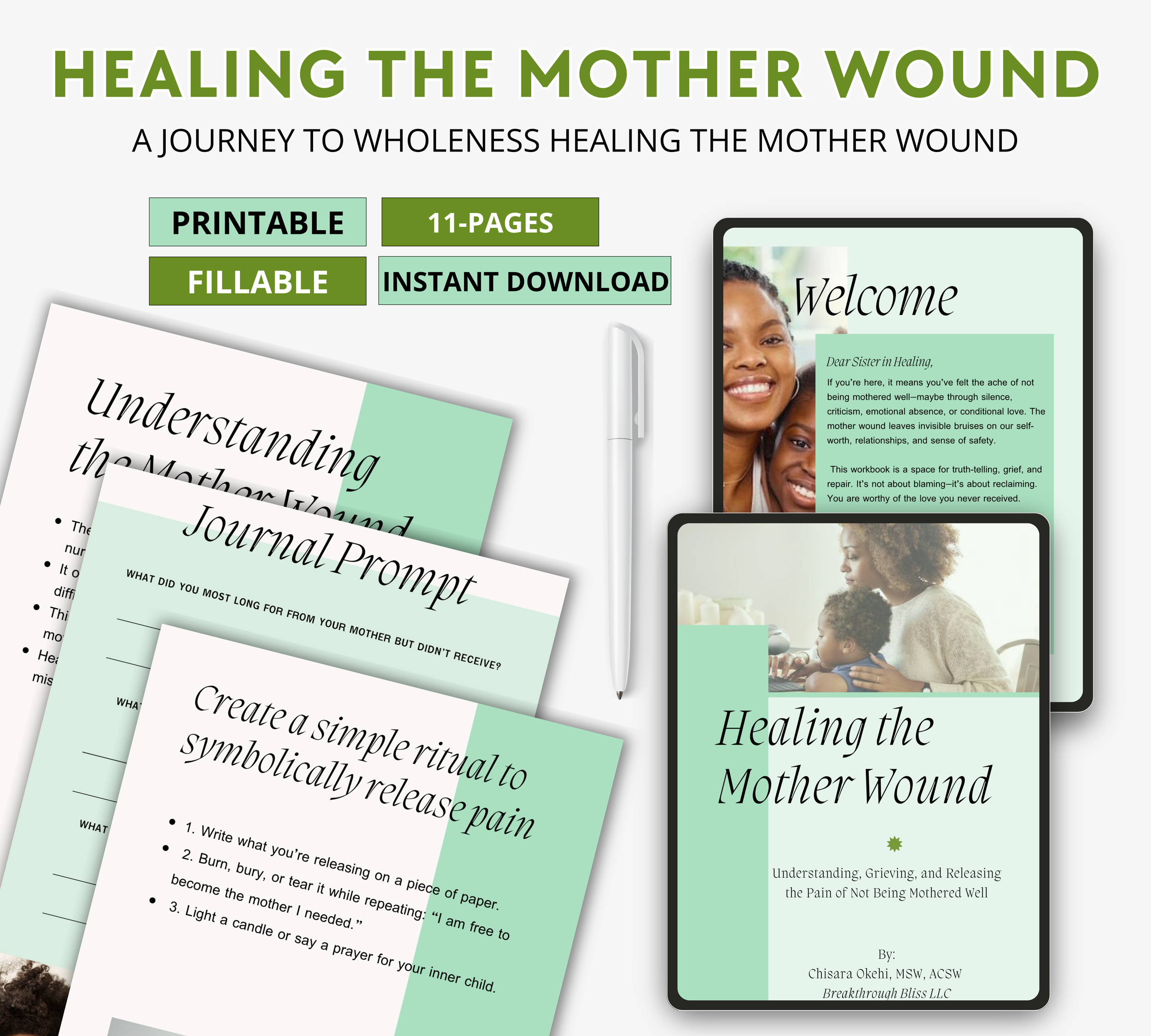
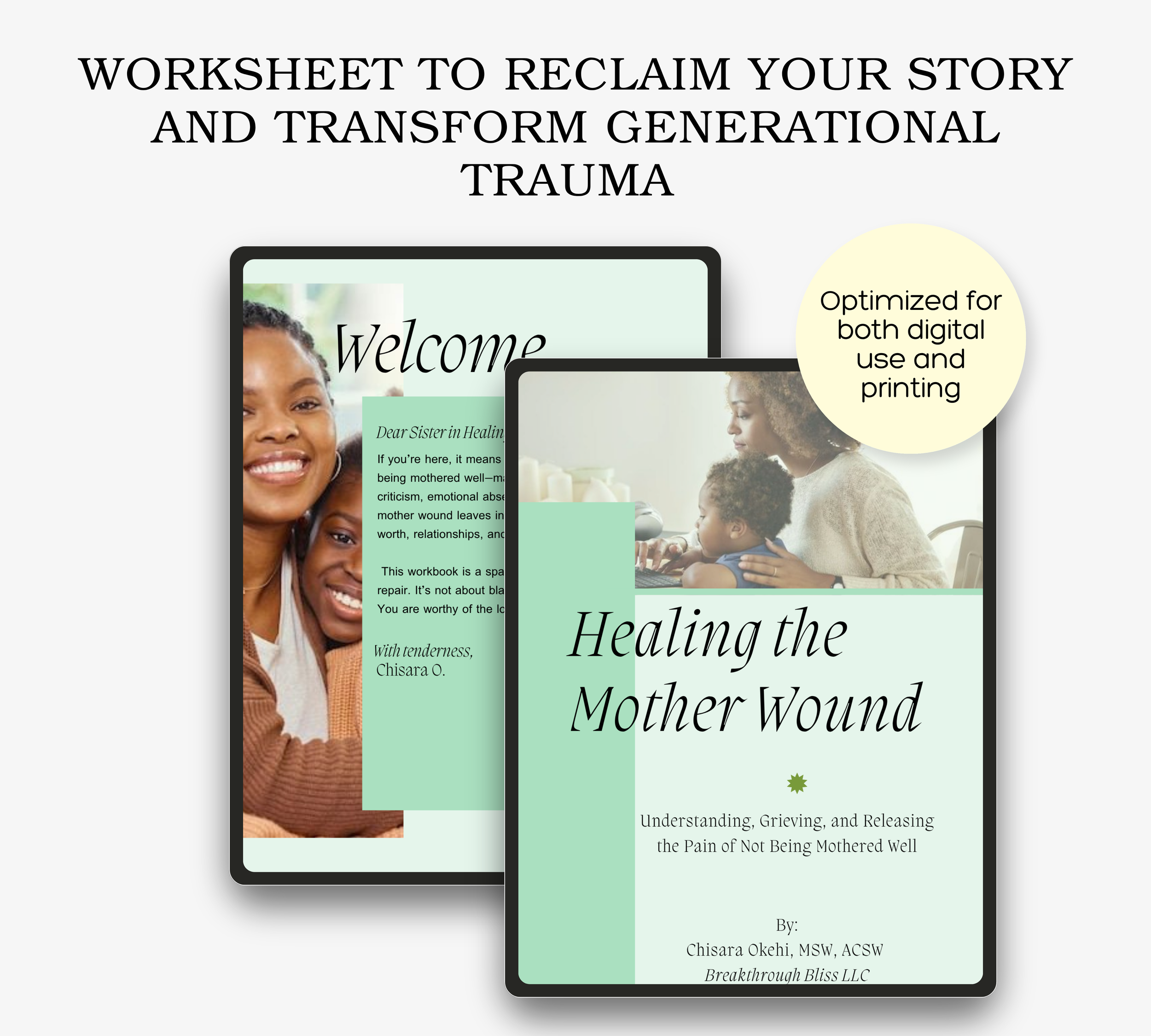
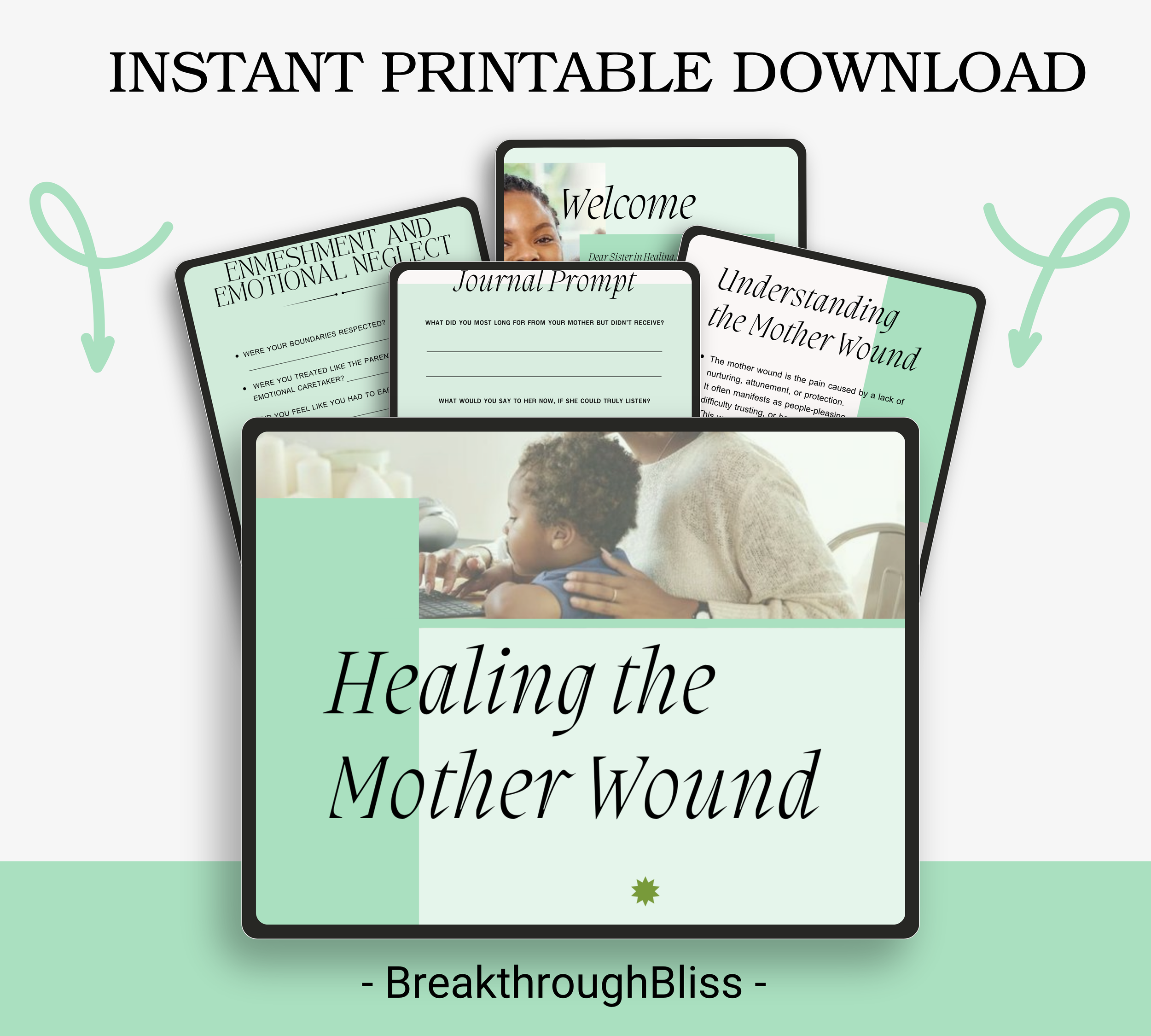

The mother wound forms when a child does not receive consistent emotional safety, protection, or unconditional love. It may show up later as people-pleasing, perfectionism, harsh inner criticism, difficulty trusting, or feeling like love must be earned rather than freely given.
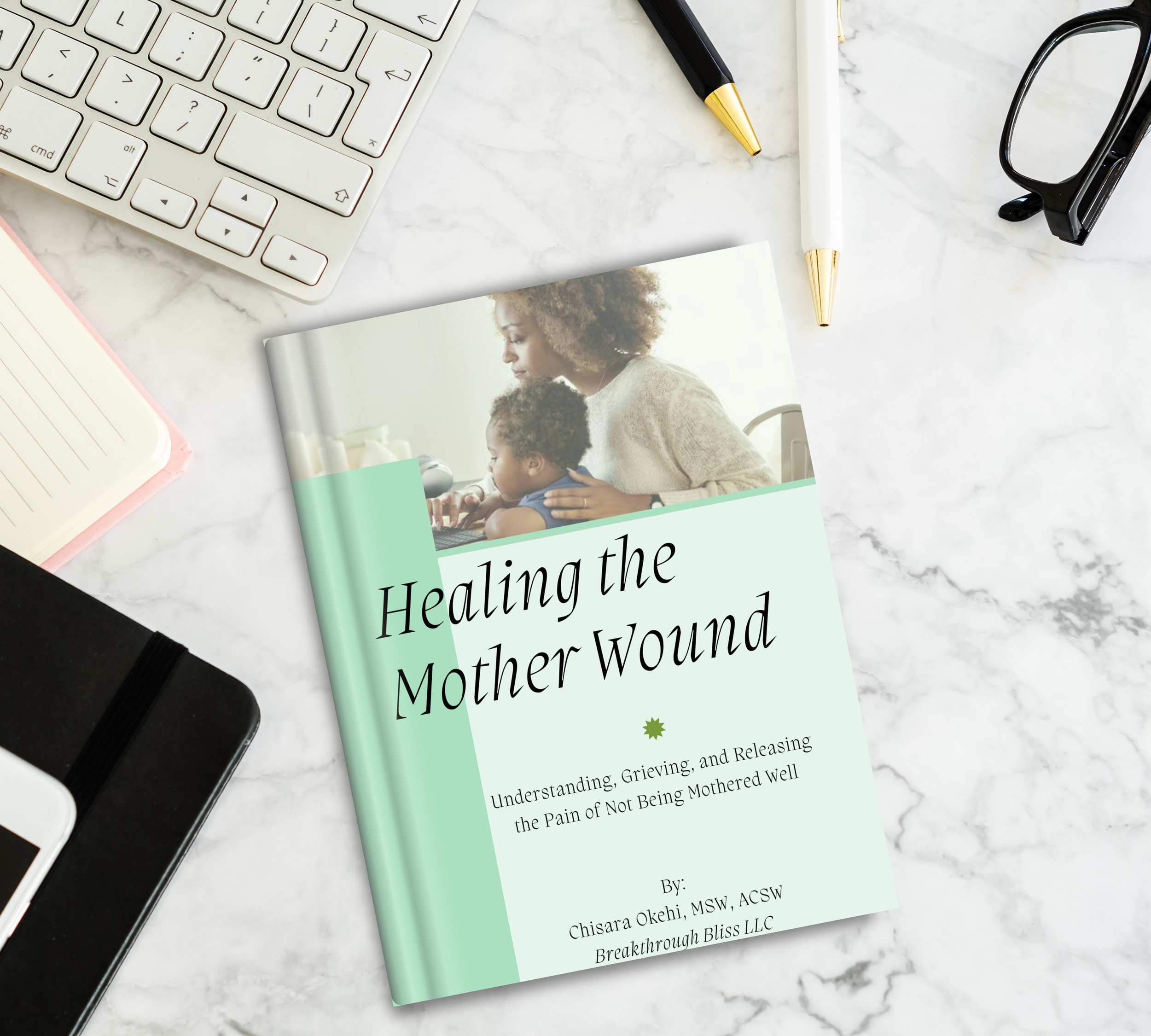
Healing the Mother Wound was created as a sacred container for truth-telling, grief, and repair.
Written by Chisara Okehi, LCSW, a trauma-informed clinical social worker with over 15 years of experience, this workbook blends clinical insight, cultural awareness, and soulful reflection to help women acknowledge what was missing without blame or self-betrayal.
This workbook is not about vilifying your mother.
It is about validating your pain and reclaiming your right to feel whole.
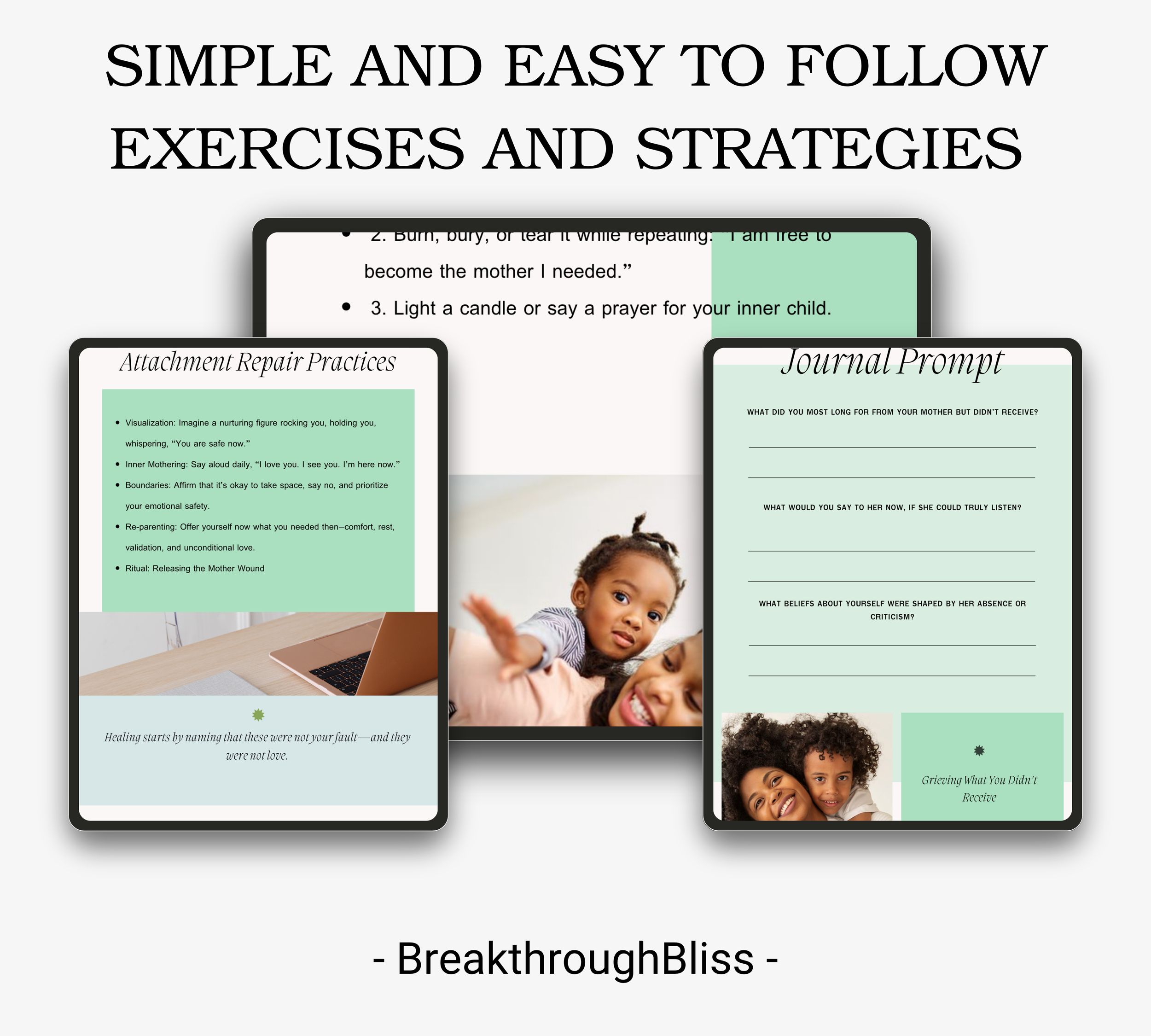
✔ A clear understanding of what the mother wound is and how it forms
✔ How emotional absence, criticism, enmeshment, or parentification impact adult self-worth
✔ Guided journaling to grieve what you did not receive
✔ Reflection prompts to explore beliefs shaped by maternal absence or conditional love
✔ Exercises addressing emotional neglect and boundary violations
✔ Grief letters and inner-child writing practices
✔ Visualization practices to restore safety and emotional soothing
✔ Inner-mothering affirmations to rebuild self-trust and compassion
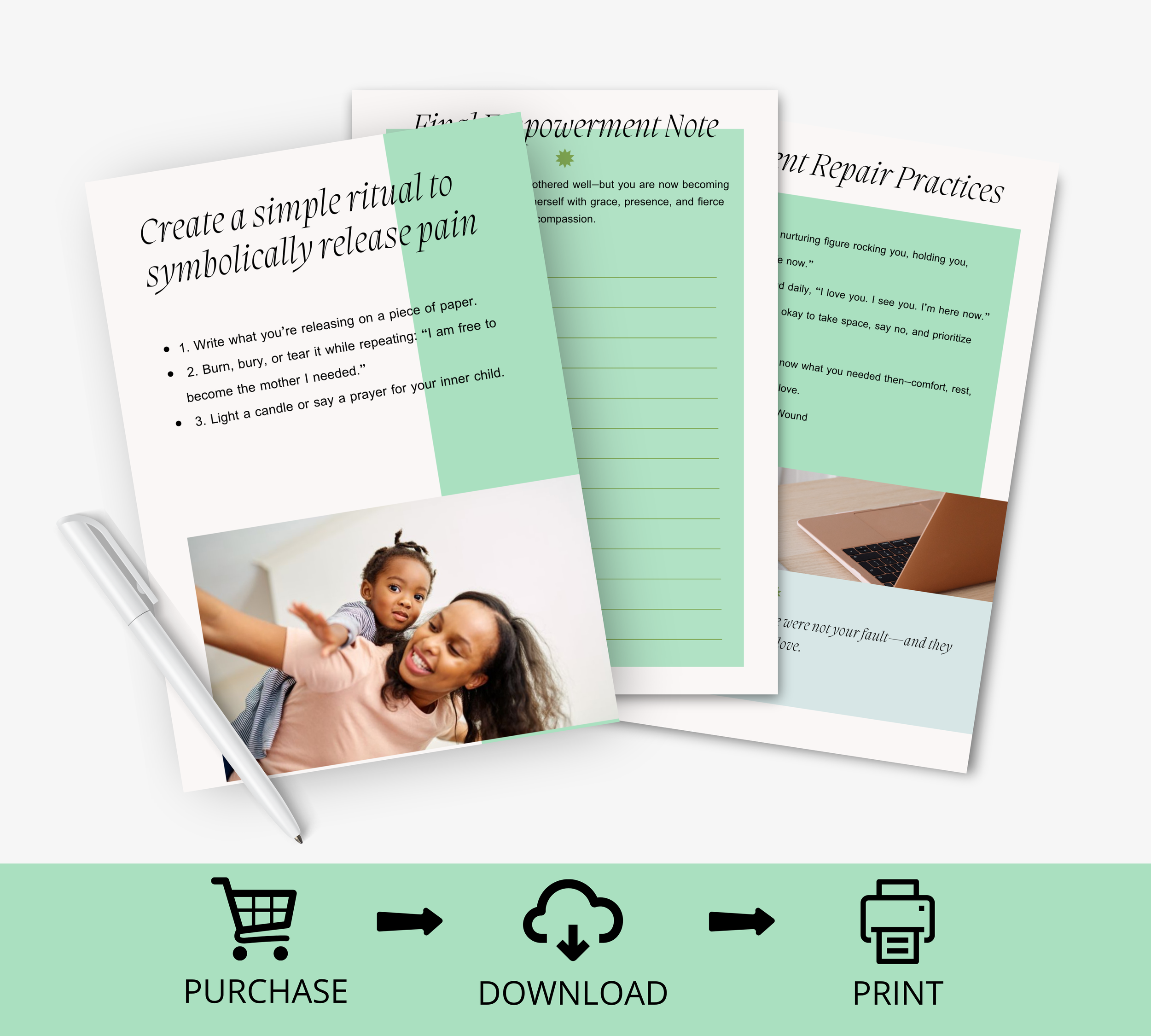
✔ Re-parenting tools to offer yourself comfort, validation, and care
✔ A simple ritual to symbolically release pain and reclaim autonomy
✔ Final empowerment reflections to support legacy healing
Each section is designed to move gently, honoring both the grief and the strength you carry.
This workbook is for women who:
• Felt unseen, criticized, or emotionally unsupported by their mother
• Were expected to be the caretaker, peacemaker, or emotional anchor
• Struggle with self-worth, boundaries, or people-pleasing
• Feel grief for the mother they needed but did not have
• Want to heal generational patterns without shame
• Are ready to become the safe, nurturing presence for themselves
This workbook is especially affirming for Black women navigating the intersection of generational trauma, cultural expectations, and emotional survival.
This is not surface-level inner-child work.
Healing the Mother Wound centers grief, attachment repair, and re-parenting through a trauma-informed lens. It validates the complexity of loving your mother while also naming the harm that occurred. The tone is gentle, honest, and deeply respectful of lived experience.
• Digital fillable PDF workbook
• Immediate download after purchase
• Printable or usable on your device
• 11 thoughtfully designed pages
• Can be used independently or alongside therapy or coaching
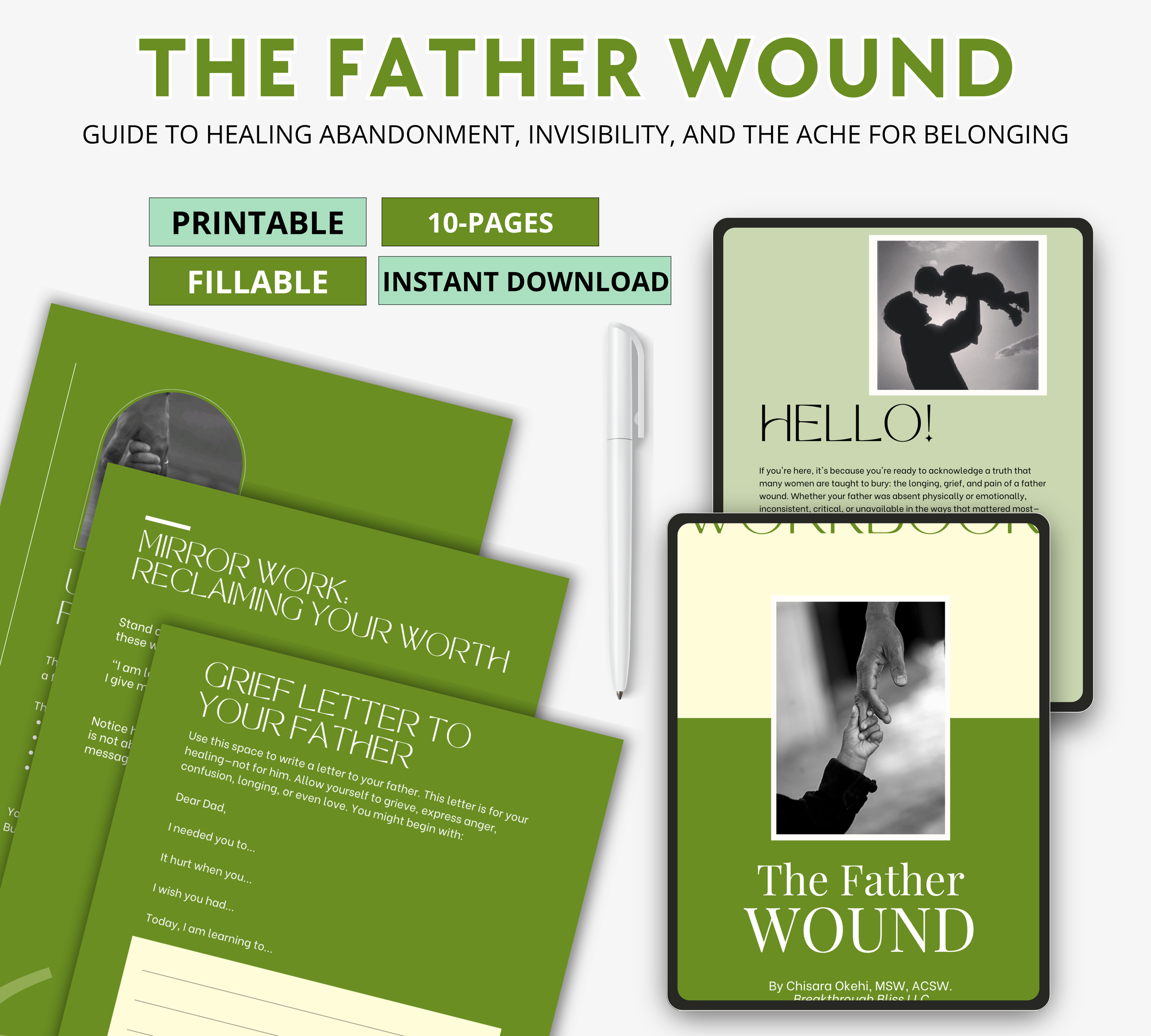
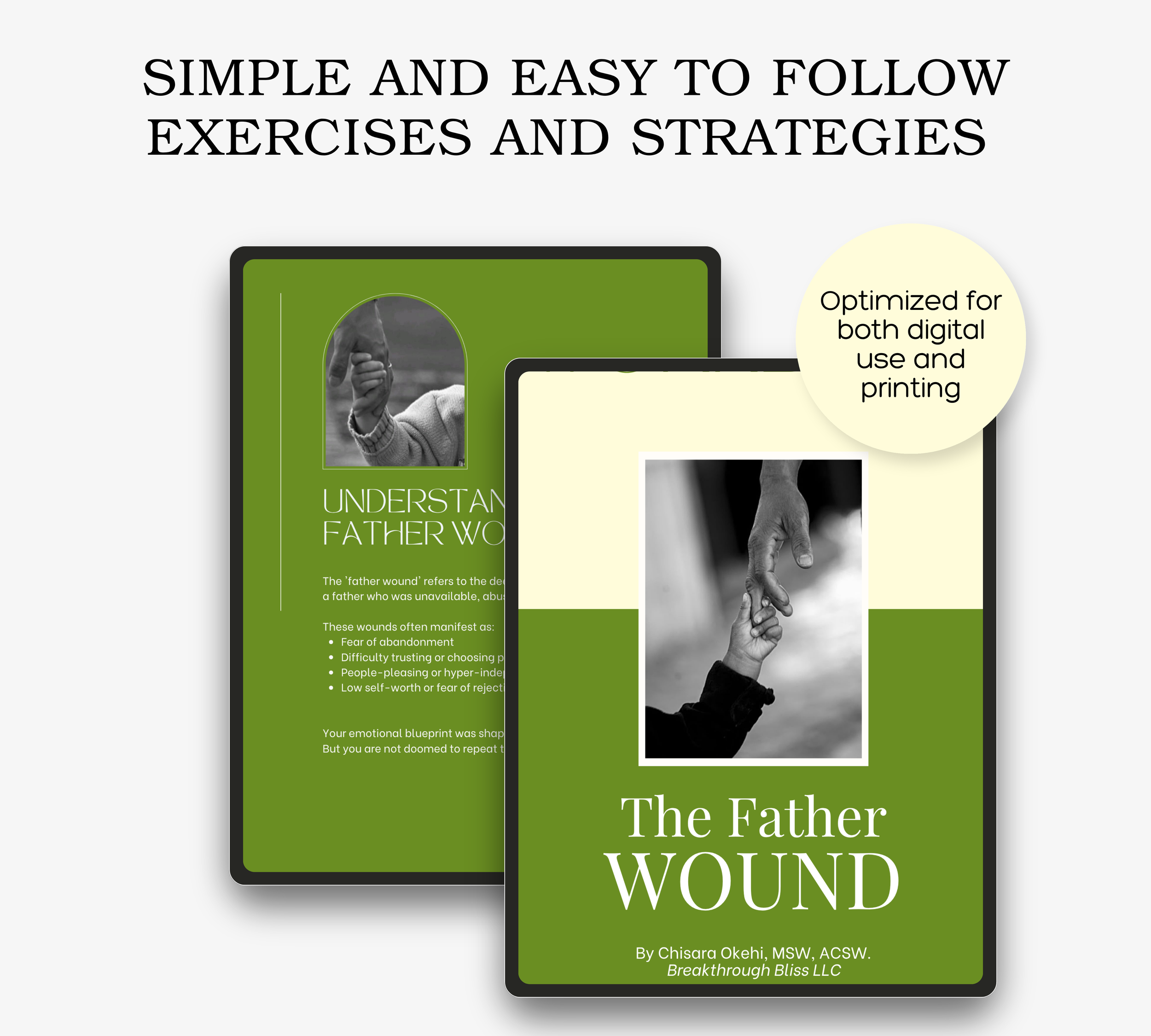
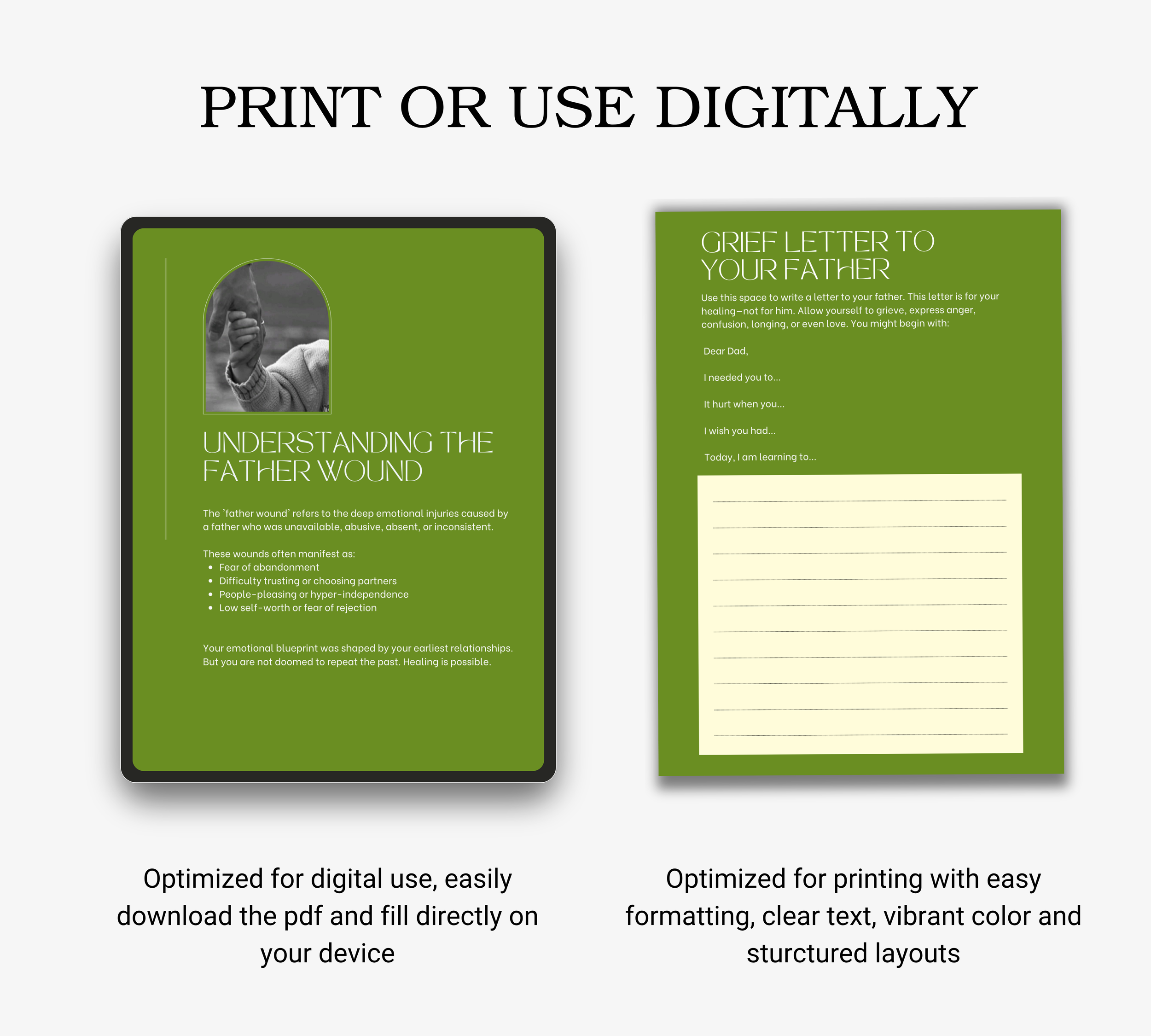
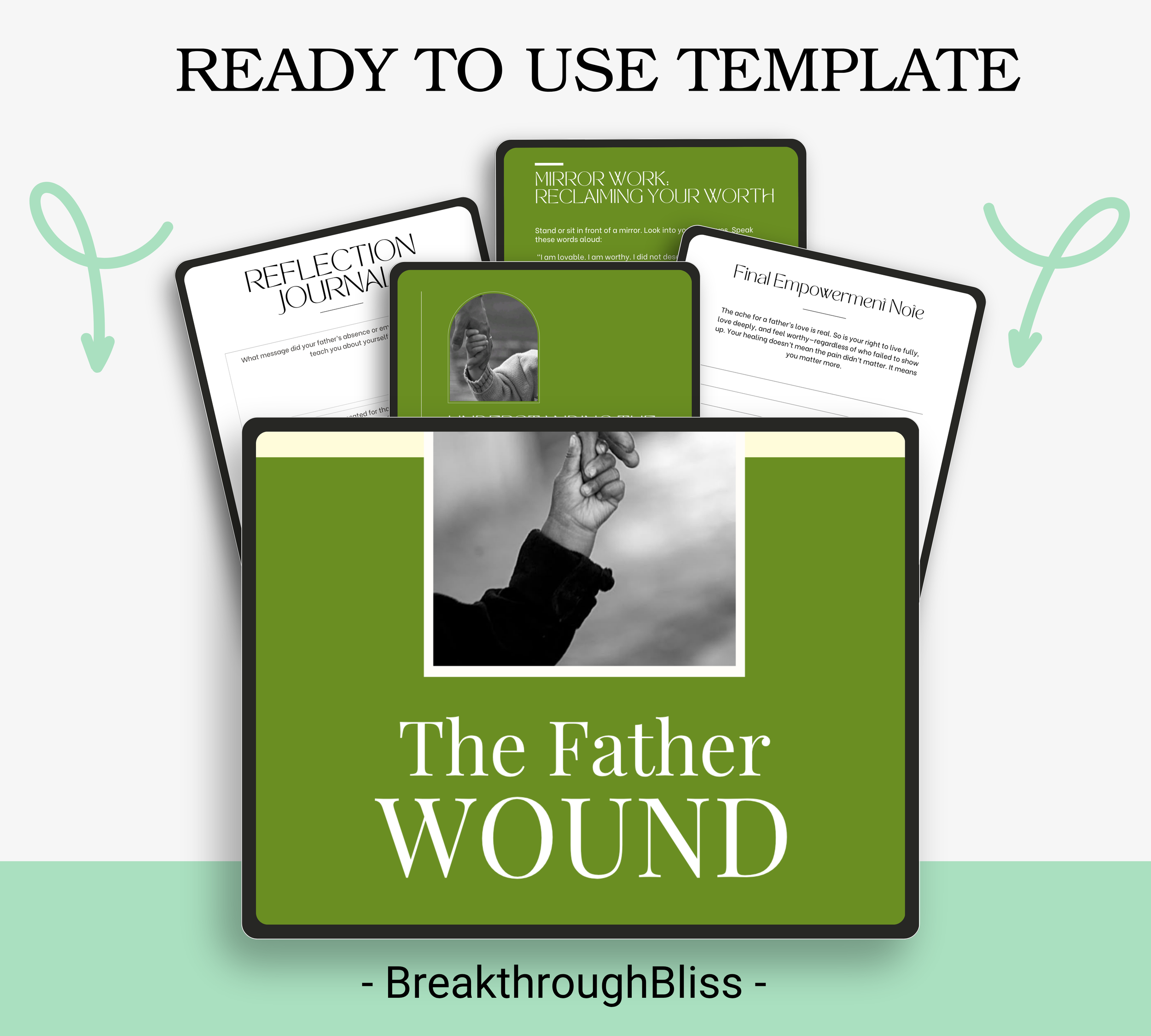

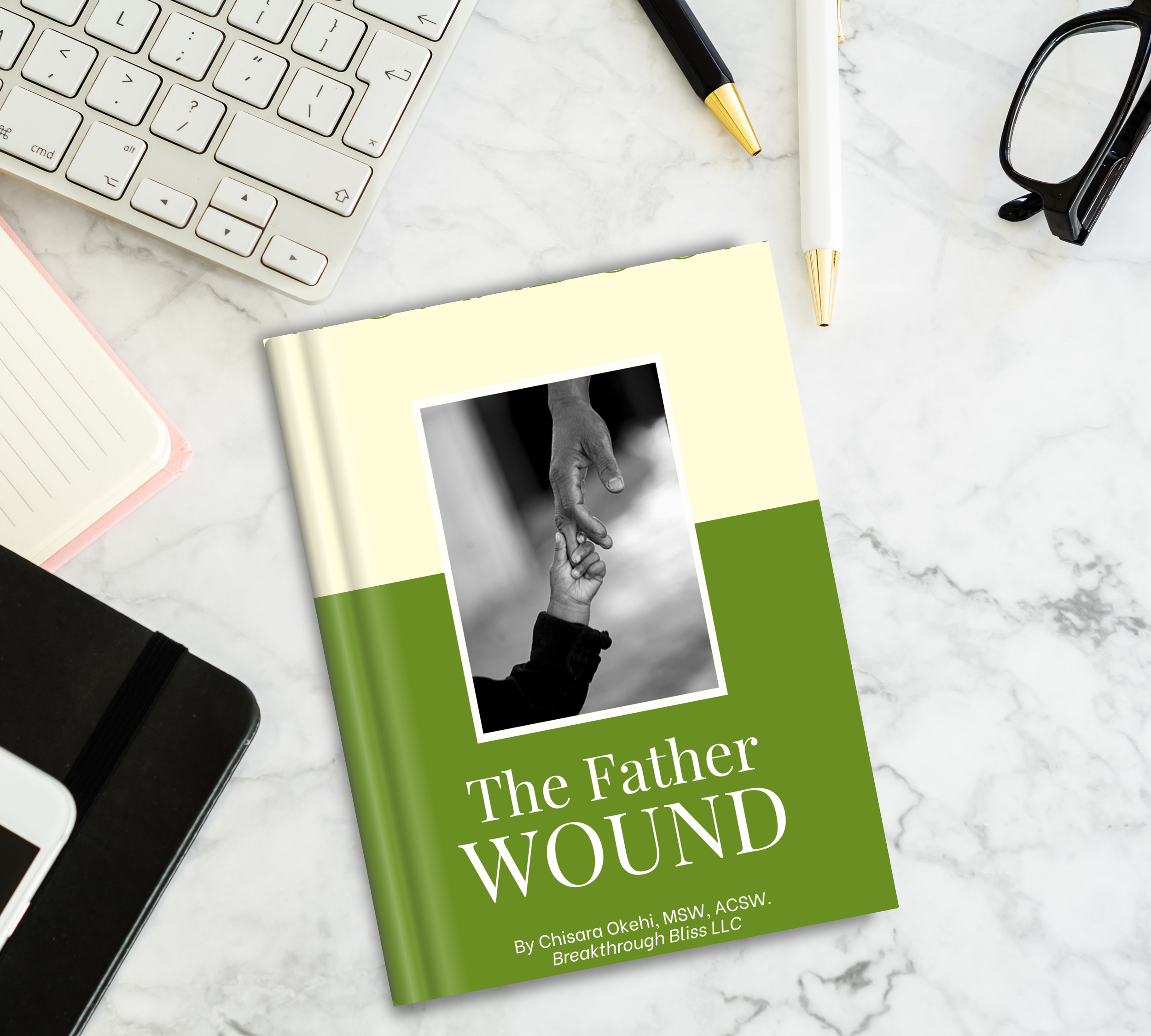
The father wound forms when a child’s need for protection, validation, guidance, and emotional presence goes unmet. For many women, this wound shows up later as fear of abandonment, difficulty trusting partners, people-pleasing, hyper-independence, or chronic self-doubt.
The Father Wound was created to help you face that pain honestly, without minimizing it and without blaming yourself.
Written by Chisara Okehi, LCSW, a licensed clinical social worker, emotional wellness coach, and founder of Breakthrough Bliss LLC, this workbook integrates trauma-informed clinical insight with reflective, emotionally safe practices. With over 15 years of experience supporting women through complex trauma, grief, and relational wounds, Chisara guides you through this work with clarity, compassion, and cultural awareness.
This workbook is not about blaming your father.
It is about reclaiming your worth and rewriting the messages his absence left behind.
✔ A clear understanding of what the father wound is and how it develops
✔ How paternal absence, inconsistency, criticism, or emotional unavailability shape adult relationships
✔ Identification of common patterns such as fear of abandonment, people-pleasing, and hyper-independence
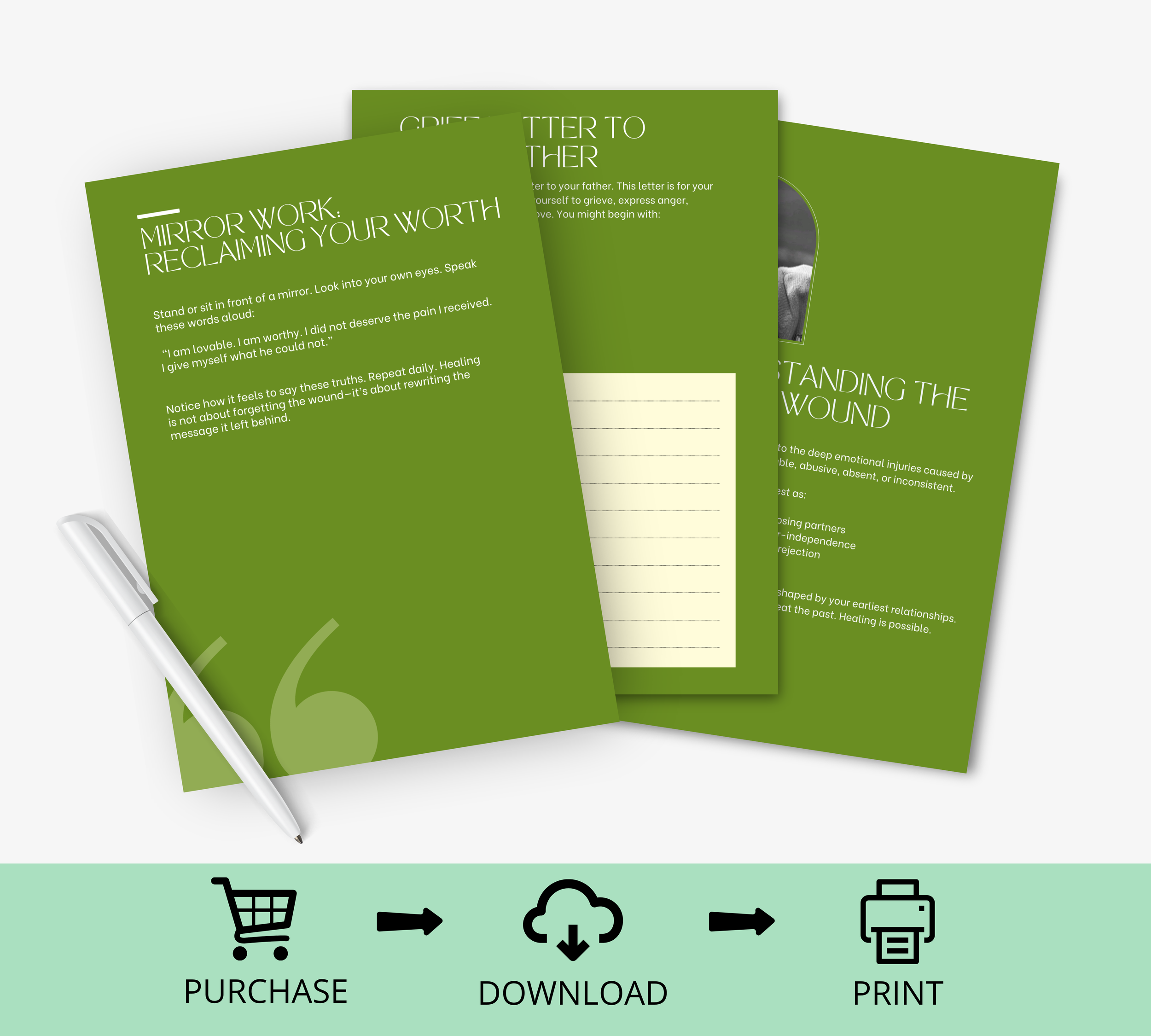
✔ A guided grief letter exercise to express anger, longing, love, and unmet needs safely
✔ Emotional mapping exercises to identify how early father dynamics repeat in current relationships
✔ Mirror work practices to restore self-worth and self-validation
✔ Reflective journaling prompts to explore belonging, attachment, and re-parenting
✔ Gentle affirmations to reinforce lovability, worth, and emotional safety
✔ A closing empowerment reflection that centers self-trust and healing
Each section is designed to move at a pace that honors grief while supporting clarity and emotional integration.
This workbook is for women who:
• Grew up with an absent, emotionally unavailable, or inconsistent father
• Struggle with trust, abandonment fears, or relationship insecurity
• Feel responsible for others while neglecting their own needs
• Experience low self-worth rooted in early rejection or neglect
• Want to heal attachment patterns without self-blame
• Are ready to become their own source of safety and validation
This is not surface-level inner-child work.
The Father Wound is grounded in trauma-informed clinical practice and acknowledges how early paternal relationships shape emotional blueprints, attachment styles, and self-concept. The tone is honest, validating, and emotionally safe, without pressure to forgive prematurely or bypass grief.
• Digital fillable PDF workbook
• Immediate download after purchase
• Printable or usable on your device
• 10 thoughtfully designed pages
• Can be used independently or alongside therapy or coaching


Many Black women are taught early on to be strong, resilient, and self-sacrificing. Over time, survival becomes second nature, and self-worth quietly gets buried beneath responsibility, productivity, and emotional labor.
I Am Still Worthy was created to help you unearth what was never lost.
Written by Chisara Okehi, LCSW, a licensed clinical social worker, emotional wellness coach, and founder of Breakthrough Bliss LLC, this workbook integrates trauma-informed clinical insight with reflective, soul-centered practices. With over 15 years of experience supporting individuals through complex trauma, grief, and emotional wounds, Chisara brings both professional expertise and deep cultural understanding to this work.
This workbook does not ask you to prove your worth or perform healing.
It reminds you that your worth is your birthright.
✔ A grounding welcome that reframes survival as strength, not failure
✔ Daily confidence rituals to build self-honoring habits and emotional grounding
✔ Identity work prompts to reconnect with who you are beyond pleasing, proving, or performing
✔ Reflection questions to clarify core values and reclaim silenced parts of self
✔ Reframing exercises that challenge survival-based beliefs and replace them with affirming truths
✔ Self-celebration trackers to help you notice and honor how you show up for yourself
✔ Empowering affirmations to reinforce self-trust, voice, and worth
✔ A closing empowerment reflection to anchor the truth that your worth is non-negotiable
Each section is designed to be accessible, gentle, and effective, making this workbook easy to return to during moments of self-doubt or emotional fatigue.
This workbook is for Black women who:
• Feel stuck in survival mode
• Tie their worth to productivity, strength, or sacrifice
• Struggle with rest, self-validation, or softness
• Were taught to earn love rather than receive it
• Want to reconnect with identity beyond trauma and patriarchy
• Are ready to move from surviving to becoming
This is not a generic self-esteem workbook.
I Am Still Worthy is grounded in trauma-informed clinical practice and written specifically for Black women. It acknowledges the impact of trauma, abandonment, patriarchy, and generational survival without pathologizing resilience.
The tone is affirming, honest, and emotionally safe, no toxic positivity, no pressure to heal faster.
• Digital fillable PDF workbook
• Immediate download after purchase
• Printable or usable on your device
• 10 thoughtfully designed pages
• Can be used independently or alongside therapy or coaching
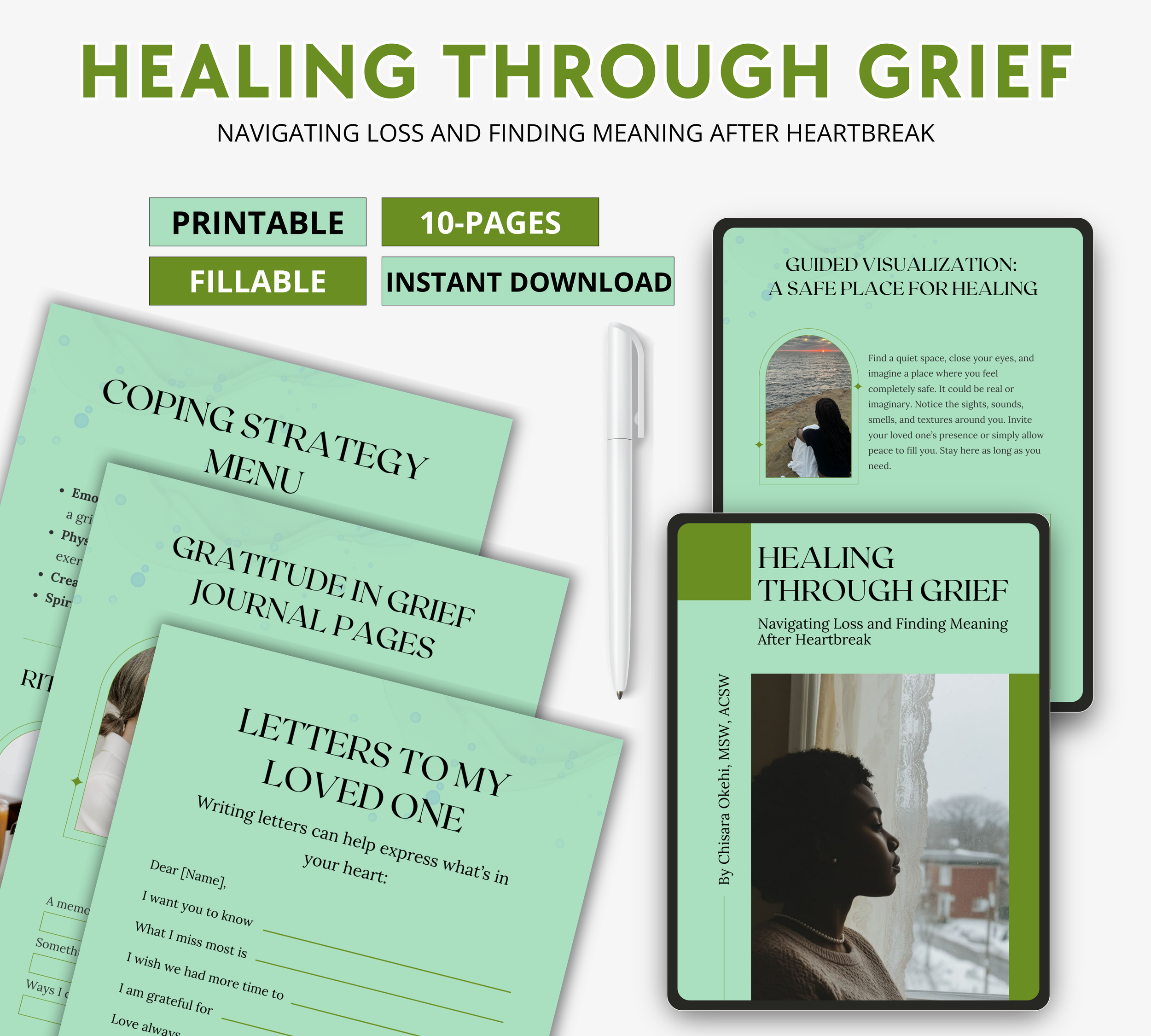
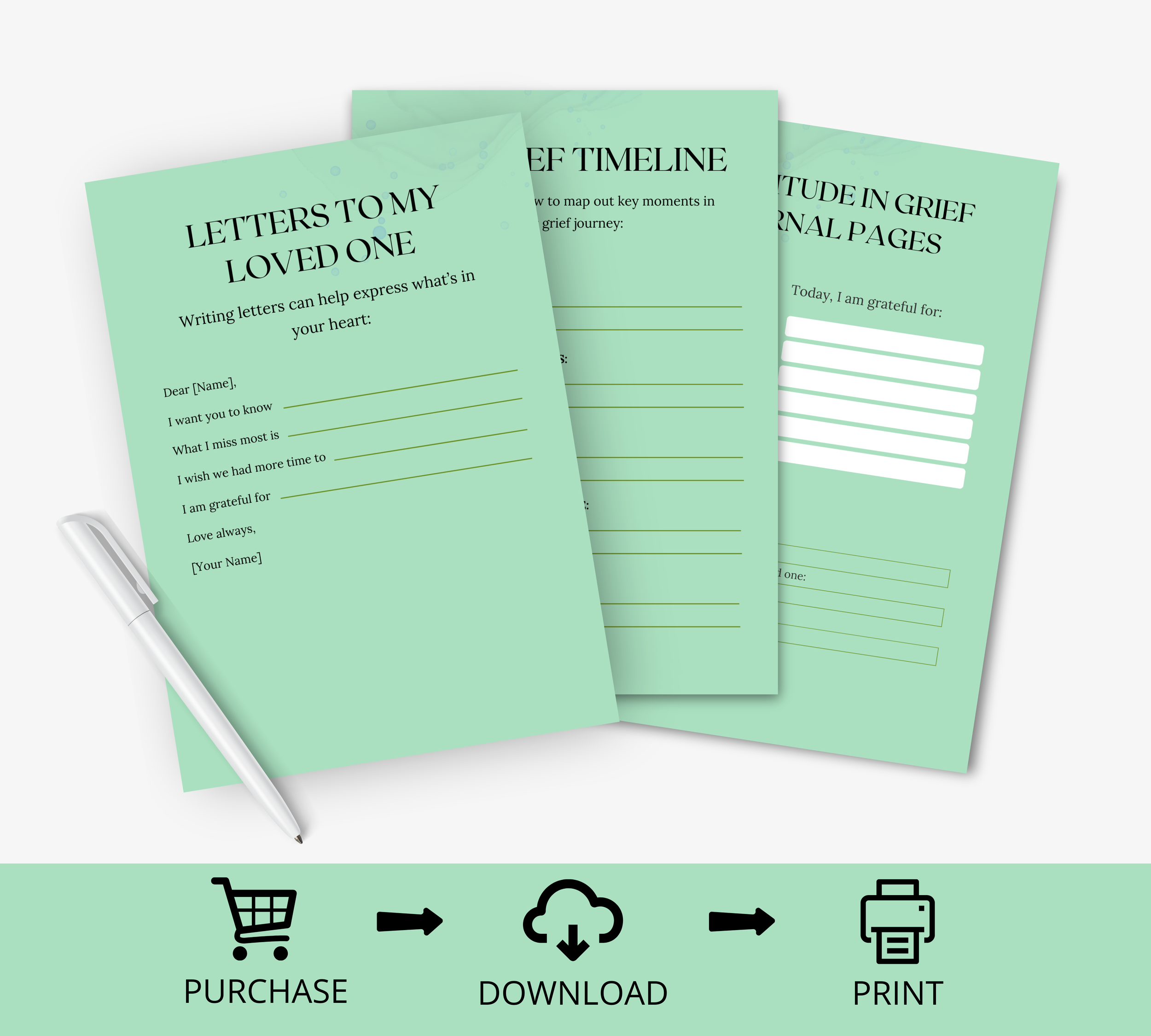
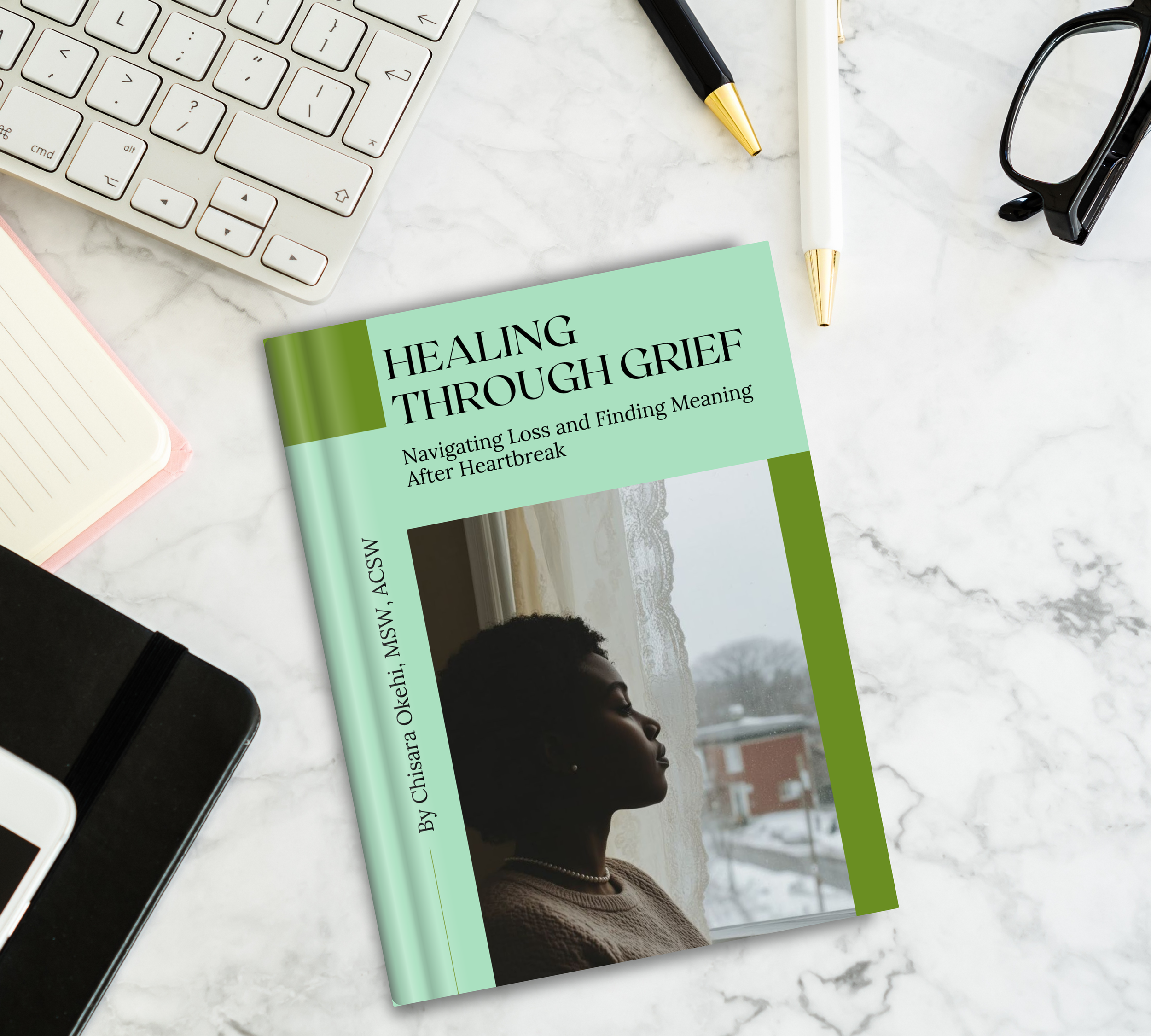
Grief reshapes us. It touches the body, the heart, and the spirit. Yet many people are taught to rush their healing, suppress their emotions, or grieve in silence. This often leaves grief unprocessed and misunderstood.
Healing Through Grief was created to slow the process down.
Written by Chisara Okehi, LCSW, a trauma-informed Licensed Clinical Social Worker and emotional wellness coach with over 15 years of experience, this workbook blends clinical insight, reflective journaling, and grounding practices to help you explore grief with honesty and compassion.
This is not a workbook about fixing your grief.
It is about learning how to live alongside it with tenderness, meaning, and self-respect.
✔ An overview of the five types of grief, including disenfranchised and collective grief
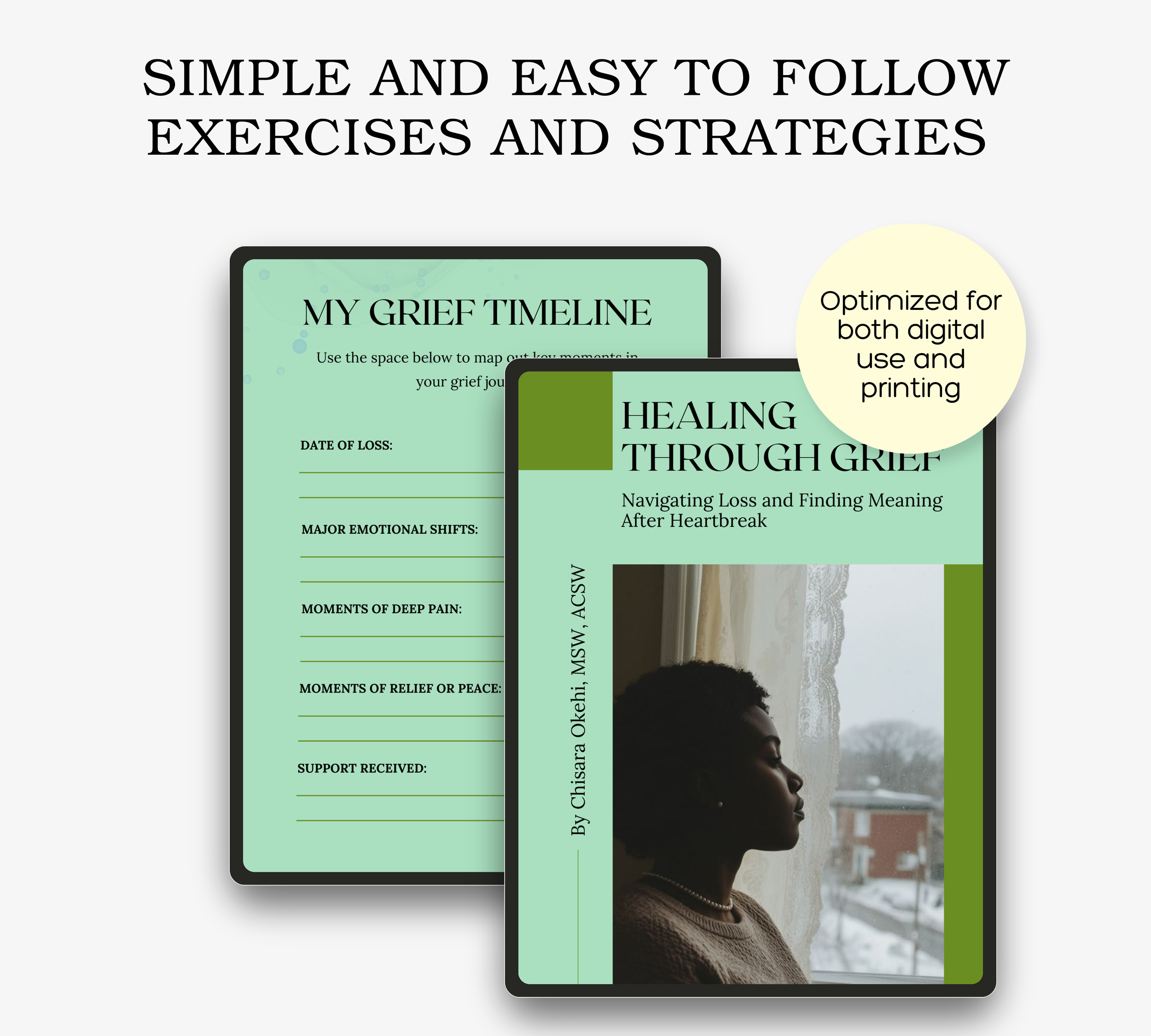
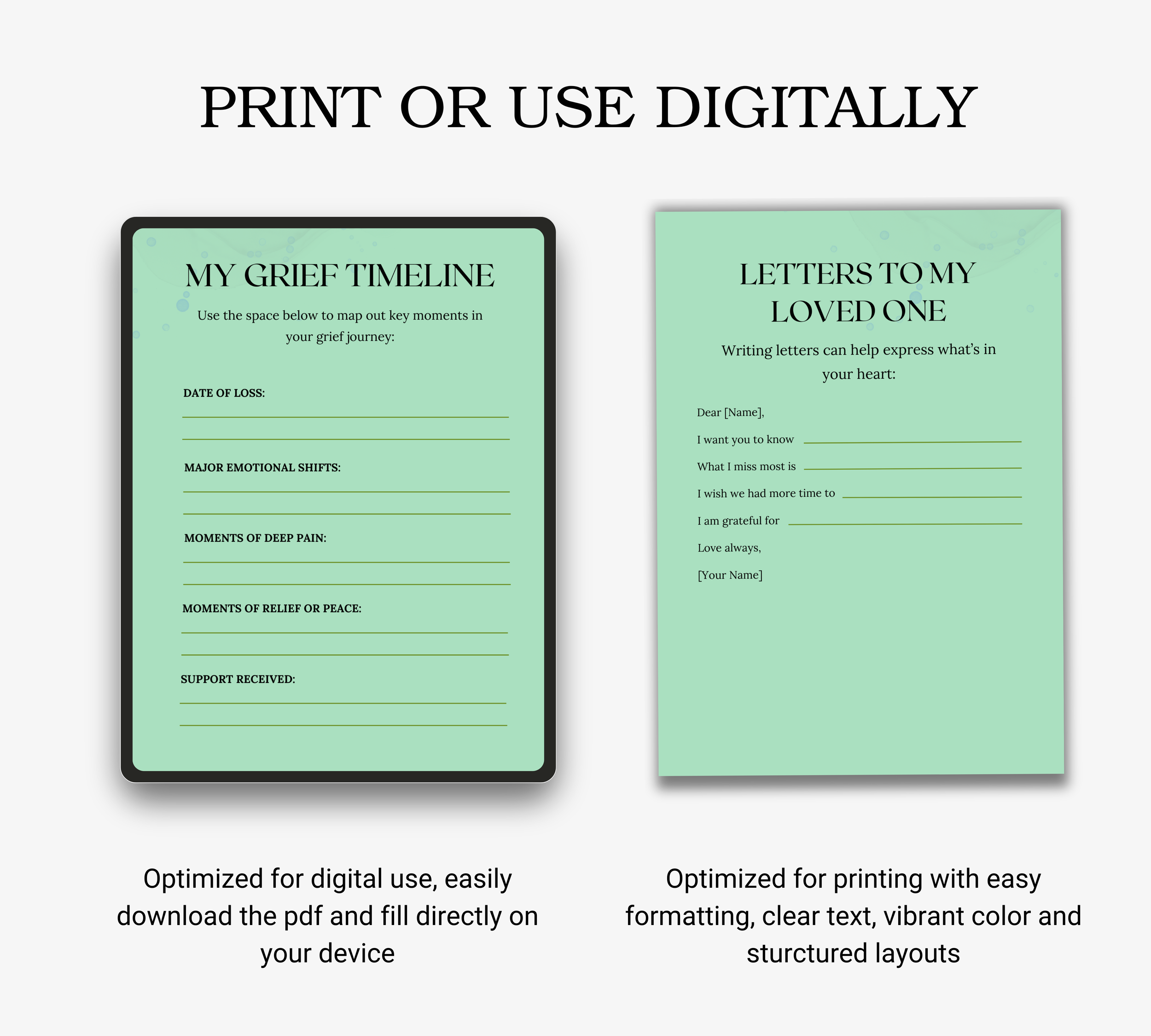
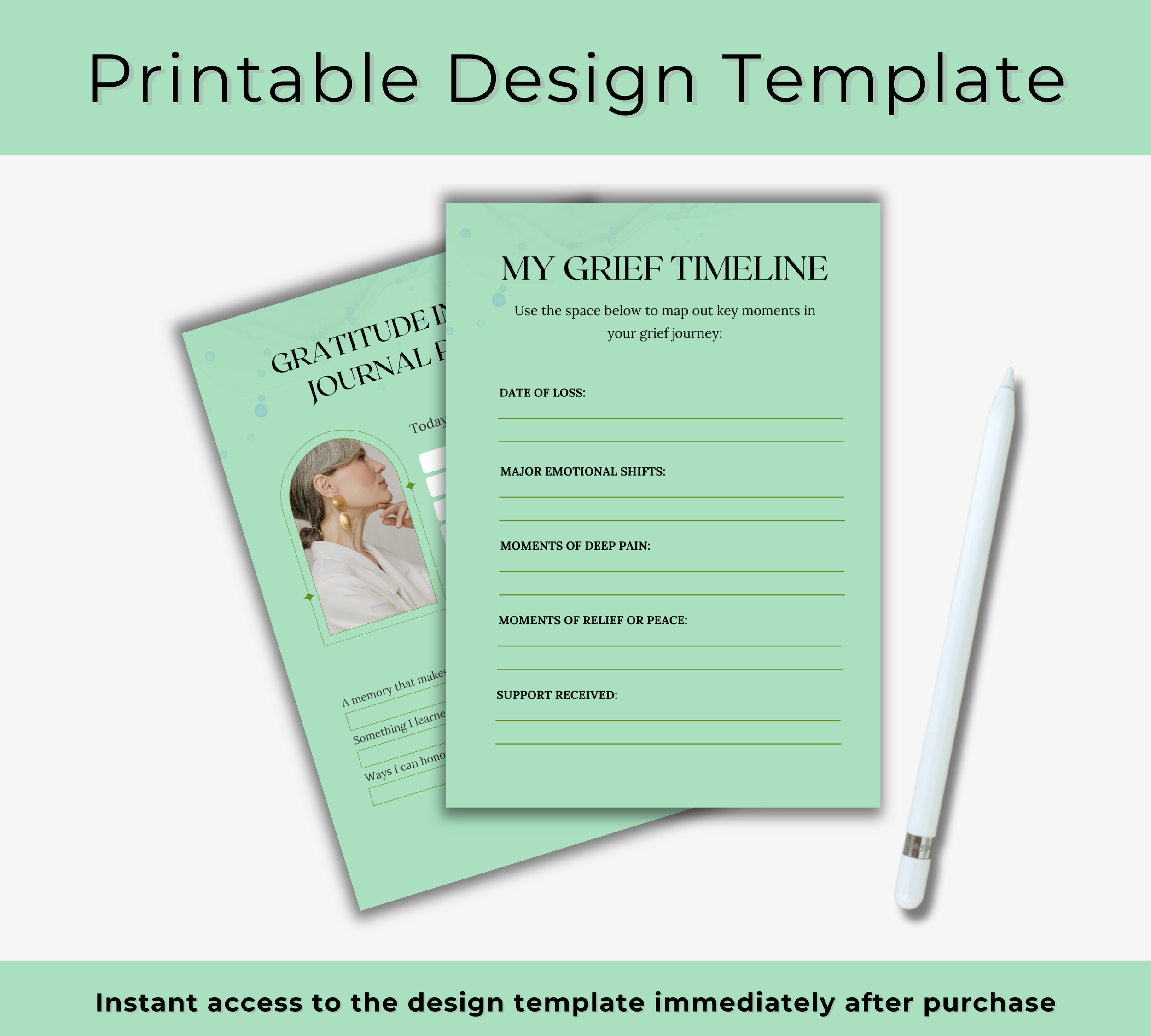
✔ A grief timeline to map emotional shifts, pain, relief, and support
✔ Guided letter-writing exercises to express love, loss, and unfinished conversations
✔ Coping strategy menus for emotional, physical, creative, and spiritual care
✔ Rituals for honoring loss and maintaining connection
✔ A guided visualization to create an internal sense of safety and grounding
✔ Gratitude-in-grief journaling prompts to hold both sorrow and remembrance
✔ Curated book and podcast recommendations for continued support
Each section is designed to meet you where you are, without pressure to move faster than your nervous system allows.
This workbook is for women who:
• Are grieving the loss of a loved one, relationship, or life chapter
• Feel overwhelmed, numb, or unsure how to process their grief
• Want to honor their pain without being consumed by it
• Need permission to grieve in their own way and time
• Are seeking meaning, grounding, and emotional support
• Want a trauma-informed approach that feels gentle and validating
This is not a step-by-step grief program.
Healing Through Grief honors grief as a personal, non-linear experience. It validates losses that are often overlooked and offers tools that support integration rather than avoidance. The tone is compassionate, steady, and rooted in clinical trauma-informed care.
• Digital fillable PDF workbook
• Immediate download after purchase
• Printable or usable on your device
• 10 thoughtfully designed pages
• Can be used independently or alongside therapy or coaching
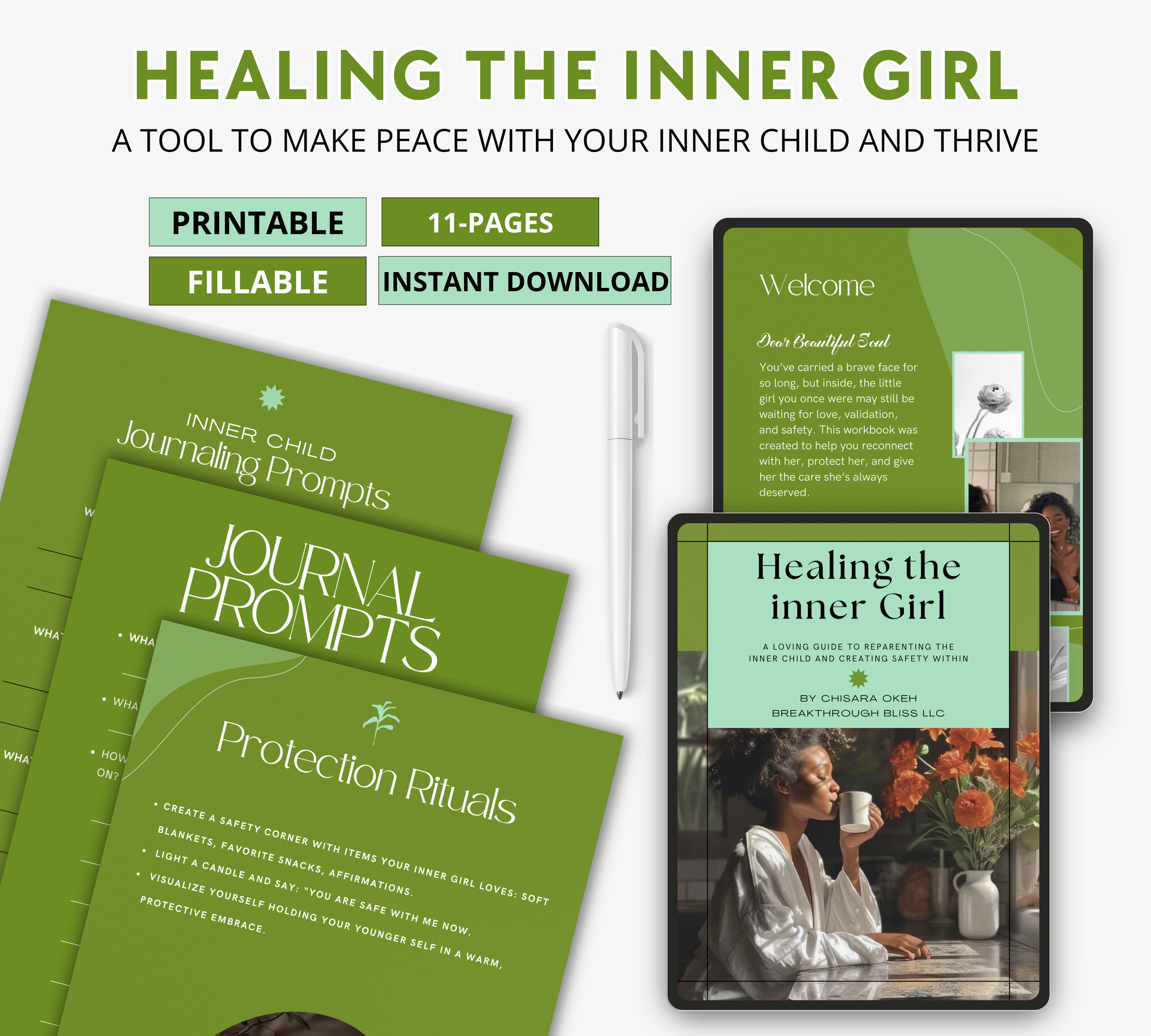
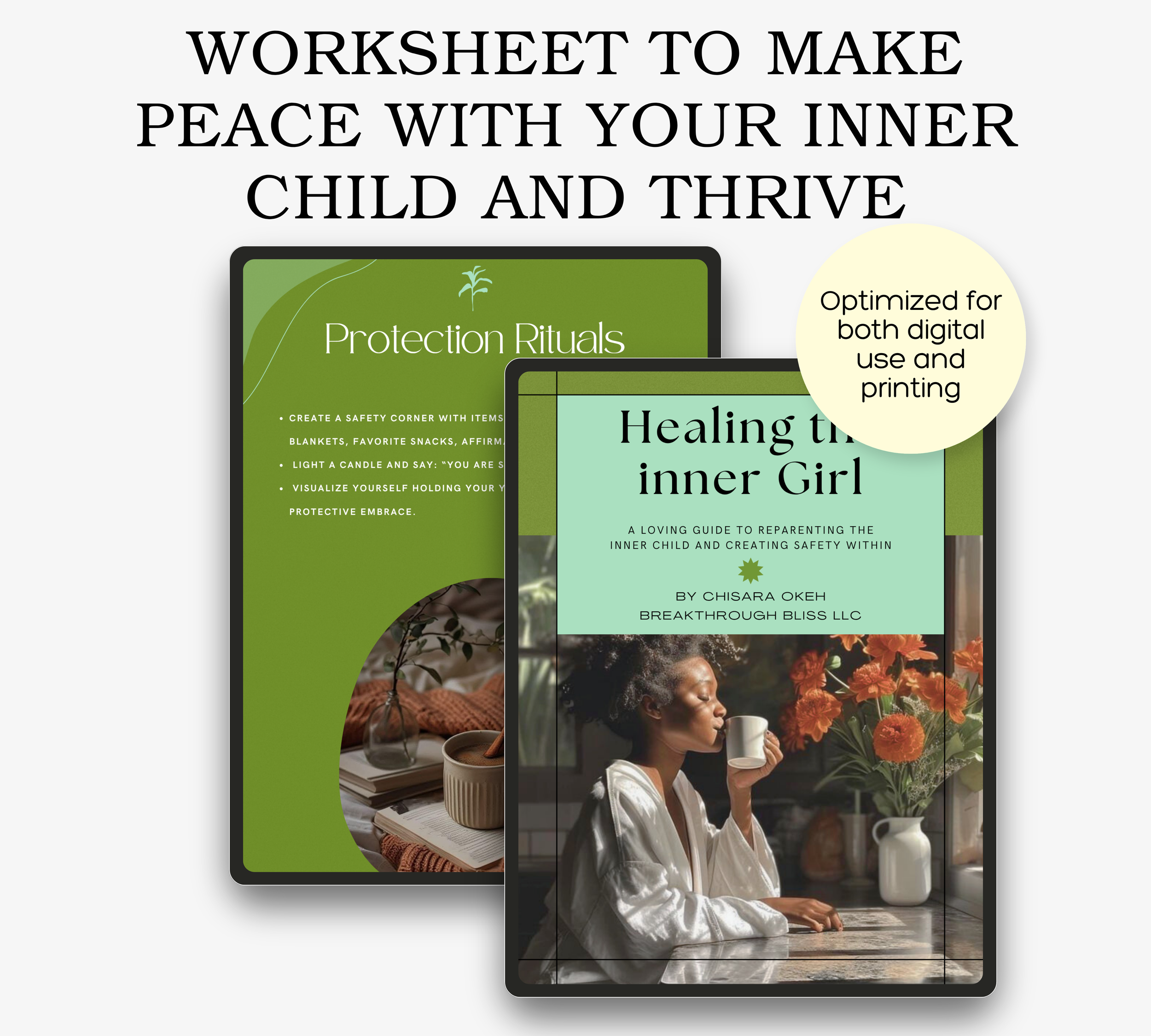
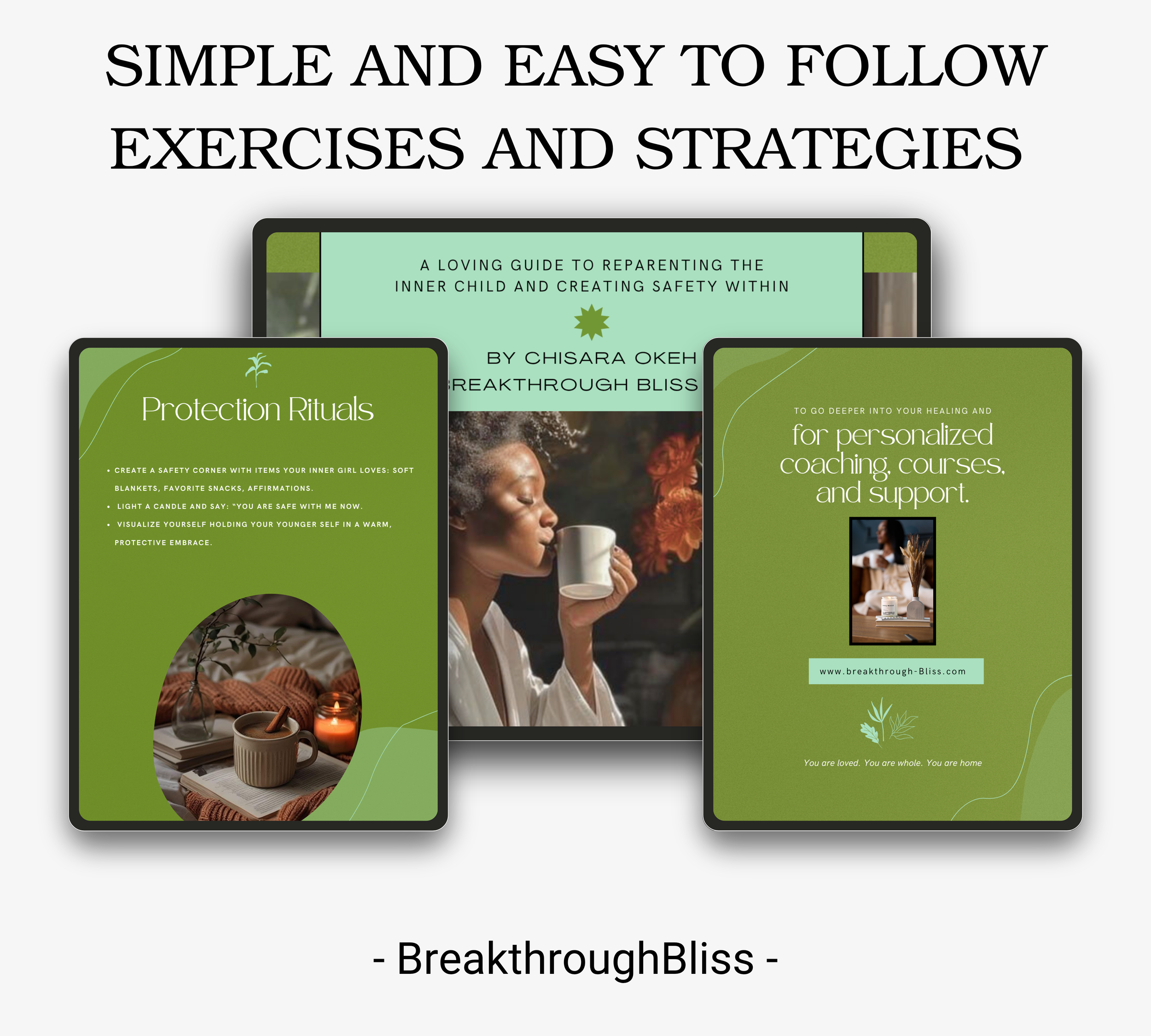
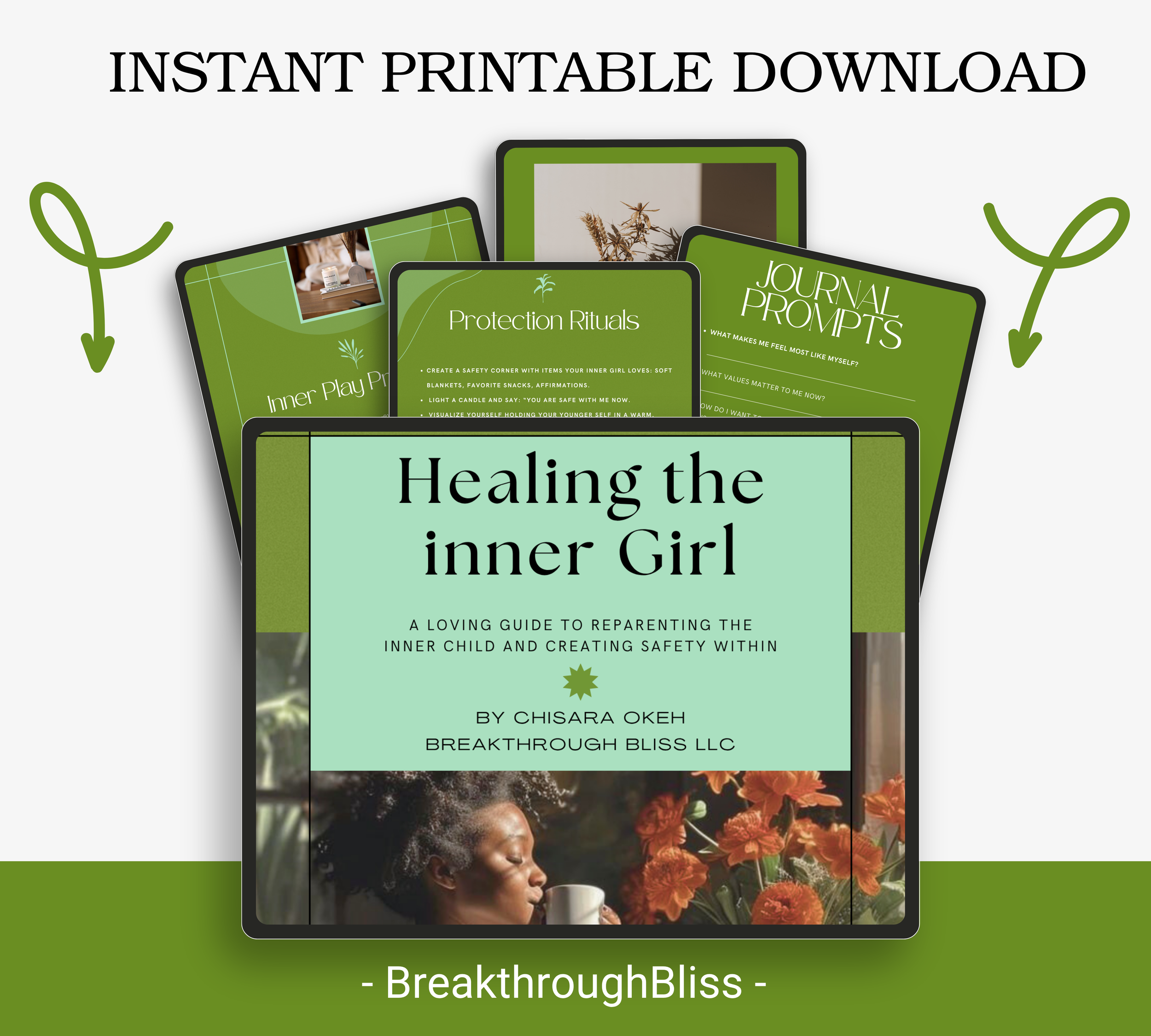
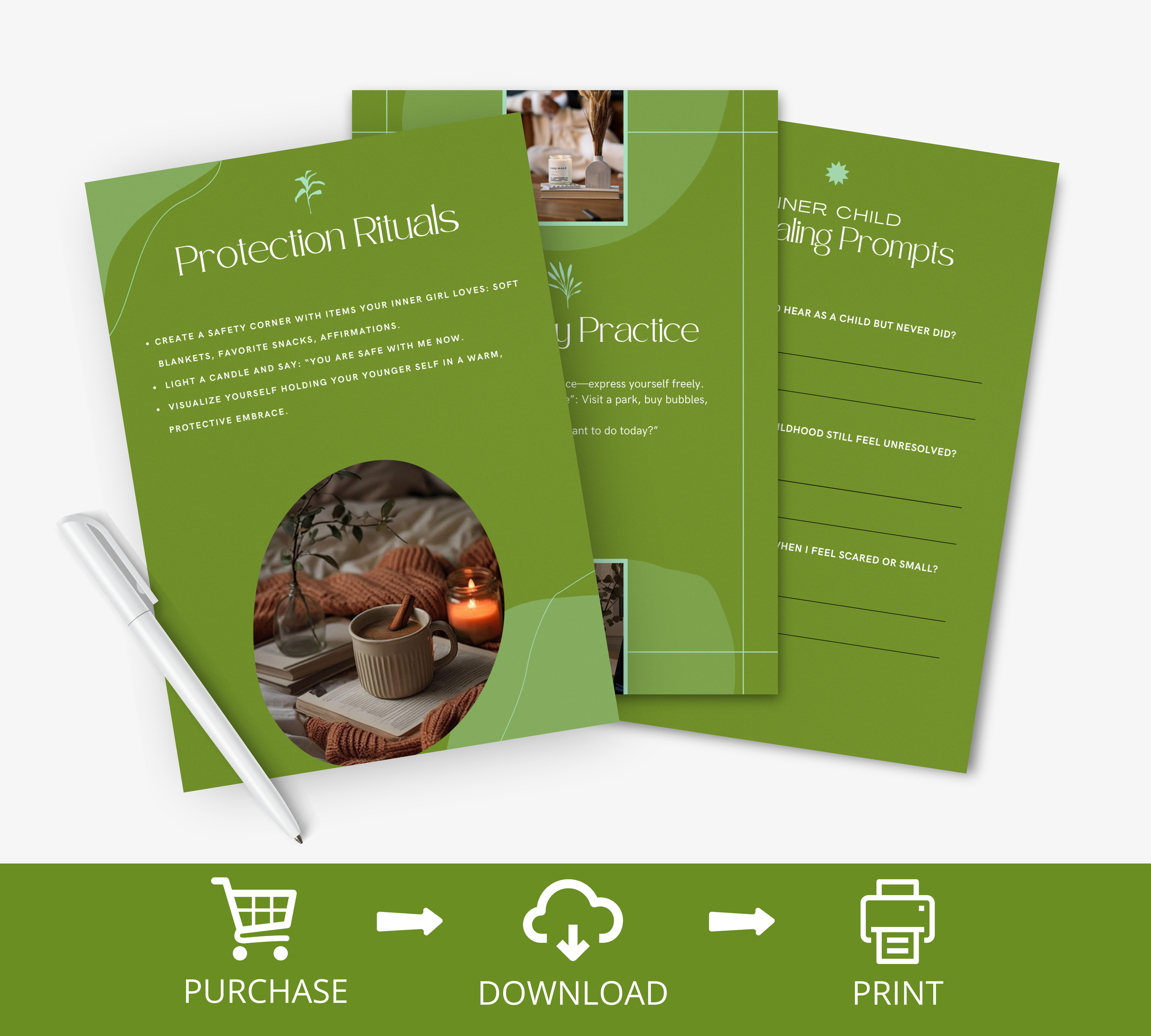

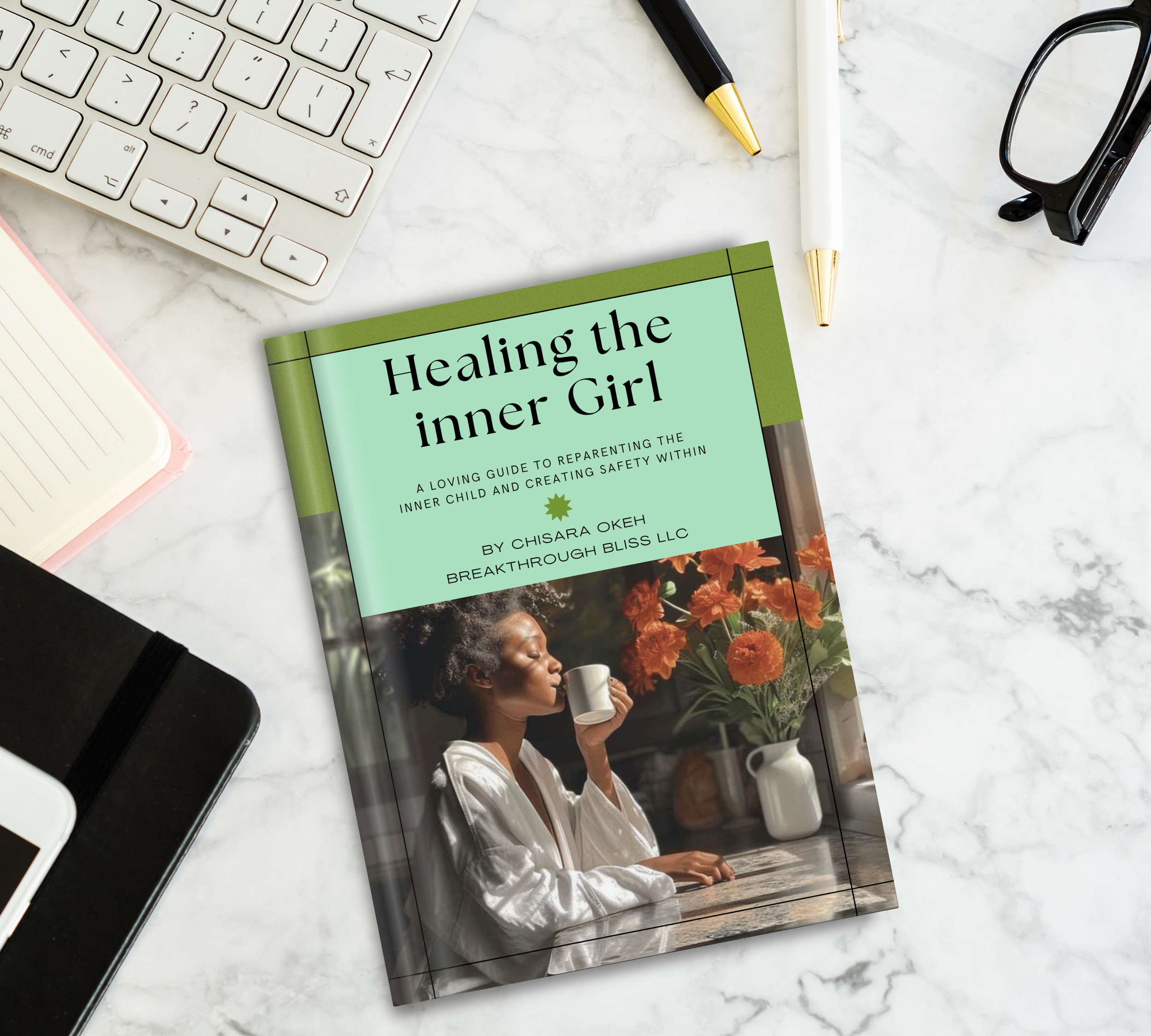
Many women carry strength on the outside while their inner girl still waits quietly for protection, validation, and love. When early emotional needs went unmet, that younger part of you may show up later through people-pleasing, fear, shame, hyper-independence, or difficulty trusting safety.
Healing the Inner Girl was created as a compassionate guide to help you gently reconnect with that part of yourself and begin the process of reparenting with care, patience, and self-trust.
Written by Chisara Okehi, LCSW, this workbook blends trauma-informed care, inner-child healing practices, and soulful reflection to help you create safety within. Rather than fixing or judging your inner child, this workbook invites you to see her, protect her, and love her into wholeness.
You are not broken.
You were waiting to be held.
✔ Understanding who the inner girl is and how she shows up in adulthood
✔ Identifying unmet childhood needs with compassion
✔ Journaling prompts to explore unresolved memories and emotional wounds
✔ Writing a healing letter from your adult self to your inner child
✔ Protection rituals to help your body and nervous system feel safe
✔ Visualization practices to strengthen self-soothing and inner safety
✔ Inner play exercises to reconnect with joy, creativity, and curiosity
✔ Reflection on identity, belonging, and self-definition beyond trauma
✔ Affirmations and empowerment prompts to reinforce self-trust and worth
Each exercise is designed to be gentle, grounding, and emotionally supportive.
This workbook is for women who:
• Grew up feeling unseen, unsafe, or emotionally unsupported
• Carry people-pleasing, fear, or shame rooted in childhood experiences
• Want to heal their inner child without re-traumatizing themselves
• Desire softness without losing strength
• Are ready to become their own safe place
• Want inner-child work that feels nurturing, not overwhelming
This is not surface-level inner-child work.
Healing the Inner Girl centers emotional safety, nervous system awareness, and reparenting with compassion. It respects the pace of trauma healing and avoids forcing emotional exposure.
The tone is warm, affirming, and deeply respectful of lived experience.
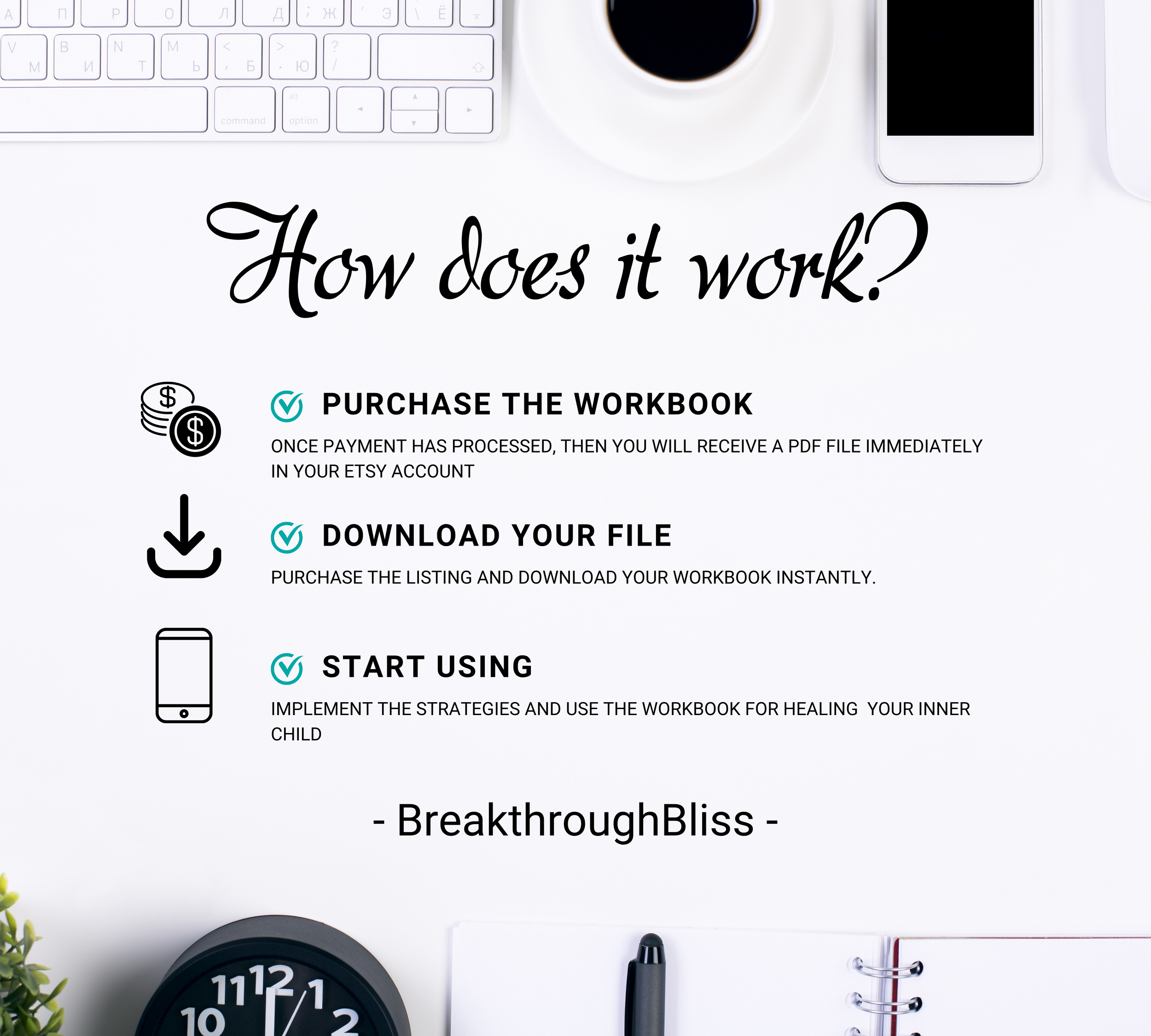
• Digital fillable PDF workbook
• Immediate download after purchase
• Printable or usable on your device
• 12 thoughtfully designed pages
• Can be used independently or alongside therapy or coaching


Many women learned early how to survive by disconnecting from their needs, emotions, and softness. The inner girl who once needed protection, comfort, and reassurance often remains quietly within, still holding unanswered questions, unmet needs, and longing for safety.
Reclaiming the Inner Girl was created as a sacred space to return to her.
Written by Chisara Okehi, LCSW, a licensed clinical social worker, emotional wellness coach, and founder of Breakthrough Bliss LLC, this workbook integrates trauma-informed care, parts work, and somatic safety practices. With over 15 years of experience supporting women through complex trauma and emotional wounds, Chisara guides this work with tenderness, clarity, and deep respect for the pace of healing.
This workbook does not ask you to fix your inner child.
It invites you to love her, protect her, and walk forward together.
✔ A grounding welcome that frames the workbook as a sacred, safe space for inner-child healing (page 2)
✔ A Love Letter to Little Me exercise to acknowledge pain, offer protection, and reclaim self-compassion (page 4)
✔ Parts-work reflections to meet and understand your inner girl, including her fears, needs, and joys (page 5)
✔ A trauma timeline exercise to gently explore experiences that shaped safety and self-worth across childhood and adolescence (pages 6–7)
✔ A guided Safe Place meditation to help your nervous system experience protection and comfort (page 8)
✔ Creative inner-child prompts, including drawing, collage, coloring, and affirmations to access nonverbal healing (page 9)
✔ A final empowerment reflection reinforcing that you are now your own safe place (page 10)
Each section is intentionally gentle, allowing healing without retraumatization or emotional pressure.
This workbook is for women who:
• Grew up feeling unseen, unsafe, or emotionally unsupported
• Carry inner-child wounds related to abandonment, neglect, or trauma
• Want to practice re-parenting with compassion and safety
• Struggle with self-trust, softness, or emotional vulnerability
• Desire inner-child work that feels nurturing, not overwhelming
• Are ready to become a consistent source of safety for themselves
This is not surface-level inner-child journaling.
Reclaiming the Inner Girl is grounded in trauma-informed clinical care and honors the nervous system’s need for safety. It integrates parts work, somatic grounding, creative expression, and guided visualization in a way that respects emotional pacing and autonomy.
The tone is soft, validating, and deeply protective of the healing process.
• Digital fillable PDF workbook
• Immediate download after purchase
• Printable or usable on your device
• 11 thoughtfully designed pages
• Can be used independently or alongside therapy or coaching


For women who experienced trauma early in life, unsafe dynamics can feel normal. Chaos may have been mistaken for love. Control for care. Emotional unpredictability for connection. Over time, this makes it difficult to trust yourself, your body, and others.
Finding Safe Ground was created to help you interrupt those patterns and begin rebuilding safety from the inside out.
Written by Chisara Okehi, LCSW, this workbook blends trauma-informed psychoeducation, nervous system awareness, and practical relationship tools. You will learn how to recognize safety in your body, assess relationships more clearly, and slowly rebuild self-trust without rushing or self-blame.
This workbook is not about forcing yourself into relationships.
It is about learning how to choose connection that feels peaceful and grounded.
✔ Redefining what safety truly is and what it is not
✔ Understanding how trauma shapes relationship patterns
✔ Learning to use your body as a safety compass
✔ Identifying physical and emotional signs of safety and unsafety
✔ A clear comparison of safe versus unsafe people
✔ Common red flags after trauma and what they signal
✔ Green flags that indicate healthy, respectful relationships
✔ Step-by-step guidance to assess new relationships
✔ Exercises to rebuild trust in your intuition
✔ Creating a personalized emotional and physical safety plan
✔ Visualization and role-play exercises to practice boundaries
✔ Affirmations to reinforce worthiness and self-trust
✔ Curated book and support resource recommendations
This workbook is for adult women who:
• Experienced childhood trauma, emotional abuse, sexual abuse, or neglect
• Struggle to identify safe people or healthy relationships
• Feel hypervigilant, guarded, or unsure of their instincts
• Find themselves repeating unhealthy relationship patterns
• Want calmer, more respectful connections
• Are ready to prioritize emotional safety without guilt
This workbook is especially supportive for women healing from complex trauma and relational wounds.
This is not relationship advice based on rules or quick fixes.
Finding Safe Ground centers the nervous system, self-trust, and lived experience. It acknowledges that healing happens slowly and that safety must be felt in the body, not just understood intellectually.
The tone is validating, steady, and grounded in clinical trauma-informed care.
• Digital fillable PDF workbook
• Immediate download after purchase
• Printable or usable on your device
• 13 thoughtfully designed pages
• Can be used independently or alongside therapy or coaching


Spiritual trauma cuts deeply because it impacts not only relationships, but identity, safety, and meaning. Many people leave faith spaces carrying grief, anger, confusion, or fear, unsure of what they believe anymore or whether they are allowed to question what they were taught.
Faith Unbound was created as a gentle, non-judgmental guide for healing from those wounds.
Written by Chisara Okehi, LCSW, this workbook integrates trauma-informed mental health principles with reflective spiritual exploration. It does not tell you what to believe. Instead, it supports you in understanding your experiences, releasing shame, and rebuilding a sense of spiritual safety, whether that means redefining faith, practicing spirituality differently, or letting certain beliefs go entirely.
This workbook honors your autonomy. Your spiritual journey belongs to you.
✔ Understanding church hurt and spiritual trauma, including common causes and mental health impacts
✔ Reflection on leadership abuse, shame-based doctrine, exclusion, and loss of community
✔ A guided faith timeline to process key moments of belonging, questioning, and betrayal
✔ Journaling prompts to explore grief, anger, fear, and identity confusion
✔ Deconstruction exercises that allow questioning without shame
✔ A personalized spiritual safety plan to reduce triggers and restore emotional grounding
✔ Healing rituals and grounding practices to release pain and reconnect with what feels sacred
✔ Prompts to clarify what spirituality, faith, or freedom means to you now
✔ Affirmations to support self-trust, autonomy, and spiritual healing
✔ Curated book, podcast, and support group recommendations
This workbook is for individuals who:
• Have experienced harm, manipulation, or judgment in faith spaces
• Feel disconnected from their spiritual identity after church hurt
• Struggle with guilt or fear when questioning beliefs
• Are grieving the loss of faith community or certainty
• Want to redefine spirituality in a way that feels safe and authentic
• Need a trauma-informed approach to spiritual healing
This workbook is inclusive of people who are religious, spiritual, questioning, or no longer practicing any faith tradition.
This is not a devotional and it is not religious instruction.
Faith Unbound centers emotional safety, autonomy, and psychological healing. It respects diverse belief systems and recognizes that healing may include rebuilding faith, redefining spirituality, or releasing religion entirely.
The tone is compassionate, validating, and grounded in clinical understanding of trauma.
• Digital fillable PDF workbook
• Immediate download after purchase
• Printable or usable on your device
• 13 thoughtfully designed pages
• Can be used independently or alongside therapy or coaching


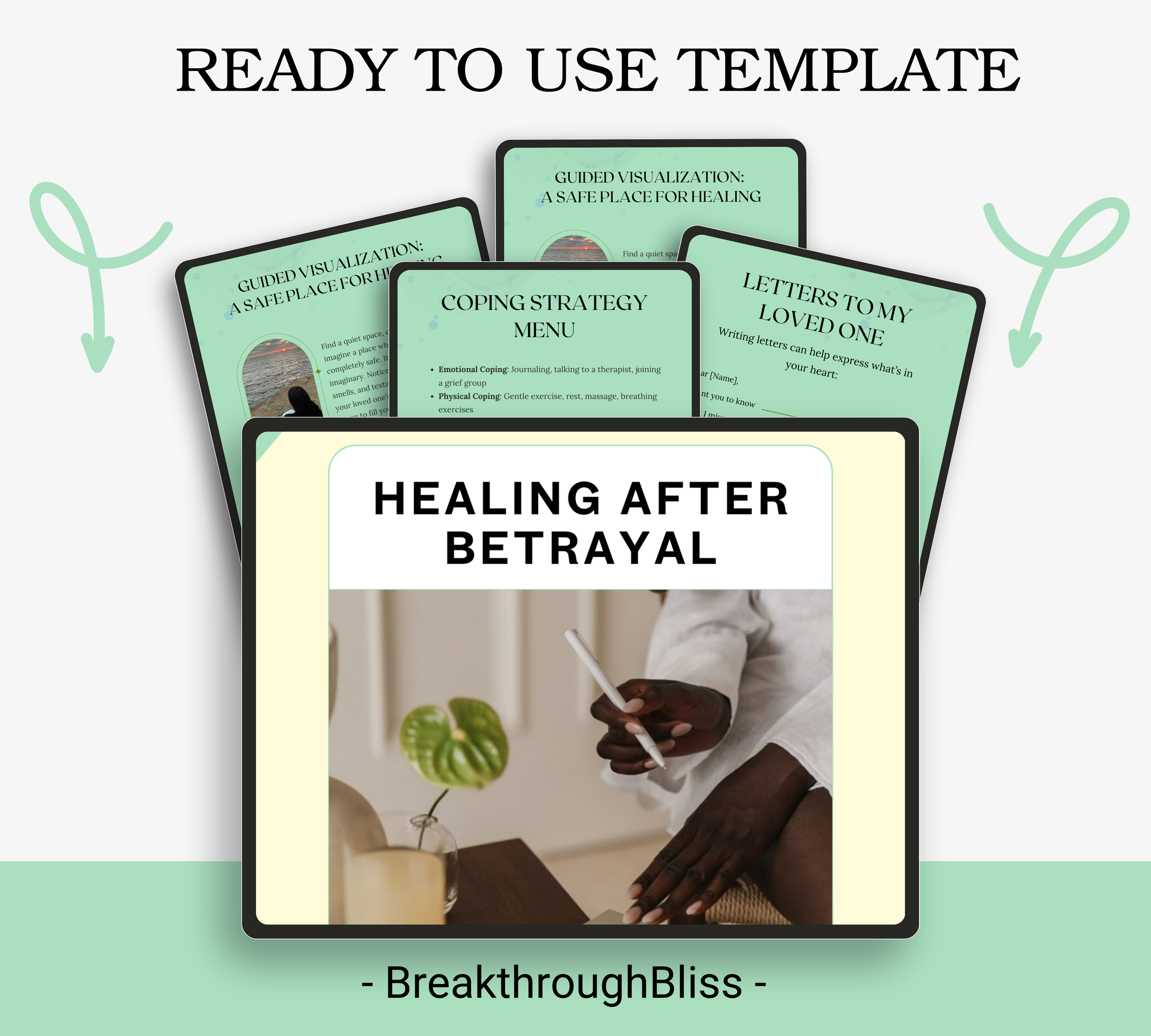
Betrayal can feel disorienting and destabilizing. Whether the hurt came from a partner, friend, family member, or trusted figure, betrayal often leaves behind confusion, self doubt, hypervigilance, and a deep questioning of your own judgment. Many women struggle not only with trusting others again, but with trusting themselves.
Healing After Betrayal was created as a safe, structured space to help you process what happened, understand your emotional responses, and begin rebuilding trust from the inside out.
Written by Chisara Okehi, LCSW, this workbook integrates trauma informed practices, emotional regulation tools, and reflective exercises to support healing at your own pace. Rather than pushing forgiveness or reconciliation, this workbook centers self protection, clarity, and self validation.
Healing does not mean forgetting. It means learning how to feel safe again, starting with yourself.
✔ The five stages of betrayal recovery, from shock to reconnection or release
✔ Guided reflection to help you make meaning of the betrayal without self blame
✔ A structured trust rebuilding plan focused on boundaries and intuition
✔ Self validation journal prompts to strengthen emotional self support
✔ Visualization exercises to restore a sense of safety and self security
✔ Coping strategies for managing emotional overwhelm and triggers
✔ Affirmations to support trust, self worth, and emotional grounding
✔ Reflection worksheets to clarify boundaries and next steps
✔ Thoughtfully selected book recommendations for continued healing
Each section is designed to help you move from emotional survival toward stability and empowerment, one intentional step at a time.
This workbook is for women who:
• Have experienced betrayal in personal or professional relationships
• Struggle with trust, safety, or self doubt after being hurt
• Feel emotionally guarded or hypervigilant
• Want to rebuild boundaries and self trust
• Are healing from relational trauma at their own pace
• Want support that feels validating, not pressuring
This workbook is especially supportive for women navigating betrayal layered with past trauma or chronic emotional invalidation.
This is not a forgiveness workbook and it does not rush reconciliation.
This workbook honors the reality that healing after betrayal is complex and deeply personal. It prioritizes emotional safety, autonomy, and self trust over performative healing. The tone is compassionate, steady, and grounded in clinical understanding.
• Digital fillable PDF workbook
• Immediate download after purchase
• Printable or usable on your device
• 11 thoughtfully designed pages
• Can be used independently or alongside therapy or coaching
No results match your search. Try removing a few filters.

